

evangelical church Church
Evangelical church in the village of Stredné Plachtince in Banská Bystrica region is a single-boat sacral building with a wall. Its roots date back to the 14th century. The object exhibits layering of construction stages from Gothic to Renaissance to neoclassicalism. It is registered in the Central List of Monument Fund of SR under number ÚZPF 483.
Historical sources indicate that in the village there was already between 1332 and 1337 Gothic Chapel Dacs from Kosihovec. After the Reformation, Alexander Dacso, who accepted the Evangelical Confession, gave it to subjects and to the Evangelical Church. The building is mentioned in resources as a chapel even in 1626.
Architecturally, it is an object with a rectangular end of the presbytery, a tower and sacristy on the north side. From the 14th century the cross rib vault of the Presbytery, broken triumphal arc, eastern slit window and southern portal in lining with rods was preserved. The late-Gothic saddle portal leads to the sacristy. In 1621 a Renaissance design was carried out, which created a vault of the boat and windows. In 1742 the temple ship was probably extended.
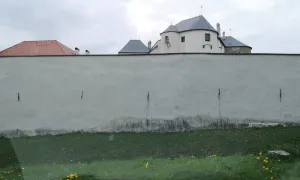
The 22-meter tower was built between 1832 and 1833 in replacement for the older one. It ends with a bell-like helmet with a blind lateral. The facade is divided into pooled pilasters, a cordon ledge, and two tall blanks nowhere. The facades of the church are smooth with windows with a semicircular inlay. Substantial reconstruction and neoclassical refasding took place in 1925. The entire area is surrounded by a wall that was repaired in 1994.
The interior of 22 x 8 x 5 meters contains a baroque wooden altar on a stone foundation from the beginning of the 18th century, consisting of three paintings and statues of the apostles. The wooden baptistery is decorated with statues depicting the baptism of Jesus. The wooden pulpit has ten divine commandments marked at the top with digits. In the space there is one bronze gilded chandelier and organ from 1949.
The key events in the history of the object were repairs in 1856, when the benches were replaced and the chorus removed from the side of the ship. At that time, part of the ceiling above the organ had to be increased by almost two meters. In the tower there is a gothic bell from the 15th century with majuscule inscription. During World War I, two of the three bells were recuperated; new bells from Manousek from Brno were purchased in 1925.
The upgrade of the object took place gradually. Electricity was introduced in 1944, general exterior repair took place in 1969 and in 1970 electric heating in the benches was realized. In 1999 and 2000, the altar, pulpit, baptismal, and inner painting were repaired. The organ was repaired and tuned in 2007 and 2015.
The church is in good condition and stands on a hillside in the southeastern edge of the village.
Tehdy a dnes
Drag the slider and compare how the monument might have looked when it was built with the view today.
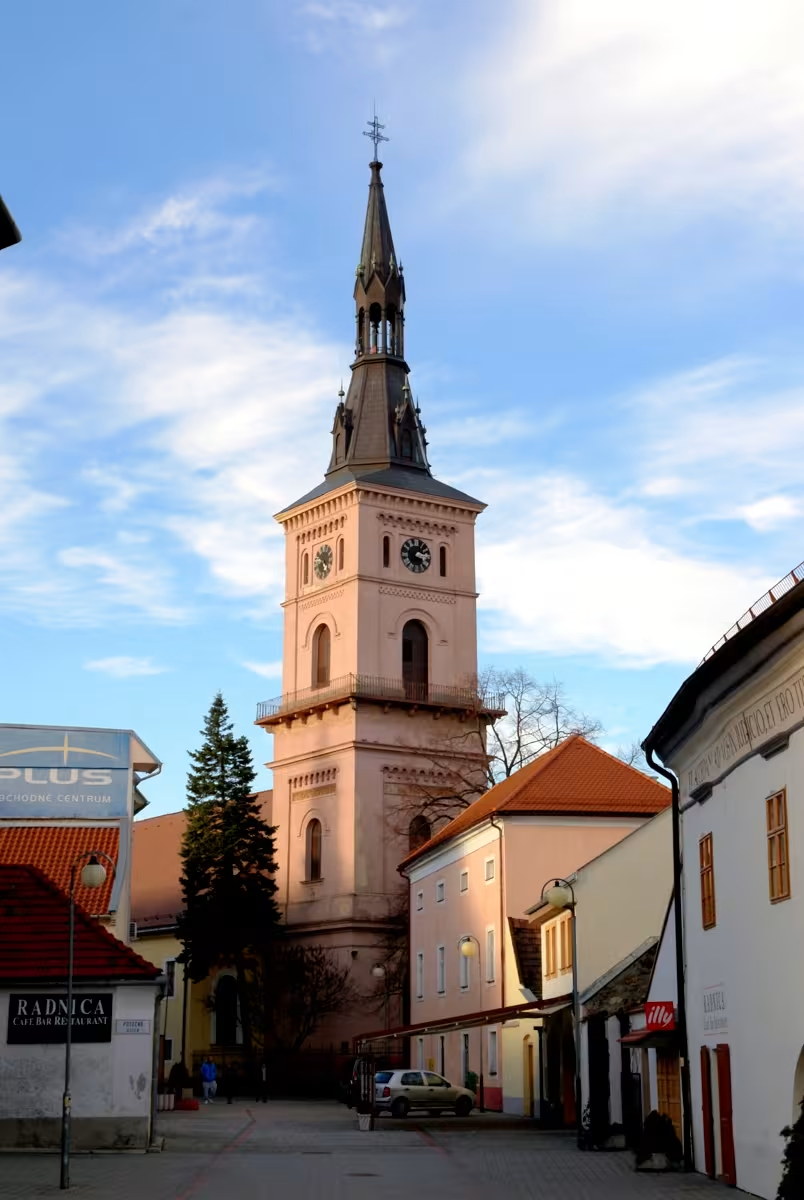
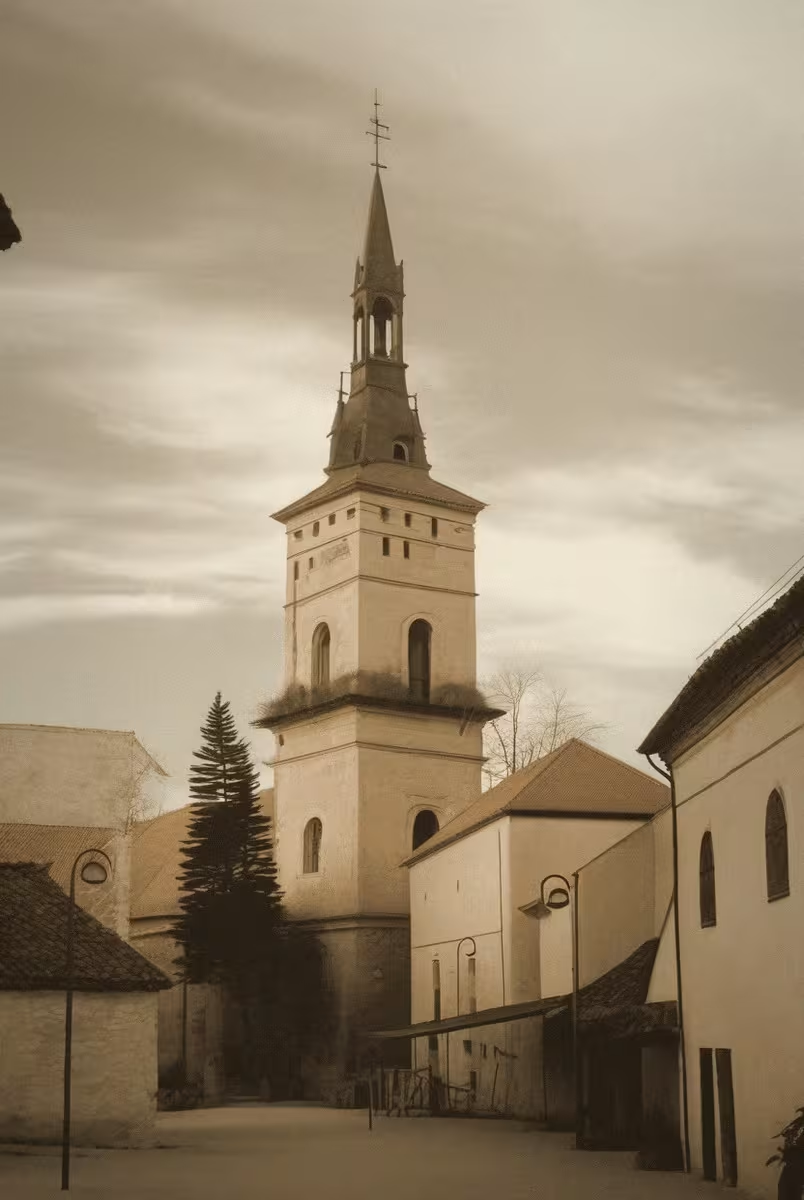
The historical view on the left is a visualisation generated by artificial intelligence and serves as inspiration.
Historical Milestones
- 1621
- renaissance treatment, where the vault and windows were formed
- 1742
- likely extension of the temple ship
- 1832-1833
- a new tower 22 metres high
- 1925
- substantial reconstruction and neoclassical refasation
- 1949
- organ position
Interesting facts
- The roots of the building date back to the 14th century when the Gothic Chapel Dacs from Kosihovec stood in the village. - The object exhibits layering of construction stages from Gothic to Renaissance to neoclassicalism. - In the tower there is a gothic bell from the 15th century with majuscule inscription. - The interior contains a baroque wooden altar from the beginning of the 18th century and a wooden pulpit with ten divine commandments. - The 22-meter tower was built between 1832 and 1833 and is finished with a bell-shaped helmet with a blind lateral.
Guide
The guide was voiced by a synthetic voice created by artificial intelligence.
Show guide text
The text was prepared by artificial intelligence and has not been editorially reviewed. It may contain inaccuracies.
Welcome to the village of Stredné Plachtince. Right now, you are standing in front of a building that is a silent but profound witness to the history of the region. Before you, the bars of the evangelical church along with the enclosed wall that surrounds this sacral space. When you look at it, you may see at the first moment a harmonious structure that fits into the land of the Banská Bystrica region, but in fact there is an architectural record of several centuries of change, faith and local history before you.
Let's go now to the story of this place together. Although the building you see today has its present form thanks to later modifications, the roots of this building go much deeper into the past. To understand where we are, we have to rush into the 14th century. It was during this period that the Gothic chapel was built by the Dacs from Kosihovec. It is fascinating to think that long ago, this place was reserved for the spiritual needs of the community. Since the first Gothic chapel, the building has evolved and grown along with the needs of the people who lived and prayed.
If you look at the architecture itself now, notice that this church is not the product of a single era. Rather, it is a layer of building stages that are stacked together as layers in a book. The first significant change was the Renaissance adjustment of 1621. It was at this time that a vault of the ship was formed, and windows were created that allowed light into the space. This is the time when the architecture sought balance and clarity, which was reflected also in the available temple.
Let's keep going in time. In 1742, the temple ship was probably extended. This shows that the community grew and with it the need for more space for all believers. Subsequently, in 1832 and 1833, a new tower joined. If you now raise your eyes upwards, you will see this dominance, which is 22 metres high. The tower not only supplies the building with the necessary vertical accent, but also serves as the owner of one of the most valuable treasures of this place.
In the last major phase of the changes, namely in 1925 the church underwent substantial reconstruction. That's when the neoclassical prefasding took place, which means the exterior appearance of the building got the elements you see today. Neoclassicism is characterized by cleanliness of lines and by the return to Ancient patterns, which gives the entire object its present, dignified character. And if you could get inside, you'd see an organ that was built in 1949 and that complements the liturgical life of this temple.
Although the names of specific architects who worked on the construction remained unknown in time, their work speaks for itself. It's a continuity story. Imagine those generations of people who went through the gate of this church, who listened to the bell and who sought comfort or joyful moments in these walls.
Now I would like to invite you to one interesting thing that may not be immediately visible from the first point of view, but is extremely important. In the tower there is a gothic bell from the 15th century. This bell is an extraordinary artefact because it bears a majuscule inscription, which means it is written in large letters. Imagine that this bell survived for almost six centuries of history, survived the changes in regimes, wars, and rebuilding the building around it, and it is still part of this place. It's a direct connection to the time when the original Gothic chapel was standing here.
In addition to the bell, there is another jewel hidden in the interior, and this is a baroque wooden element that testifies to the artistic taste of previous centuries. It is this layering of styles - from Gothic to Renaissance and Baroque to Neoclassicism - that makes this evangelical church a unique architectural document in the Central Sailing. It's not just a building, it's a living history that is different in every stone and every train.
Now feel the atmosphere of this place for a moment. Look at the fenced wall, which in the past not only defined the boundaries of sacred space but also provided a sense of security and separation from the everyday world. You stand before a building that was constantly adapting, but at the same time retained its identity.
I hope this short trip to the past has helped you to better appreciate the value of this temple. Now you can explore the surroundings in peace, admire the details of the facade and imagine how the 22-meter tower sounded a gothic bell hundreds of years ago. Thank you for your attention and we wish you a pleasant next stay in the Central Sailing.
Tips for visitors
Visit the evangelical church in the Central Sailing in the spring or summer, when the surroundings of the wall are in the flower.
We recommend shoes with firm soles and dressing suitable for sacral space.
Photos recommend exterior images, especially details of the facade and wall. Suitable light is during the golden hour when the low sun highlights the texture of the stone.
Families with children can explore the evangelical architecture and observe the monument.
Frequently asked questions
Can the monument be visited?
Religious buildings are usually open mainly during services; at other times a visit is normally arranged with the parish or the operator. We have not verified specific times.
Where is the monument?
Location: č. 32, Stredné Plachtince, Banskobystrický kraj. The map on this page shows the exact spot.
Why is the monument protected?
It is listed in the Central List of the Monuments Fund of the Slovak Republic as a national cultural monument (ÚZPF no. 32A-483).
For children
Close your eyes and imagine you're moving in time. You're flying through thick clouds, and your target is the Middle Sail. Right now we are landing at a time that was about 626 years ago. The year is 1400. There are no cars or cell phones around you. You smell the smoke from the fireplaces and you only hear the noise of the wind and the swaying of horses. It was during this period that the story of a special place began to be written.
Nearby
🏰 Historic sites (49)
- Cirkevné regionálne vlastivedné múzeum S. Godru 0.0 km
- Július Pántik 0.1 km
- Obetiam 2. svetovej vojny 0.2 km
- Obetiam 1. svetovej vojny 0.2 km
- Mariánsky stĺp 3.3 km
- Obetiam SNP a 2. svetovej vojny 3.3 km
- Múzeum bábkarských kultúr a hračiek 3.4 km web
- Modrý Kameň 3.4 km web
- Bálint Balassi 3.5 km
- Andrej Hlinka 3.6 km
- sv. Anton Paduánsky 3.6 km
- Kúria Ambrózyovcov 3.6 km A. H. Škultétyho 359/40
- Kálmáná Mikszátha 4.1 km
- SNP 4.2 km
- A. H. Skultety 4.3 km
- Pamätník baníkov 4.3 km
- Kaštieľ Príbelce 4.5 km
- Janko Kráľ 4.7 km
- Pamätník Zaniknutej Obce Selce 5.8 km
- Suchý Bukovec 6.6 km
🍽️ Restaurants and dining (38)
- Stop Cafe 3.2 km
- Pod vrbou 3.4 km
- Hostinec Šťuka 3.4 km
- Hradná cukráreň 3.4 km
- Atila 3.6 km +421 47 48 25318
- Marťák 3.7 km Boženy Němcovej
- Hostinec u Lubika 3.8 km Boženy Němcovej
- Mafík 3.8 km +421 908 041 230
- Adub 3.9 km +421 905 640 342
- Martiner 4.0 km
- Papuča 4.0 km
- Slovenská haluškáreň 4.1 km
- Jedáleň U Poštárov 4.2 km +421 917 361 411
- Koala 4.2 km +421 47 48 313 63
- Jedáleň Novohrad 4.3 km +421 47 48 31 793
- Jakub 4.3 km +421 47 48 315 12
- Sola 4.3 km
- Stánok Fornetti 4.3 km
- Gastro-Hell 4.4 km
- Bistro 4.4 km
🏨 Accommodation (11)
- Chalupy NATURAL SLOVAKIA 2.5 km web
- Penzión u Vinára 3.0 km
- Chata Španí Laz 3.1 km
- Penzión Kaštieľ 3.8 km +421 47 48 311 67 web
- Camping & Glamping Slovakia 4.0 km web
- Hotel Dolina 4.3 km
- Camping Lazy 6.7 km web
- Hotel Koprovnica 8.3 km +421 474 896 303 web
- Ubytovňa Centrum 8.4 km +421 905 532 978 web
- Chatky Žabky 13.7 km Hlavná 307 web
- Chata Alexandra 13.8 km areál termálneho kúpaliska web
🚲 Rentals and sport (4)
- Biokúpalisko Krtko 3.6 km +421 47 48 30819 web
- Mestská plaváreň 3.7 km web
- K Park 3.8 km
- Cyklospol 4.2 km Námestie Augusta Horislava Škultétyho 10
🥾 Hiking and nature (149)
- Ostrý vrch 1.5 km
- Hlboká Stráň 1.5 km
- Špicatá Stráň 1.6 km
- Židova diera 1.9 km
- Hájnický kameň 2.0 km
- Kamenný vrch 2.1 km
- Peniažok 2.3 km
- Skala 2.4 km
- Španí laz 3.1 km
- Na vŕšku 3.3 km
- Historický cintorín rodu Balašovcov 3.5 km
- Kalvária 3.7 km
- Hôrka 3.8 km
- Hlavy 3.8 km
- Dubový vrch 4.0 km
- Skala 4.2 km
- Baňa Dolina 4.3 km
- Babka 4.5 km
- Pohanský vrch 4.6 km
- Kraje 4.7 km
Thematic route
As there are no other sites in the area of the area, I propose a thematic route aimed at exploring the main objective and its area.
Route of the tour in the Central Sailing:
1. Garden wall - Type: Defence building. The visit begins with the bypass of the historical wall, which protected the evangelical temple and its surroundings.
2. Evangelical church - Type: Temple. Possibility to view the architecture and interior of the building.
3. Church area - Type: Courtyard. Walking around a building that connects the temple with its protective elements.
Seasonal recommendations
In spring, the environs of the Evangelical Church in the Central Plauchtins will wake up to life and nature around the wall will bloom. The fresh green color of plants combined with spring light creates a peaceful atmosphere suitable for outdoor photography. It is recommended to put on suitable shoes in wet soil and visit the site in the morning. The summer season brings intense sunlight, which highlights the details of medieval architecture and white walls of the building. The neighborhood is full of flowers. Due to high temperatures, early morning or late evening time is the most appropriate. Light clothing and sun protection are practical. Autumn in Banskobystrický kraj Rozświetí landscape with yellow and red tones that create contrast with the historical wall. When visiting, it is advisable to choose layered clothing and unpretentious shoes, as autumn mornings tend to be cold and wet. Zimą operates an evangelical church in the Central Plachtincach ascetically, especially if the building is covered by snow. The snow cover will dampen the sounds. Due to the low temperature and freezing air, it is necessary to dress in warm layers and tight footwear with anti-slip sole.
Visualisations and artistic views


The visualisations are generated by artificial intelligence and serve as inspiration.
Visitor Tips
No tips yet. Be the first!
Log in and add your tip.
Location on Map
More monuments – Stredné Plachtince
Show all in the town

Visitor photos
No photos yet. Be the first to add a photo from your visit!
Log in and add your photo or leave a rating.
You get more points for a visit verified in the app — we can tell from the GPS that you are there.
Reviews and comments