








merica na obilie Surveying instrument
Merica in the village Poprad is a national cultural monument, which is registered in the Register of the Monument Office of the Slovak Republic under the number ÚZPF 4535. The building comes from the second half of the 18th century, namely from 1775, and is made in Baroque style.
The area of this monument consists of one object, which is the stone meter itself. In terms of construction characteristics it is a stone building dating back to 1775.
The monument is located on Sobotské Square in the town district Spišská Sobota, which belongs to the village Poprad in Prešov region. The building is registered in the Central List of Monument Fund under the number 416-4535.
Merica on the Sobotské Square in Spišská Sobota presents evidence of historical amenities of public space in this location. Visitors to the village Poprad can find it directly in the historical core of Spišská Sobota. Her presence in the square documents the period of organisation of market space.
Historical Milestones
- 1775
- Construction of stone meter in Baroque style.
- 190-2000
- Enrollment of the object in the Central List of Monument Fund of SR.
Guide
Show guide text
The text was prepared by artificial intelligence and has not been editorially reviewed. It may contain inaccuracies.
Welcome to Poprad. You have just stood in a place that is mute, but the more eloquent witness to the ancient business traditions of our region. In front of you there is a historical grain meter. When you look at it, you may at first glance be interested in its simplicity and purpose. It is an object that in the past has played a key role in the daily life of the city's inhabitants, in their trade and in the fair distribution of crops. You stand before a piece of history that reminds us of the time when honesty when measured was a fundamental pillar of confidence between the buyer and the seller.
Let's go back in time and think about why this meter is actually standing here. In medieval and early-aging cities such as Poprad, market control was one of the most important tasks of the city administration. The crop was a basic commodity that depended on the life of all sections of the population. In order to prevent fraud and to ensure justice, cities were implementing official measures. This was the standard by which the cereals were measured on the markets. It was a public guarantee that whoever buys gets exactly what he paid for. Although we do not know the exact date of its creation and the names of the masters who made it remain shrouded in secrecy, its presence here in Poprad is clear evidence of developed urban life and efforts to establish order in business relations.
When you look closer, note its shape and overall design. It is an object designed to withstand everyday use and difficult market conditions. Feel its proportions, which in the past were strictly controlled by the city council. Every detail on this subject had its meaning and served to avoid being manipulated in moderation. Notice how it works in the space in which it is located. Even though he is no longer fulfilling his original function today, he still exudes the authority and seriousness that she had in times of her greatest glory. It is a reminder of the craftsmanship of our ancestors who have been able to create objects not only useful but also durable.
Looking at this metric, we find stories of people moving around it daily. Imagine the mass of the Poprad market, the screams of traders, the smell of freshly imported grain, and the tension that accompanied each measurement. It was these places where people from close and far away surroundings met, where shops were closed, and the fates of individual families formed. Although we do not know the names of specific personalities directly associated with this measurement, we know that it was part of the life of city officials, marketers and farmers who came here to monetize the fruits of their year-round work. She was a silent witness to their achievements and disappointments, their daily struggle for livelihood.
An interesting thing that is often associated with such historical rates is the question of their accuracy and protection from counterfeiting. In the past, any modification of official peace has been severely punished. If someone tried to adjust the metric to be smaller, he would risk not only a high fine but also a loss of honor and exclusion from guilds or trade associations. Thus, this metric is also a symbol of justice and moral values that have previously been seen as an integral part of public life. It is fascinating to realize that this subject, which we now see as a historical artifact, was once the center of attention and the instrument upon which peace in the city depended.
I hope that this short stop at the Poprad crop yard impressed you and made you think about how our world and our business habits changed. History is not only about great battles and known rulers, but also about such everyday objects that help us to understand the lives of our ancestors. I invite you to continue to discover other corners of Poprad, to see the atmosphere of its historical streets and to look for further clues that have left us generations ahead. Thank you for your attention and I wish you a lot of nice experiences in getting to know our city. Goodbye.
Tips for visitors
The best time to visit Poprad is during sunny days in summer or winter, when the city offers a unique atmosphere under the High Tatras. We recommend taking comfortable shoes for a walk along the historic square and camera, as the best light to capture details of historical objects is in the early morning hours or before sunset. For families with children, a visit to the city center is easy and offers plenty of space to move in the pedestrian zone.
Frequently asked questions
Can the monument be visited?
We have not verified whether this monument is accessible. Please ask the owner or operator, or the local municipal office.
Where is the monument?
Location: Sobotské námestie, Spišská Sobota, Poprad, Prešovský kraj. The map on this page shows the exact spot.
Why is the monument protected?
It is listed in the Central List of the Monuments Fund of the Slovak Republic as a national cultural monument (ÚZPF no. 416-4535).
For children
Close your eyes for a second and imagine you're just walking around a dusty square in Poprad. The air smells freshly baked bread and in the distance hears horsespinning horseshoes. The year 1775 is written, and just before us is one very important news. It's exactly 251 years since this rare thing appeared in town to guard justice. No computers, no scales with a display, just a real piece of history that had to be as accurate as Swiss watches. Welcome to Poprad grain lawn!
Thematic route
The route is focused on a tour of the historical artifact in Poprad and its immediate surroundings.
Thematic route: Historical heritage in Poprad
1. Grain yard Type: Historical artifact The stone jar was used to measure the grain in the selection of natural doses in medieval Poprad.
2. Courtyard and surroundings Type: Exterior Space in the vicinity of the merica allows to explore the artifact and surrounding architecture.
3. Indoor exhibition Type: Interior spaces The exposition approximates the periodal measurement systems and economic history of the region.
Seasonal recommendations
Spring in Poprad brings a gradual awakening of nature and the first warm rays of the sun, which pleasantly illuminate the historic city center. The atmosphere is peaceful during this period, as the city is still preparing for the main tourist season. This is an ideal time to visit those who seek a more intimate environment without large crowds. I recommend choosing layered clothing because the weather under the Tatras can be variable and the morning temperatures are still low. The best time for a tour is morning, when light is brightest and allows for detailed observation of architecture.
Summer in Poprad is connected with long days and intense sunlight, which highlights historical details of monuments. During this time, the city is pulsing with life and attracts many visitors, so it is advisable to plan a visit for the early hours of the morning to avoid the greatest rush. Due to high temperatures it is necessary to have a head covering and plenty of fluids. The atmosphere is very lively and open, while surrounding greenery in parks creates a pleasant contrast to historical objects.
Autumn in the Podtatra region brings specific soft light and colored nature, which gives melancholy and nostalgic touch to historical places. The air is getting cooler, which requires warmer clothes, especially windshields and strong shoes, which will protect you from moisture. Attendance is decreasing during this period, which ensures sufficient space for undisturbed photography and peaceful perception of history. The best lighting conditions to capture the atmosphere occur during the late afternoon, when the sun drops below the horizon.
Winter in Poprad has an unrepeatable charm, especially when the city covers a snow blanket that dampens sounds and creates an impression of peace. In Advent time and during the winter months, it is necessary to take care of high quality winter clothes, gloves and cap, as temperatures may drop deep below freezing. The atmosphere is very chambery at this time and thanks to winter lighting the historical core of the city is very fairytale.
Visitor Tips
No tips yet. Be the first!
Log in and add your tip.
More monuments – Poprad
Show all in the town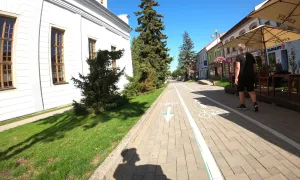
Visitor photos
No photos yet. Be the first to add a photo from your visit!
Log in and add your photo or leave a rating.
You get more points for a visit verified in the app — we can tell from the GPS that you are there.
Reviews and comments