

old church of St. Ondrej Church with grounds
The church of St. Ondrej in the village Víťaz in Prešov region is an early Gothic sacral building with an area from the first half of the 14th century. It contains later revealed medieval Gothic windows, paintings and later Baroque-Classicist modifications. The Monument Office of the Slovak Republic records this area under the number of ÚZPF 11480 and consists of three objects: the Roman Catholic Church of St. Andrew, the fenced wall and the church cemetery.
The oldest written mention of the church comes from the register of the papal tithe from the 1930s of the 14th century. The village was founded before 1245 and the church was founded probably in the early 14th century. It was built as a larger early Gothic church, consisting of a longitudinal ship covered with frescoes and a polygonal presbytery. In historical written sources, the church is also mentioned in the 16th century. There was a cemetery around the church, where it was buried in modern times, and nobility had a place for last rest in the 20th century. The area defines the originally medieval stone wall.
The building underwent several construction development stages. Originally early Gothic church baroko-classicist rebuilt between 1776 and 1778. The entrance portal has a stucco ornament and this summer. It has long been thought that this was a new building from the end of the 18th century, as from the 1960s to the 1970s there was a continuing view that the date was linked to the period of construction. Another renovation took place in 1927. The 2000 renewal brought new knowledge and revealed Gothic windows and paintings. From the Middle Ages, almost the entire building was preserved except the tower and the southern atrium, which were built in the 18th century. There was also a sacristy that left a walled entrance from the sanctuary. The original early-gothic windows with splinters and stone shambles, stone corner blocks bordering the walls of the polygonal sanctuary and a high Gothic window in the southern wall of the ship were preserved from exterior elements. Orientation in the east-west direction, presbytery on the east side, absence of windows in the north wall, entrance from the south or west and thick stone walls are signs of medieval sacral structure. The longitudinal boat is encircled by a cross vault, in the presbytery there is an altar horse and a Czech plaque with a stucco ornament. The facade of the church is smooth, the tower also has smooth facade, it is covered by a baroque laterne mine sitting on the terrace roof ledge and was once divided by corner pilasters. The stone console of the original rib vault in the southwest corner was preserved in the interior of the sanctuary. The historical elements include a wooden spiral staircase, which leads through a stone portal from the exterior to the attic.
The ownership conditions and administration of the object are associated with the local nobility. In the 17th century there was the nobleman John Berthothy, whose monument resembles the Renaissance epitaph. The noble families used the church cemetery as a place of last rest during the 20th century.
During the reconstruction in 2000 it was possible to prove the medieval origin of the building hidden under Baroque modifications. In the ship there are remnants of gothic wall paintings with dimensions of approximately 2 x 1.5 meters, showing the human figure and weaker visible attributes. In the interior stands the late Baroque main altar from the second half of the 18th century with rococo accessories, wooden column architecture and the image of St. Andrew the Apostle. On the sides below the rococo canopy are located sculptures of St. George and Florian and in the extension of the sculptures of St. Anton and Joseph the foster parent. The side altars from the second half of the 18th century are rococo altars, designed as pendantes, and carry medium images from the first half of the 20th century depicting Saint Anna and Cyril and Methodius. In the interior there is a small altar from the second half of the 18th century with a box, rococo vases and statue Vir dolorum. Another part is the rococo pulpit from the second half of the 18th century with a rococo ornamentic on the windowsill and paintings of the apostles Peter, Paul, and the Savior. There is a rococo-classicist organ from the second half of the 18th century with a rich rocoj ornamentation on the closet and a free Baroque picture of St. John Nepomuk from the second half of the 18th century. Renaissance epitaph John Berthothy from red marble dates back to 1643 and contains a gender coat and inscription in Latin. The building was declared a national cultural monument in 2005.
The state of the church is currently very good and the object serves its original purpose. It is located on the elevation at an altitude of 504 meters on the eastern edge of the village.
Tehdy a dnes
Drag the slider and compare how the monument might have looked when it was built with the view today.
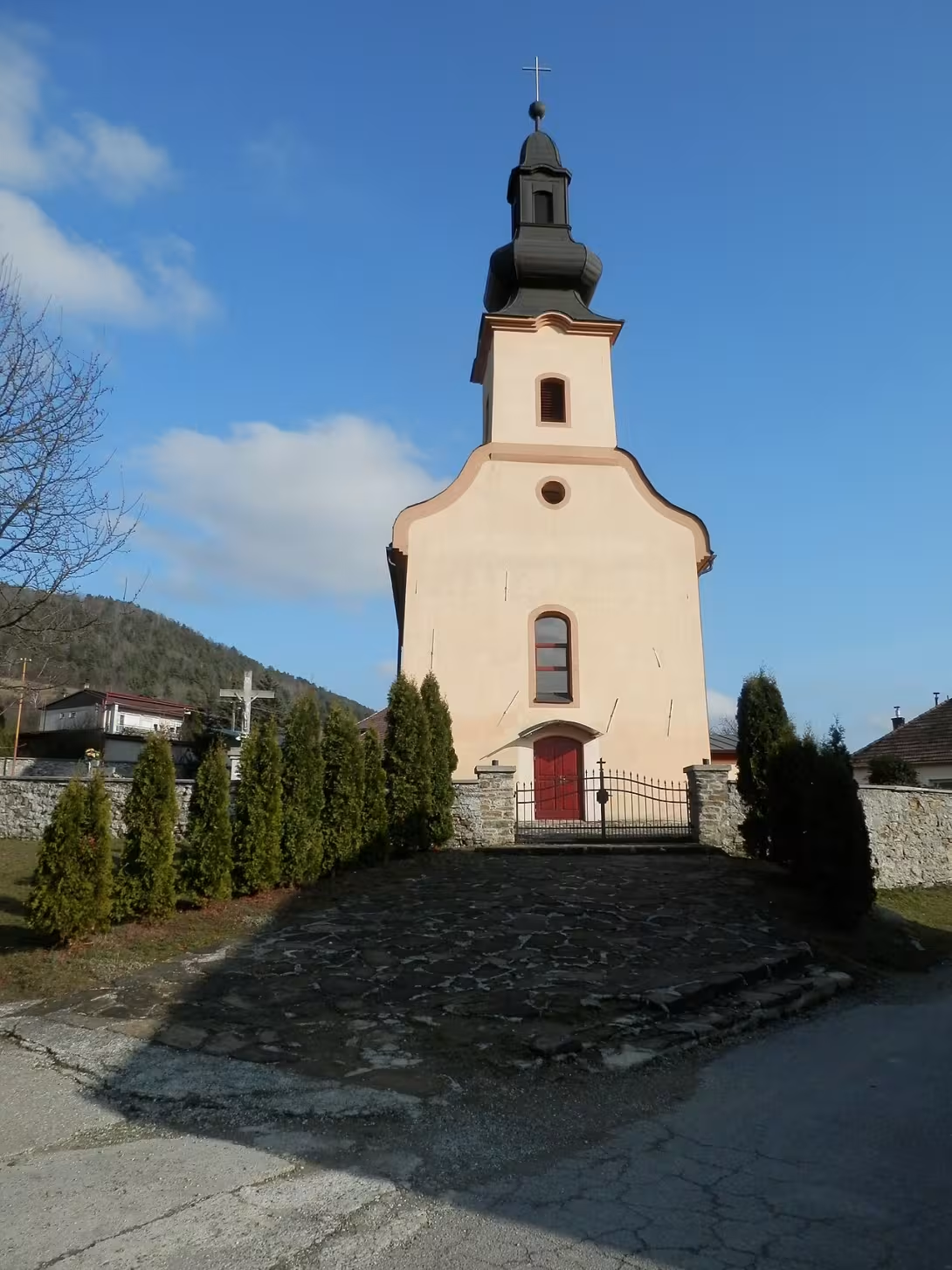
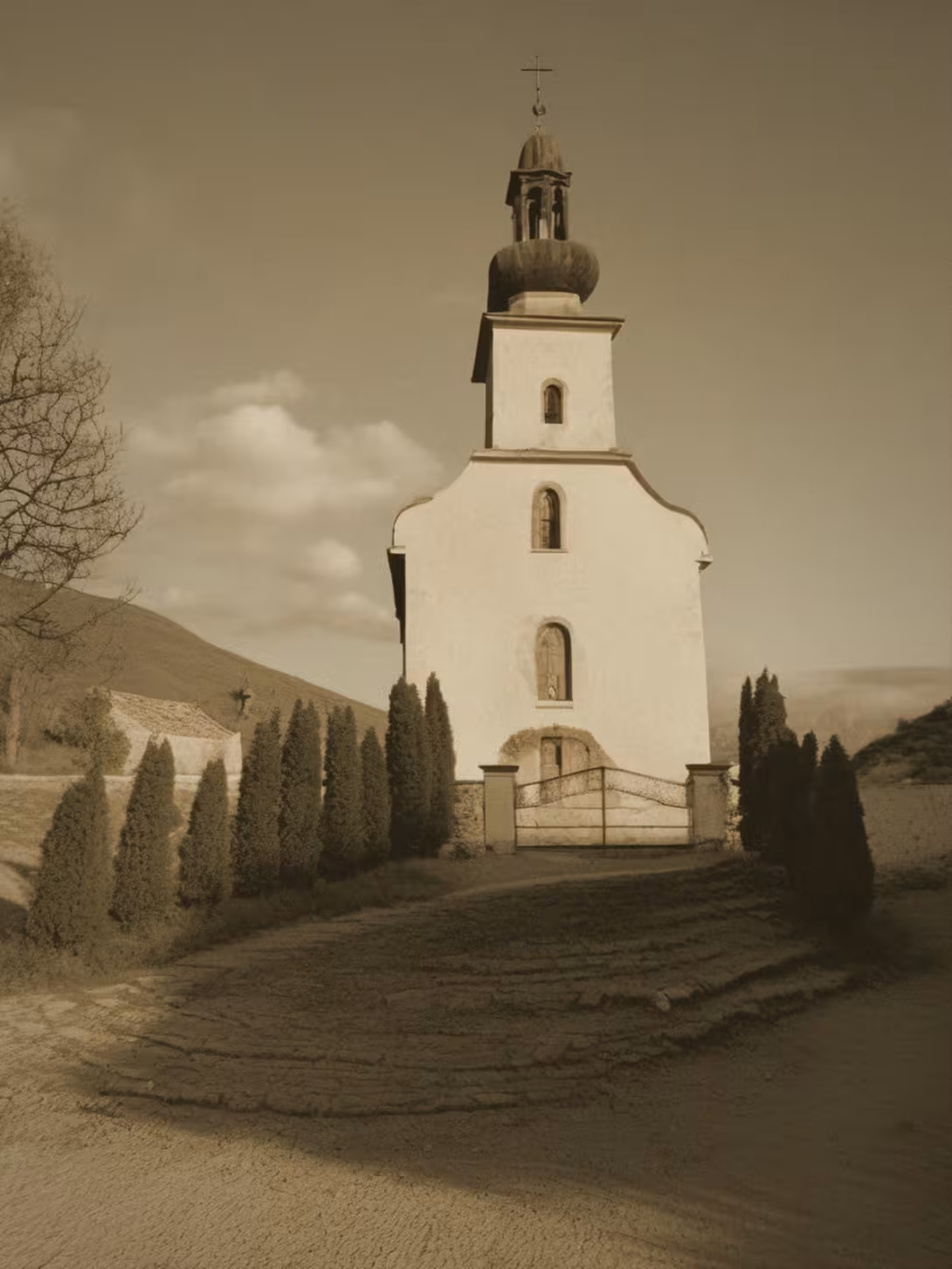
The historical view on the left is a visualisation generated by artificial intelligence and serves as inspiration.
Historical Milestones
- 1776-1778
- Baroque-Classicist reconstruction of the church
- 1927
- Renovation of construction
- 2000
- Greater renovation, where Gothic windows and paintings were revealed
Interesting facts
- The church of St.
Guide
The guide was voiced by a synthetic voice created by artificial intelligence.
Show guide text
The text was prepared by artificial intelligence and has not been editorially reviewed. It may contain inaccuracies.
Welcome to our stop tonight. Right now you are standing in front of the old church of St. Ondrej in the village of Winner. You put your headphones on, and you're in a place with a deep history that breathes all this space. In front of you, you can see a structure surrounded by a wall and an old cemetery. Feel this calm atmosphere while together we look at what this place is hiding under its surface. Let us move on to the very beginning and historical context of this temple. St Andrew's Church in the village The winner is in his core an early Gothic object, which comes from the first half of the 14th century. Imagine how many centuries this place costs, how many foreheads have been transformed, and how many generations of people have gone through. For years, it seemed to be the construction of later data, since history and time left significant traces on his face. Now pay attention to the architecture itself and the details you have right in front of you. Although the precise architects of this object remain unknown, their work has survived for ages. If you look at the exterior, you can see the result of the later modifications, namely the Baroque-Classicist reconstruction that took place between seventeen seventy-six and seventeen seventy-eight years. In 19, 27, 7, the building went through another renovation that gave it new strength. However, the greatest surprise came later. Let's move on to a moment that has completely changed the view of this monument. A greater recovery in the year two thousand brought an incredible discovery. In these works, the original Gothic windows and precious paintings, which were previously hidden from the public eyes, were exposed. It was this finding that finally confirmed the medieval origin of the building, which until then hid later Baroque adjustments. Imagine the feeling of the restorers when under the layers of older repairs, they found evidence that you were standing before the gothic jewel of the first half of the 14th century. From the Middle Ages to today, a respectable part of this building has been preserved, which to this day forms a harmonious whole with a wall and surrounding cemetery. When you stand there, you can think about the stories that this place has experienced. Although the names of particular historical personalities, rulers or nobles, who would be closely associated with this church remain in the shadow of the past, the greatest personality of this place is the building itself and the people of the village of Víž who have kept it alive, protected and enhanced for centuries. Each generation brought here a piece of itself, whether in the form of building modifications in the eighteenth century or later renovations in the 20th and 20th centuries. Finally, I would like to invite you to further reflect and perceive this place. When you leave, go around the fenced wall and let the power of tradition radiate by this old church of St. Andrew. Thank you for your attention and I wish you many more wonderful experiences in discovering other interesting places in Prešov region. Goodbye.
Tips for visitors
St. Ondreja v Víťaz is worth visiting in spring or autumn when surrounding nature complements the appearance of the building.
Comfortable shoes and drinking water are recommended in the area. Due to the nature of the site, it is appropriate to choose appropriate clothes.
To photograph the details of the facade and structure of the building is a good time shortly before sunset. To capture the context of the memory it is recommended to photograph from different angles.
Families with children can connect the visit with a walk around the village and explore history through details on the exterior of the building.
Frequently asked questions
Can the monument be visited?
Religious buildings are usually open mainly during services; at other times a visit is normally arranged with the parish or the operator. We have not verified specific times.
Where is the monument?
Location: č. 90, Víťaz, Prešovský kraj. The map on this page shows the exact spot.
Why is the monument protected?
It is listed in the Central List of the Monuments Fund of the Slovak Republic as a national cultural monument (ÚZPF no. 417-11480).
For children
Close your eyes now and imagine pressing the invisible button on the time machine. Can you feel the gust of wind? The air will change, and you're sat in 1400. Exactly 626 years ago, you landed in the picturesque village of Winner. There are no cars, asphalt roads or mobile phones around you. There are only dense forests, grazing sheep, and something special is growing in the centre of the village. It's St Andrew's Church.
Nearby
🏰 Historic sites (46)
- zákop 3.1 km
- Kaštieľ Fričovce 5.0 km web
- Obetiam 2. svetovej vojny 5.6 km
- Múzeum obuvi 5.7 km web
- Štefanská Huta 6.2 km web
- Kaštieľ Hendrichovce 6.3 km web
- murovaný košiar 7.3 km
- Obetiam 1. svetovej vojny 9.1 km
- Gloriet 9.1 km
- 20. výročie Nežnej revolúcie 9.1 km
- Osloboditeľom 9.2 km
- Lovecký dom 9.2 km web
- Kaštieľ Péchy 9.2 km
- Pánsky dvor 9.2 km
- Winklerov kaštieľ 9.3 km
- Kaštieľ Krompachy 9.4 km Zemanská 195/1
- Kaštieľ Žipov 9.4 km
- Kaštieľ Szinyeovcov 9.5 km web
- Lipovce 9.5 km
- Na pamiatku padlým v ohni svetovej vojny 1914 - 1918 10.8 km
🍽️ Restaurants and dining (81)
- U robotníka 0.3 km
- Bar 0.3 km
- U robotníka 0.3 km
- Kaviareň s bowlingom 0.5 km
- U Armstronga 0.6 km
- U andelička 0.7 km
- Greš 3.1 km
- K7 club 3.1 km
- Pod Javorom 4.7 km
- Tango Bar 4.9 km
- Hostinec u Mili 5.5 km
- Poľovník pod hôru 5.5 km web
- la Casata 5.8 km +421 919 212 414 web
- Branisko 6.7 km
- Charlott 7.8 km SNP 403/87
- Kaviareň Európa 7.9 km
- Sport club 8.1 km
- Domino Bar 8.5 km
- Piváreň 2ka 8.8 km
- Hositnec na kopcu 8.9 km
🏨 Accommodation (36)
- PZ-Kluknava 3.1 km
- Kaštieľ Fričovce 5.0 km +421 51 791 10 67 web
- U smelého srnca 5.3 km web
- Hotel Biela Dáma a Čierny Rytier 6.0 km +421 53 4473720 web
- Motorest Branisko 6.7 km
- Chata pod Roháčkou 7.8 km web
- Askony 8.8 km
- Hotel Plejsy 8.8 km +421 53 429 8015 web
- Alena 8.9 km Cintorínska 986/8
- Péchy Castle Hotel 9.2 km +421 910 850 214 web
- Skautské táborisko Žehrica 9.3 km
- Marina 9.3 km
- Penzión Piller Kaštieľ 9.4 km +421 918 189 572
- Hotel Canyon 9.6 km Lipovce 158 158 +421903601973 web
- Zuzana 9.7 km
- Zlaté kopyto 9.8 km
- RELAX 10.0 km
- Simona pod Smrekovicou 10.1 km
- Chata Energetik 10.2 km Hornádska 570/81
- Horský hotel Hutník - Plejsy 10.4 km RO Plejsy 419/2
🚲 Rentals and sport (4)
- Obecné športové a oddychové centrum 4.0 km
- Turlíky Spišské Vlachy 11.4 km +421 902 416 379 web
- Soof 12.1 km
- Telocvična 12.2 km
🥾 Hiking and nature (301)
- Hôrka 1.5 km
- Podmorský zosuv 1.6 km
- Slaná voda 1.7 km
- Slaná voda 1.8 km
- Za horou 2.0 km
- Vrch 2.0 km
- Hôrka 2.5 km
- Jánošíkova skala 3.5 km
- Zimná hora 3.6 km
- Birošova studňa 4.0 km
- Koľvek 4.1 km
- Kamenčie 4.1 km
- Breže 4.4 km
- Vtáčia hora 4.6 km
- Zadný Moravec 4.8 km
- Dlhá 4.9 km
- Slatvinka - Kvašna voda 5.2 km
- Sopková 5.2 km
- Studnička pri žľabe 5.2 km
- Ostrý vrch 5.3 km
Thematic route
Here is the proposal of the thematic cruise route, which focuses on the historical area and its surroundings.
1. Old church of St. Ondrej (Church with campus) - historical monument in the village Víťaz, which preserves the original medieval architecture.
2. The area around the church of St. Ondrej - the exterior zone and the historical courtyard, which forms the area for walk and tour of the outer walls of the building.
Seasonal recommendations
Spring around St. Ondreja v Víťaz brings awakening of nature when meadows and slopes are furnished in green. During this period, solid, waterproof footwear is recommended, as the soil after winter snowfall is soaked and muddy. A windproof jacket will also come together, as the spring wind in elevated places is cold. A good time to visit and photograph is morning.
Summer months cover the church in vegetation, which surrounds the sacral structure and provides shade under the trees. The atmosphere is calm. During warm sunny days it is necessary to think about the head covering, drinking water and sunscreen, as some parts of the exterior are exposed to direct sunlight. A good time to arrive is the late afternoon when summer rays lean towards the horizon and the heat is reduced.
Autumn changes the scenery around the church into a varied range of shades from yellow to orange to red, while fallen leaves form a carpet under the feet. Lighting in this period is soft, often with low sun and foggy colds. The autumn roams are suitable for warmer layered clothing, as the cold wind coming from the mountains can surprise you, as well as high-quality footwear for slippery leaves. Suitable lighting conditions for admiration of exterior details are around noon.
Winter transforms the winner and his surroundings into a snowy landscape from which St. Andrew's church rises. The atmosphere is quiet. In winter months, warm winter clothes, including hats, gloves, and tall shoes, are necessary for deeper snow. A good time to visit is a short afternoon when daylight is brightest before it is almost dark.
Visualisations and artistic views


The visualisations are generated by artificial intelligence and serve as inspiration.
Visitor Tips
No tips yet. Be the first!
Log in and add your tip.
Location on Map
More monuments – Víťaz
Show all in the town

Visitor photos
No photos yet. Be the first to add a photo from your visit!
Log in and add your photo or leave a rating.
You get more points for a visit verified in the app — we can tell from the GPS that you are there.
Reviews and comments