

parish church with cemetery Church and parish cemetery
The parish church of St. Lawrence with church cemetery in the village Malá Hradná in Trenčín region comes from the second half of the 13th century. The building has evolved from probably Romanesque origin to the Reformation period to Baroqueization.
The existence of a stone church is documented in 1329, when it was owned by the master Stefan called Pohan. The first Roman Catholic priest, priest Martin, was mentioned in 1332. In 1540 the parish and the church were reformed by the Gospel preachers Valentine Otýpek and Mikuláš Keller. The church returned to the Catholic Church in 1661 after the eviction of the last evangelical preacher Daniel Malatides, which was due to Countess Maria Forgach. Later, in 1706, Baltazár Crepusculi tried to re-evangelize the parish, but mostly unsuccessfully.
It is a single-boat space with a flat ceiling and a polygonal cap Presbytery with a spring vault. The building is assigned hallway and sacristy. Facades are smooth and divided lysene frame. The tower with a tent roof is placed asymmetrically against the shield facade, because the expansion of the ship got outside the axis of construction. In the interior there are side emporas and brick organ chorus in the western part.
In 1758, thanks to Count Joseph Ileshazi, the church was expanded and baroqued. The main altar of St. Lawrence from the second half of the 18th century has a column architecture on a curved floor plan with canalized columns, vases, angels and altar painting. The side of the Rococo altar of St John Nepomuk from the second half of the 18th century contains relief of the saint in the niche and sculptures of angels. Second side altar Piety is rococoque with later supplements and contains the sculpture of the Shaštín Virgin Mary. The Rococo pulpit from the second half of the 18th century is decorated with reliefs and sculpture of the archangel Michael. Among other facilities is the Renaissance free painting Piety from the 17th century depicting the monastery, the classicistic stone baptistery from the end of the 18th century with the 18th century tealized cap from the 19th century and the statue of Lourdes Virgin Mary from 1891.
Zvonology includes a bell from the year 1700 from the Trnava bell-seeker K. Kornik. Other bells were made by Christopher Bienstoh and John Ernest Christelli. In 1916 two bells from 1739 and 1776 were refurbished. In 1727 the organ had five registers, in 1789 the Count Ján Ileshazi donated 12 registration organ and in 1906 a new tool was installed.
In 1750 a new crypt was built, which served until 1793. In 1789 the remains of St. Lawrence and Perfect were inserted into the main altar. Patronage above the church was taken over in 1835 by the banker family Sina. In 1894 the church was severely damaged by lightning, which led to a general repair under the curatel Countess Ifigenie d " Harcourt.
The current state of the church is good. The building together with the extinct church cemetery from the 13th to 14th century is registered in the Central List of Monument Fund of Slovakia under the number of ÚZPF 12235/1 and 12235/2.
Historical Milestones
- 1329
- existence of a stone church owned by the Master Štefan called Pohan
- 1540
- parish church and parish were reformed by the Evangelical preacher Valentine Otypok and Mikuláš Keller
- 1661
- the church returned to Catholic denomination after the eviction of the last evangelical preacher Daniel Malatides
- 1758
- thanks to Count Joseph Ileshazi the church was expanded and baroqueized
- 1894
- adjust the towers
Interesting facts
- The church comes from the second half of the 13th century and its existence in stone form is documented in 1329. - The tower with the tent roof is placed asymmetrically against the shield facade, because the expansion of the ship got outside the axis of construction. - In 1789 the remains of St.
Guide
The guide was voiced by a synthetic voice created by artificial intelligence.
Show guide text
The text was prepared by artificial intelligence and has not been editorially reviewed. It may contain inaccuracies.
Welcome to the village of Malá Hradná. Right now, you are facing one of the most important monuments in this region, which is the parish church of St. Lawrence, along with the church cemetery. When you look at the construction, you may be impressed by its peaceful atmosphere and the way it naturally fits into the Trenčín region. It is a place that has hundreds of years of history and testifies to the spiritual development of local inhabitants. Look at the overall silhouette of the building before you and try to feel the centuries that have passed from the foundation of the first stone to the day of today.
Let's now plunge together into a deeper context and find out when and how this church originated. Although the exact dates of the beginning of the construction are unknown, we know that the building itself dates back to the second half of the 13th century. Imagine how long it is. In writing, the existence of a stone church was documented from 1329 when it was owned by a man named Master Stephen, who was known as the Pohan. At that time it was a significant stone object that dominated and served as a center of spiritual life for all residents in the area.
Now that you are looking at architecture, I recommend you focus your view of the tower. Notice something very interesting and perhaps strange. The tower, which has a tent roof, is not placed symmetrically against the shield facade. If you look closely, you'll see it's shifted. Why is it like this? The answer lies in the history of building construction. At some point, the church ship was expanded, and it was at this point that the original tower got off the axis of the building. This detail is a fascinating witness to how buildings in the past adapted to new necessities, sometimes having to accept compromises that today create the unique visual nature of the building.
In addition to the tower itself, which was further modified in 1894, see the overall form of the building. The church is not in its original medieval form. If you notice certain elements that are more elegant and airier, this is the result of the 1758 changes. At that time, thanks to the noble support contribution of Count Joseph Ileshazi, the church was expanded and baroqued. It was during this period that he gained his present face, which combines medieval roots with Baroque aesthetics.
The history of this place is not only a story of stones and architecture, but above all a story of people and their religion. St. Lawrence's church survived periods of great change. In 1540 the parish and the church itself became reformed. This process was led by the Gospel preachers Valentine Otýpek and Mikuláš Keller. After a long period of evangelical times, however, the situation changed. In 1661 the church returned to the hands of Catholic denomination. This happened after the eviction of the last evangelical preacher named Daniel Malatides. These changes reflect the wider religious currents and tensions that then flowed through the entire territory of our regions.
Now I would like to invite you to one interesting thing that binds to the inside of the church and its spiritual value. If you look at the main altar, imagine the year 1789. It was this year that the remains of the saint were inserted into the main altar, which made the building of the church not only a place of prayer, but also a place of respect and pilgrimage for believers. It is a detail that gives the building a deeper sacral dimension and connects it with the tradition of the worship of saints.
Remember also to look at the church cemetery that surrounds the church. Cemeteries from the time when churches were centers of the village are often silent archives of family stories. In combination with the church, they create a whole that reminds us of the transience of life and the duration of memories.
So you are facing a building that has survived centuries, changes in religion, expansion of spaces and adjustments of the tower. From the medieval stone church of magister Štefan from 1329, through the 17th-century reformation, to the Baroqueization of Count Ileshazi and later regret the adjustments from the late 19th-century stego. It's all encrypted in these walls.
Before we finish this short trip to the past, I recommend you a little while more quietly encircling the church around. Consider the asymmetry of the tower, consider the fate of the preachers who worked here, and you will feel the peace this church cemetery brings. It is a place where history meets spirituality and where every detail speaks of something else.
Thank you for your attention and for devoting time to this historical monument in Malá Hradná. We wish you a pleasant continuation in your journey and hope that this story surrounded you with a sense of respect for our common roots. We'll say goodbye to you and we'll put you in the next discovery of the beauties of the Trenčín region.
Tips for visitors
1. Best visit time: Spring and autumn months (April, May, September, October) have pleasant temperatures. Summer afternoons are hot, so it is recommended to visit early in the morning or evening. 2. Transport and access: Little Castle is available by car on local roads. 3. What to take with you: Comfortable shoes, water and light snacks. Prepare batteries and memory card for photography. In colder times we recommend layered clothing. 4. Photography: Details of the church facade and cemetery are best captured in the morning or before sunset. Respect the privacy and quiet environment of the cemetery. 5. Family with children: When walking around the cemetery, explain the history of the memories to the children. Take care of silence and dignity of the place. In the vicinity of the church you can focus on observing nature and architecture.
Frequently asked questions
Can the monument be visited?
Religious buildings are usually open mainly during services; at other times a visit is normally arranged with the parish or the operator. We have not verified specific times.
Where is the monument?
Location: č. 148, Malá Hradná, Trenčiansky kraj. The map on this page shows the exact spot.
Why is the monument protected?
It is listed in the Central List of the Monuments Fund of the Slovak Republic as a national cultural monument (ÚZPF no. 221-12235).
For children
Imagine the time when real knights in shiny armor were still running around the world, and the castles were just beginning to build on high beams. Just in those days, precisely in the second half of the 13th century, grew up in the village of Malá Hradná mysterious stone church dedicated to St. Lawrence. Imagine the silence when only thick forests grew around and the stomping of horse hooves sounded. As early as 1329 this stone brick giant was firmly written in old documents. He is a direct witness of medieval times, still standing in his place.
Thematic route
I offer you a draft thematic tour route that will lead you to historical monuments right in the village Malá Hradná. 1. **Color church of St. - Type: Sacral monument and historical cemetery - Why it is worth a visit: This main destination of the trip is a rare church cemetery with a dominant feature in the form of a Gothic-Renaissance temple. The place breathes history and offers a peaceful atmosphere to explore regional sacral architecture. 2. Area and surroundings of the parish church - Type: The immediate exterior of the monument - Why is it worth visiting: In the immediate vicinity of the church you can explore the original building details, historical tombstones and close admire the location of the cemetery in the fortified or otherwise defined area. This walk inside the monument area completes the overall picture of the development of this place.
Seasonal recommendations
In spring, the surroundings of the sacral building in Trenčín region are coloured green. Blooming meadows contrast the walls of the church cemetery. Because of unstable weather, mornings become cold and foggy, while the afternoon sun shines. For a walk, choose strong, waterproof shoes, as the grassy terrain around the graves may be wet and slippery after rain. We recommend a visit in the morning.
Summer months surround the area with thick leaves of trees that provide shade. The sun penetrates the crowns and creates a game of light and shadow on the tombstones, while the air smells of resin and meadow flowers. During summer we recommend light, breathable clothing and head covering. Go to church exterior early in the morning or evening when temperatures are lower and light is suitable for photography.
Autumn changes the landscape into yellow, orange and brown shades. The fallen leaves are covered by trails and the atmosphere is enhanced by earlier dimming and mist from the valleys. During this period it is necessary to warmer, layered clothing and windproof jacket, because the wind blows in a raised place. A good time to visit is the afternoon when the low sun illuminates the architecture of the area.
Winter brings peace and quiet to the Little Castle. Snow often covers the cemetery and the roof of the church. Trees without leaves reveal the contours of the building. Put on your winter shoes with non-slip soles and choose a warm cap, gloves and a thick jacket, as temperatures are low and snow movement is difficult. The best time to visit is around noon when daylight is brightest.
Visitor Tips
No tips yet. Be the first!
Log in and add your tip.
More monuments – Malá Hradná
Show all in the town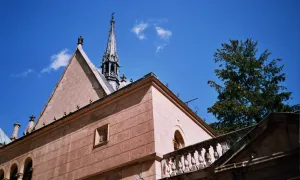


Visitor photos
No photos yet. Be the first to add a photo from your visit!
Log in and add your photo or leave a rating.
You get more points for a visit verified in the app — we can tell from the GPS that you are there.
Reviews and comments