








socha sv.Vendelína Statue
The statue of Saint Wendelin in Nováky is a Baroque sculpture from the second half of the 18th century, located in the village of Nováky in the Trenčín Region. The monument is registered under number ÚZPF 859 and has been declared a national cultural heritage site. According to registry data from the Slovak Heritage Institute, it was created in 1800 and belongs to the period of late Baroque.
The area of the monument consists only of one object: the statue of Saint Wendelin. No additional elements or related buildings are listed in the registry.
No specific technical details about the construction of the statue have been preserved from the registry data. It is known only as a statue of Saint Wendelin, without details on its design, material, or decoration. It is assumed to be made of stone or wood, which was typical for Baroque sculptures of that era.
The statue stands at Baňa Mládeže 426 in the cadastral area of the village of Nováky. It has been protected as a national cultural heritage site since 1963 when it was registered in the Central List of Monuments. Currently, the statue is located in the open space of the village and is not part of any heritage zone or protective buffer. It is accessible to the public and is situated near residential homes.
The statue of Saint Wendelin is one of the few Baroque monuments in the vicinity of Nováky. Its location at the center of the village makes it interesting for visitors interested in regional culture and history. Due to its rarity and historical significance, it is a suitable destination for brief but memorable visits.
Tehdy a dnes
Drag the slider and compare how the monument might have looked when it was built with the view today.
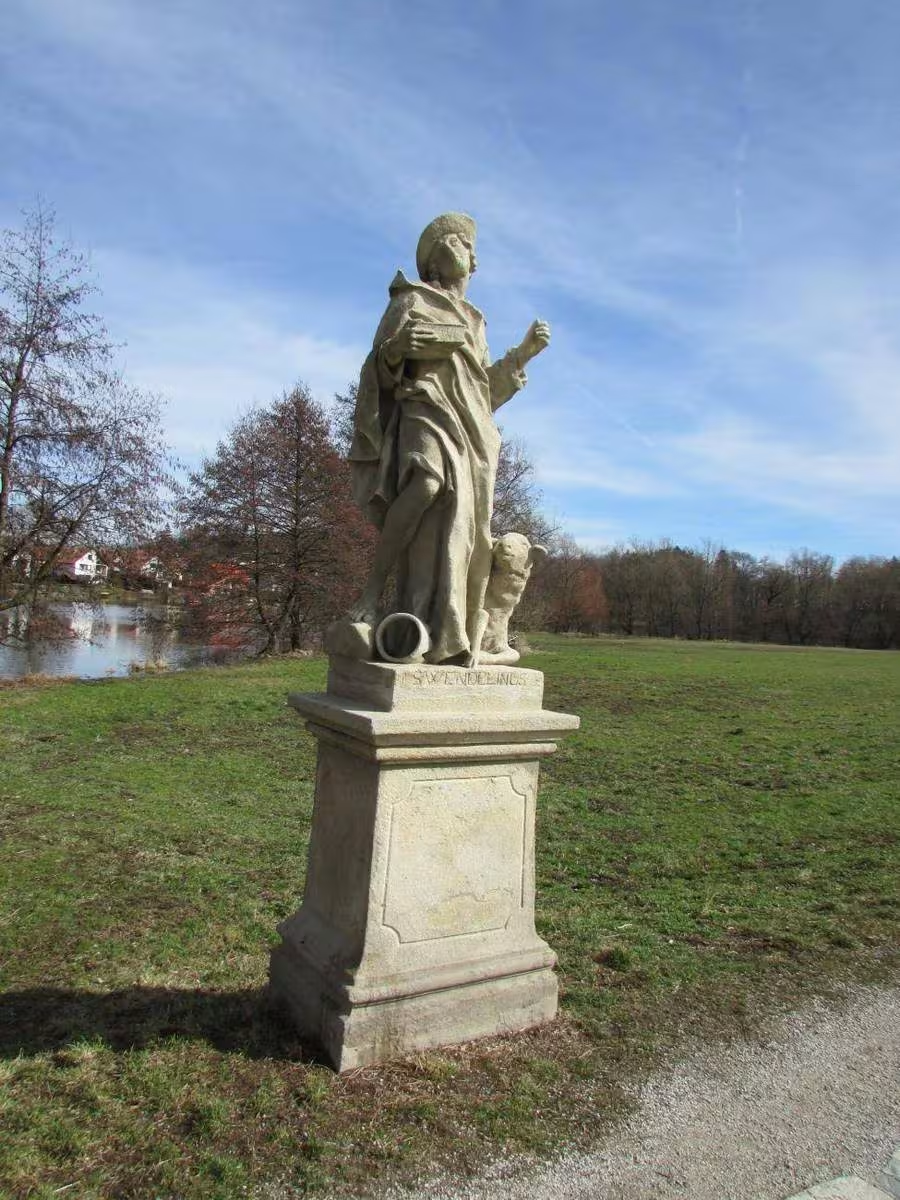

The historical view on the left is a visualisation generated by artificial intelligence and serves as inspiration.
Historical Milestones
- 1800
- The statue of St. Wendelin in Nováky was created
- 1963
- The statue was registered in the Central List of Monuments and became a national cultural monument
Interesting facts
– The Statue of Saint Wendelin is the only Baroque monument in the town of Nováky.
– It is located at Baňa Mládeže 426 and is accessible to the public.
– It was originally registered in the Central Register of Monuments in 1963 and has been declared a national cultural monument.
– According to registration records, it was created in 1800 and belongs to the Late Baroque period.
Guide
Show guide text
The text was prepared by artificial intelligence and has not been editorially reviewed. It may contain inaccuracies.
Welcome to the statue of Saint Wendelin in Nováky
You are standing before one of the finest Baroque statues in our region – the statue of Saint Wendelin, which will instantly captivate you with its quiet grandeur. As you look at it, you see the modest yet expressive figure of the saint holding keys in his hands – a symbol of protection against plague and the safeguard of agriculture. The statue stands on a small pedestal that raises it above the ground, and its face is turned toward heaven as if praying for the protection of the village. Do you feel the same reverence that your ancestors felt before it? This statue dates back to the second half of the eighteenth century when Baroque art reached the peak of its flourishing in our region as well. At that time, many villages began building or restoring statues of saints meant to protect against danger and contribute to the fertility of the soil. Saint Wendelin was a popular patron of agriculture, forests, and animals back then, and his statues were placed along roadsides, in town squares, or near churches. This particular statue in Nováky belongs to those built both according to tradition and by the needs of the local inhabitants – perhaps along a road or near an important building that may now be forgotten. Let us move on to the details that make this statue so special and monumental. First, perceive its form – the statue is made of stone, probably sandstone or marble, which was used at the time for its durable qualities. The figure of the saint is crafted in a classic Baroque style, meaning it is somewhat dynamic, with a movement that expresses his spiritual presence. Looking at his face, notice how it is somewhat idealized yet human at the same time – the sculptor sought to express not only the sanctity but also the humanity of the saint. The keys in his hands are detailed, showcasing the meticulous work of the artist. Now, pay attention to the surrounding space. The statue stands on a small pedestal, which is likely also part of the monument. Pedestals often served not only as support but also as a symbolic boundary between the human world and the spiritual world. Around the statue, there may have been several other elements reminiscent of Baroque art – such as small statues, reliefs, or other symbols that are now invisible or lost. Thanks to the fact that the statue is a national cultural monument, it is protected from alterations, allowing us to enjoy its original beauty. When you look at the statue of Saint Wendelin, you cannot avoid the question: why right here? Why in this particular village? History does not reveal all secrets, but we can perhaps assume the statue was erected either at the instigation of locals praying for protection from the plague or for a good harvest, or according to a tradition passed down from generation to generation. Saint Wendelin was also popular in the Slovak countryside, where many churches and chapels were dedicated to him. His statues were placed along roadsides to protect travelers or near fields to safeguard the harvest. In Nováky, the statue could have served similar purposes – as protection against danger and simultaneously as a symbol of public devotion to religion. One of the interesting features of this statue is its durability. Stone Baroque statues are rare because many of them were damaged or destroyed over the centuries. However, this statue has survived and still stands in its place today, which is proof of its quality and significance for the local residents. Because it is a national cultural monument, it is protected from changes and we can enjoy it in its original form. It is an example of how art and religion merged into a single masterpiece that still inspires and captivates to this day. Before leaving, take one more look at the statue of Saint Wendelin. Take in its quiet grandeur, expressed in every detail – from the shape of the keys in his hands to the face turned toward heaven. This statue is not only a monument to the past, but also to traditions passed down from generation to generation. It is an example of how art and religion merged into a single masterpiece that still inspires and captivates to this day. If you haven't explored the surroundings yet, take some time for further discovery. Nováky and its surroundings offer many attractions worth stopping for. From older churches and chapels to the natural beauties surrounding this place. May this visit be an opportunity for you to learn about and admire our cultural heritage. And as you depart, don't forget to take one last look at the statue of Saint Wendelin – it will likely watch you leave with a smile and a blessing.
Tips for visitors
The Statue of St. Wendelin is best visited in the early morning or late afternoon when the lighting is favorable and the site is peaceful. In the summer months, it is advisable to avoid midday when the sun is very bright.
The statue is located in the village of Nováky, which is accessible by car via local roads. If traveling by public transport, be sure to check connections using a transit planner as schedules may change.
For your visit to the statue, it is recommended to wear comfortable walking shoes and bring an umbrella or sun protection, as the site is situated in a rural environment.
The best photo spots are directly in front of the statue, offering a great view of the entire composition. It is important to shoot from various angles to capture the overall appearance of the statue and its surroundings. The best light is in the early morning or late afternoon when the sun shines from the side and creates shadows on the statue.
The surrounding area features natural beauty ideal for short walks or playing in the fresh air. For example, you can visit the local forests or fields. For children, visiting the statue can be interesting as it is a historical landmark. You can explain to them who St. Wendelin is and why his statue is placed in this village.
Frequently asked questions
Can the monument be visited?
This is a structure in a public space that can usually be seen from outside free of charge. We have not verified that this particular one is freely accessible.
Where is the monument?
Location: Baňa Mládeže 426, Nováky, Trenčiansky kraj. The map on this page shows the exact spot.
Why is the monument protected?
It is listed in the Central List of the Monuments Fund of the Slovak Republic as a national cultural monument (ÚZPF no. 227-859).
For children
Imagine lying in the grass in the sunshine, looking up. The sky stretches out above you, but suddenly you notice a mysterious figure emerging from it. A sentence in the Slovak language would be:
Thematic route
Sightseeing route featuring a visit to the Statue of St. Wendelin in Nováky
1. Statue of St. Wendelin The statue stands near the Church of St. Nicholas in Nováky. It is part of the local cultural heritage and symbolizes the protection of agriculture.
2. Church of St. Nicholas A 17th-century Renaissance-Baroque building featuring rich frescoes and a historic interior. A visit to the church complements the exploration of local culture.
3. Nováky Village Green and Local Houses A traditional Slovak village setting with stone and wooden structures. A stroll across the village green reveals authentic rural life and folk architecture.
4. Panoramic View from the Local Hill From the elevated spot above the village, you can see the surrounding landscape of the Trenčín Region. An ideal moment to relax and take in the natural surroundings.
The route is simple and logical, with an emphasis on local monuments and surroundings. Distances are minimal, as all points are located in the immediate vicinity of the village.
Seasonal recommendations
The Statue of St. Wendelin is a popular tourist attraction across all seasons.
Spring In the spring months, nature gradually awakens. Trees begin to grow, vegetable gardens come into color, and the landscape takes on vibrant tones. The Statue of St. Wendelin is frequently visited during this time, so it is advisable to arrive early. When visiting, it is recommended to wear comfortable shoes and be prepared for photography, as the lighting can be challenging.
Summer In the summer months, the Statue of St. Wendelin is a favorite destination, especially for families with children. It is best to arrive early, as large numbers of visitors tend to gather here. Photography can sometimes be difficult due to the dense crowds.
Autumn The autumn season brings a transformation of colors in nature. Tree leaves turn yellow and fall, creating picturesque scenery. The Statue of St. Wendelin is also frequently visited during this period, so it is a good idea to wear comfortable shoes and be ready for photography.
Winter In the winter months, the Statue of St. Wendelin is quieter and more peaceful. Visitors come dressed in warmer clothing. The best time to visit the statue is in the morning hours when there are the fewest people.
Visualisations and artistic views

The visualisations are generated by artificial intelligence and serve as inspiration.
Visitor Tips
No tips yet. Be the first!
Log in and add your tip.
More monuments – Nováky
Show all in the town


Visitor photos
No photos yet. Be the first to add a photo from your visit!
Log in and add your photo or leave a rating.
You get more points for a visit verified in the app — we can tell from the GPS that you are there.
Reviews and comments