

st. John Nepomuk's Church Church
St John's Church Nepomuk in Haniska is a national cultural monument from the second half of the 17th century. It is a baroque single-ship building with a polygonal presbytery and tower that combines elements of baroque, classicism and neorenesance.
In 1656 the building was rebuilt. Between 1751 and 1764 side chapels were added to the church and a new tower was built. In the script below the church there are tombs of landlords from families Mesko and Ziči.
The church is baroque, but its exterior is adapted in the style of classicism. The original three-piece façade had central rizalit towers and side wings with nowhere in which the Baroque statues are probably from J. A. Krauss. The windows have a semi-circular finish with profiled shambranes and vaults. The original Baroque chapels are concave in the facade, the classicistic southern chapel from the beginning of the 19th century is rustic and has a mirror arch. The side chapels were later expanded by extension to the east and west directions.
The interior of the ship consists of a spring vault, the presbytery has a rolling vault with lunettes. The arcade holes in the second and third vaulted fields give the impression of the triship. Above the sacristy on the left side of the presbytery there is oratorium.
The Rococo baptistery dates back to the mid-18th century. Side altars are in the style of luises (1838, 1866). The neo-orenaissance main altar from 1934 contains an image of the Virgin Mary by V. Smolka. The present altar painting of St. John Nepomuk was created by J. Pesk in 1825. V. Smurf in 1923 led a rough figure painting.
The interior decorates the paintings of Ignác Klimkovič (the Baptism of Christ, 1838) and A. Stadler (1866). In the side chapel is the image of Ignác Klimkovič from 1837, depicting Hungarian King Stephen sacrificing the crown to the patron saint of Hungary.
The church is registered under number ÚZPF 419.
Tehdy a dnes
Drag the slider and compare how the monument might have looked when it was built with the view today.
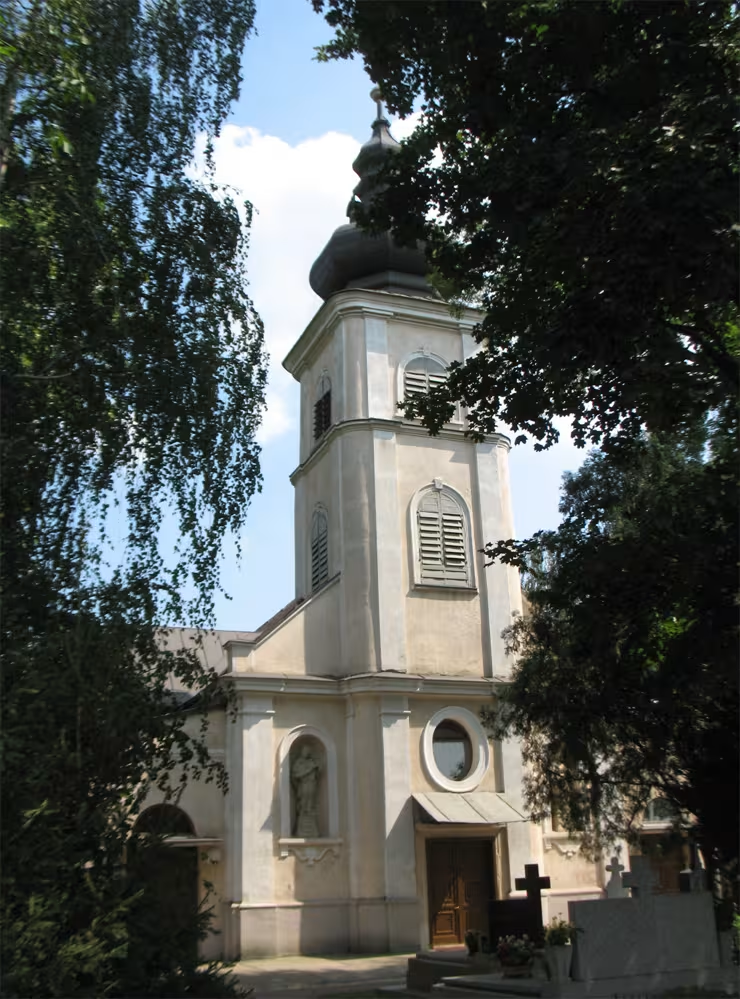
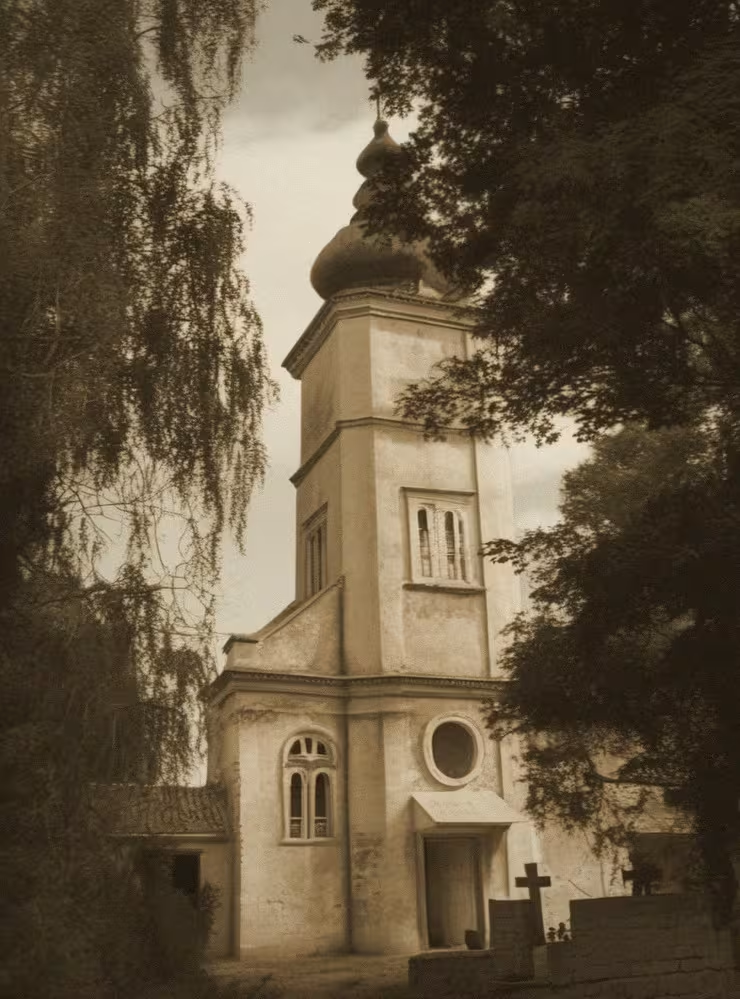
The historical view on the left is a visualisation generated by artificial intelligence and serves as inspiration.
Historical Milestones
- 1656
- Rebuilding the Church
- 1751-1764
- Extension of side chapels and construction of new tower
- round 1750
- Formation of the Rococo Baptist
- 1825
- Creation of the altar image of St. John Nepomuk
- 1837
- Creation of King Stephen's image in the side chapel
- 1934
- Building a neo-renaissance main altar
Interesting facts
- The church is a national cultural monument from the second half of the 17th century, which combines elements of baroque, classicism and neorenesance. - In the script below the building there are tombs of landmen from families Mesko and Ziči. - The facade contains Baroque sculptures that J. A.
Guide
The guide was voiced by a synthetic voice created by artificial intelligence.
Show guide text
The text was prepared by artificial intelligence and has not been editorially reviewed. It may contain inaccuracies.
Welcome to Haniska. You stand at one of the most important historical points of this location, near the building, which bears traces of many generations. The church of St. John Nepomuk is emerging before your eyes. Before you move on, stop for a moment and just feel the atmosphere of this place. It is not a mere stone and mortar building; it is a living witness of the time that has passed for centuries. Prepare to be surprised by this church's rich history and architectural diversity.
Now, when you look at the overall appearance of this monument, you will see something extremely rare. This church is a national cultural monument that is not imprisoned at one time. Rather, his face is the result of successive changes that have passed over the centuries. His story, as we know him today, began to form dramatically in the mid - 17th century. It was precisely in 1656 that a major rebuilding took place, which gave the basis to what you see today. From that point on, the church gradually grew and changed its shape according to the needs and artistic trends that dominated the world at that time.
Notice how this building changed in time. In the mid-eighth century, namely between 1751 and 1764 there was further substantial expansion. The side chapels were then built and a new tower was built, which gave the whole of its characteristic and dominant appearance. This process was not just about building arrivals, but about constantly adapting to new aesthetic ideals.
Now I beg you to pay attention to the facade you have right in front of you. If you look at her decorating, you'll see the Baroque statues. Although the exact name of their creators is not clearly recorded in history, experts believe that J. A. Krauss could have been behind their creation. These statues give the building dynamism and emotion that are so typical of baroque style. The whole church architecture is a fascinating combination of several artistic directions. It is a dialogue between Baroque, Classicism and later added by neo-Renaissance. It is this connection of different ages that makes this place special - not just a static object, but an architectural record of the development of artistic thinking.
Now let's see what happened in this space. When you go in later, pay attention to the details that tell the story of each period. In the interior you can be reached by the gentleness of the Rococo baptistery, which was established around 1750. Rocoko brings lightness and elegance to space, contrasting with more massive elements of other styles. In the side chapel you can enjoy the image of King Stephen, which was created in 1837, which is proof of how the church was later supplemented by new artistic elements.
However, the main altar, which dominates interior space, is the most recent great primacy. Created in 1934 in neo-Renaissance style, it brings to the temple a sense of stability and historical continuity. The very main picture of Saint John Nepomuk, which was created in 1825, is also an important pillar of this holy place and reflects the spiritual values that persist for a long time.
However, the history of this church does not only concern what is visible on the surface or in its interior. The real secret and depth of this place are right under your feet. Under the church building there is a crypt, a hidden place where important personalities from the past rest. There are tombs of landmen from the Mesco and Zichi families. This hidden layer of the building reminds us that the church has always been more than just a place of prayer - a memorial of the families who ruled here and who left their mark in this place. This connection between the world of the living and the world of those who are no longer among us gives the whole place a special, even sanctified feeling.
When you look at the church, try to imagine all the people standing in front of you. Those who came in 1656 to watch the first rebuilding, those who in 1750 admired the new baptistery, or those who came in 1934 to see the new neo-Renaissance altar. Each era has left its soul in this church.
I won't be arming you for long now at this first stage of your reunion. I invite you to slowly step up to the entrance and start exploring the interior in detail that we mentioned. See every line, every detail of the altar and every trace of artistic styles that work together. Let yourself be carried away by the atmosphere of this national treasure and discover your own details that this historical object will reveal to you.
I hope you like visiting Hanikov and this beautiful church of St. John Nepomuk. I wish you a pleasant and inspiring discovery.
Tips for visitors
The best time to visit is spring or autumn, when light is soft and the surrounding nature adds pleasant colors to the background of sacral construction. Take comfortable shoes, as the terrain around the church can be uneven, and in colder weather even layered clothing. When shooting, focus on the details of the facade and surrounding landscape, ideally in the morning or afternoon, when the sun creates interesting shadow effects. Nearby is a village Haniska with a quiet rural atmosphere. Specific other attractions within 30 minutes are not included in the documents, so focus on local architecture and nature. The location is suitable for families with children on a short trip, during which they can observe nature and gain basic knowledge of local history. When moving around the building, take care of safety.
Frequently asked questions
Can the monument be visited?
Religious buildings are usually open mainly during services; at other times a visit is normally arranged with the parish or the operator. We have not verified specific times.
Where is the monument?
Location: č. 120, Grajciar, Haniska, Košický kraj. The map on this page shows the exact spot.
Why is the monument protected?
It is listed in the Central List of the Monuments Fund of the Slovak Republic as a national cultural monument (ÚZPF no. 426-419).
For children
Close your eyes and imagine you're passing through time. Can you smell the cool air? Do you feel the silent noise of the meadow and the horse's mouth? We're 1656. It's about 370 years ago! There are no cars, no phones or asphalt roads around us. We're in Haniska, at a time when world-famous styles like Baroque began to spill across the country as color after canvas. Right now, something special is emerging - the church of St. John Nepomuk.
Thematic route
As there are no other objects in the area, I propose a thematic route focused on the main monument area:
1. St John's Nepomuk church - Architecture. The visit includes the exterior and interior of this sacral object in the village Haniska. 2. Church area - surroundings of the building. A walk in the courtyard and its connection to the surrounding environment.
Seasonal recommendations
In spring, the surroundings of St. John Nepomuk's church in Haniska will awaken to life and the landscape will be surrounded by fresh greenery. Nature in this area blooms then, creating a pleasant contrast with the historical façade of the building. It is recommended to visit a place in the morning when light is fine and suitable for photography. Due to variable spring weather, it is advisable to coat with layers and wear waterproof footwear.
Summer season brings intense sunlight, which highlights the details of architecture. The atmosphere is warm and the surrounding landscape region complements the full growth of vegetation. The best time to visit is early morning time or later at noon to avoid the strongest glow. It is essential to ensure sufficient drinking water and to wear lightweight, breathable clothing and a head covering.
Podzim in Košice region is characterized by a color change of leaves, which adds melancholy and romantic times. Lighting is golden and less aggressive than in summer. The shorter day and colder mornings should be taken into account when planning the trip, so it is advisable to choose the time around noon. A practical choice is clothing suitable for walking in nature, such as a windshield or light sweater.
Winter brings to Hanisko a completely different, quiet and treasured atmosphere, which is especially impressive after snowfall. The church in the snowy country operates monumentally and peacefully. A visit during this period requires warm and functional clothing, including a thermoregulatory layer, gloves and warm shoes. Because of the short day and the low temperatures, it is best to come to sew the sun so that you can perceive architecture in daylight.
Visualisations and artistic views

The visualisations are generated by artificial intelligence and serve as inspiration.
Visitor Tips
No tips yet. Be the first!
Log in and add your tip.
More monuments – Haniska
Show all in the town

Visitor photos
No photos yet. Be the first to add a photo from your visit!
Log in and add your photo or leave a rating.
You get more points for a visit verified in the app — we can tell from the GPS that you are there.
Reviews and comments