

st. Martin's Bishop's Church Church
St. Martin's bishop's church in the village of Nová Ves nad Váhom is originally an early-gothic one-ship building from the end of the 13th century. It is registered in the Central List of the Slovak Monument Fund under number 11988/1 and serves its original purpose.
During history he has undergone several reconstructions. In 1538 the interior received Renaissance cross vaults. In the middle of the 18th century, the Baroque reconstruction followed, in which they extended the ship and built a new polygonal closure of the presbytery with pressed rolling lunet vault. In the middle of the 20th century, the church was expanded by extension.
The building originally includes a square presbytery and a built-in prism tower with a baroque onion roof, lateral, mine and metal cross. Facades are smooth, divided by shambrans and semicircular windows. In 1943 a new large church was built by the builder F. Szokolóczi according to the project of architect Š. Paulík. In 1921 the interior was painted by painter M. Cheerful.
There is a classicistic pulpit from the second half of the 18th century, a wooden Confessor from the end of the 18th century and a stone baptistery from the first half of the 19th century. Under the tower there is a stone cave of the Lurdy Virgin Mary.
The area includes the church and next to the lying cemetery. It was declared a national cultural monument in 2015.
The church stands in the eastern part of the village Nová Ves nad Váhom, is in good condition, accessible to the public and regularly held services.
Tehdy a dnes
Drag the slider and compare how the monument might have looked when it was built with the view today.
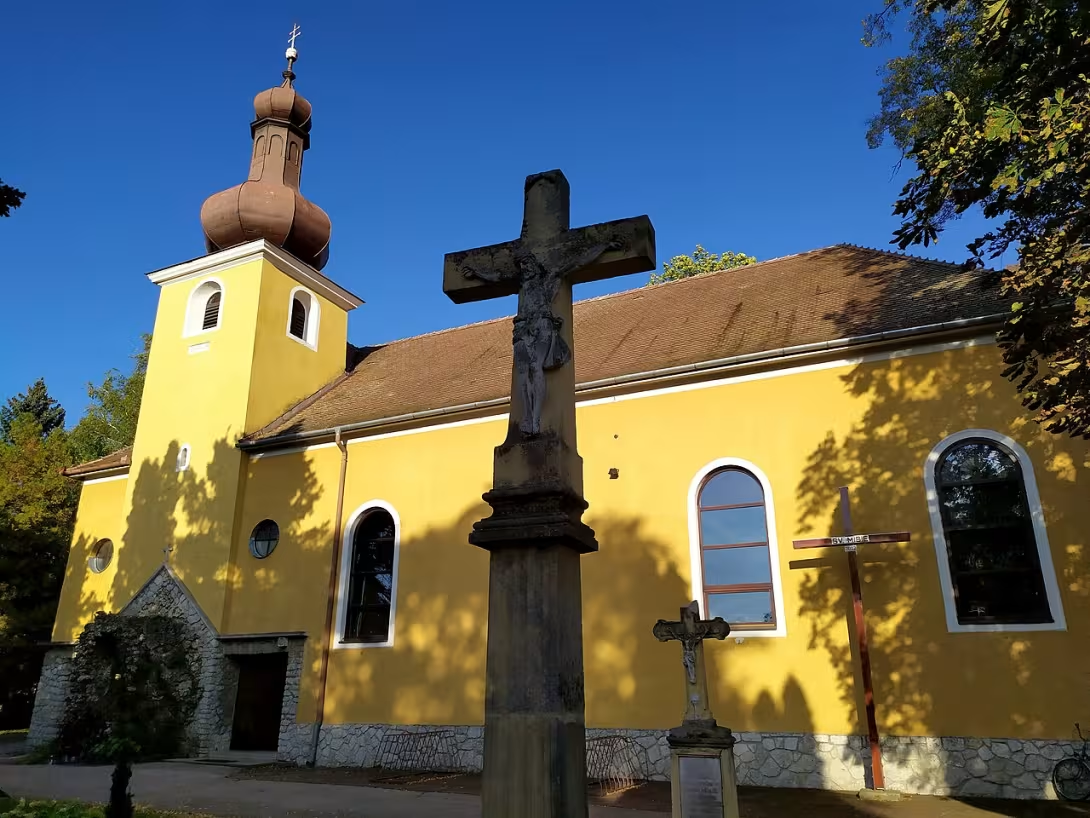
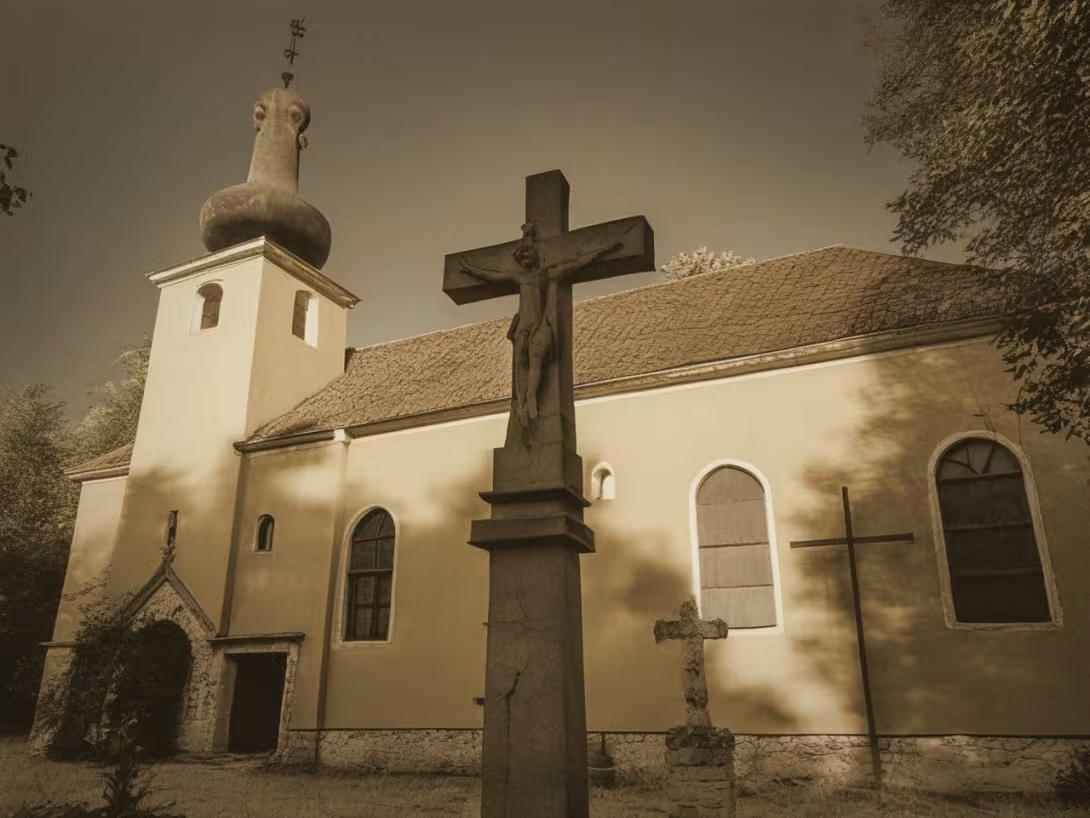
The historical view on the left is a visualisation generated by artificial intelligence and serves as inspiration.
Historical Milestones
- In 1538 the interior of the church was enchanted by Renaissance cross vaults.
- In the middle of the 18th century a reconstruction took place in the style of the Baroque, which extended the ship and built a new polygonal closure of the Presbytery.
- In 1921 the interior of the church was painted by painter M. cheerful.
- In 1943, the builder F. Szokoloczi northern part of the church boat according to the project of architect Š. Paulík.
- In 2015 the church was declared a national cultural monument.
Artistic features
-
vitráž figurálna s dekorom — sv.Martin sa delí o plášť
sklo, vkladanie do siete · moderna · 1971-1980 -
vitráž figurálna s dekorom — sv.Ján Bosco
sklo, vkladanie do siete · moderna · 1971-1980 -
vitráž s kresťanským symbolom — Sviatosť oltárna
sklo, vkladanie do siete · moderna · 1971-1980
Source: Monuments Board of the Slovak Republic — open data, licence CC BY 4.0
Interesting facts
- It is originally an early-gothic single-ship building from the end of the 13th century. - In 1538 the interior received Renaissance cross vaults. - The hranoloid tower has a baroque onion roof with a lateral, mine and metal cross. - In the interior there is a classicistic pulpit, a wooden Confessor and a stone baptismal cup shape. - Under the tower there is a stone cave of the Lurdy Virgin Mary.
Guide
The guide was voiced by a synthetic voice created by artificial intelligence.
Show guide text
The text was prepared by artificial intelligence and has not been editorially reviewed. It may contain inaccuracies.
Welcome to New Ves nad Váhom, in a pleasant environment of Trenčín region. You put on your headphones, you've turned down, and right now you're facing a rare and quiet witness of ancient times. In front of you is the Church of St. Martin the Bishop. Take a few seconds to first impression. It breathes out the peace, grandeur, and unmovable stability that this structure has kept for centuries. Looking at it, you will feel the touch of history, not in books, but in stone, wood and metal itself. You stand in a place where generations of residents met in joys and pains, where they sought comfort, hope, and spiritual home. Let us go back to the past together. Construction of this temple began at the very end of the Middle Ages, at the end of the 13th century. At that time an early-gothic single-ship building was created. Imagine the country and life of the people at that time. The medieval village needed a solid point, a spiritual center that would go beyond everyday hard work in the fields and in the areas. The establishment of a church dedicated to Saint Martin the Bishop was an extremely important event for the local community. Saint Martin, known for his self - sacrificing and mercifulness, has become the patron of this temple, and his protective hand has been watching over it to this day. Over time, however, the world changed, centuries changed, and with them the face of the church itself changed. An important milestone in its construction development occurred in 1538. During this period, when new thought and art streams of the Renaissance flowed through Europe, the interior of the temple was also changed. The original ceiling solution was replaced and the interior got solid Renaissance cross vaults. These arches added new dynamics, strength and elegance to the interior space, linking the medieval early Gothic architecture with the new Renaissance era. Now pay attention to the outer dominance of the entire object, which undoubtedly attracts your eyes first. Look up at the tower. It's a distinctive prism tower that proudly rises to heaven. You will notice that its ending bears clear features of the Baroque style. The roof of the tower is onion shaped with an extraordinary sense of proportion and aesthetics. At its peak there is a so - called lateral, or slender, open, tower above which a decorative mine rises. This whole architectural composition at its very top is crowned by a metal cross. This is not only a crafty detail, but also a clear symbol of faith and hope, which is already smiling by far at every traveler coming to Nova Ves nad Váhom. When you look at the architecture of the church as a whole, you see a unique example of how different styles can be harmoniously combined in one building. From the strict and simple early-gothic line of the thirteenth century, through the Renaissance reconstruction of arches in the sixteenth century, to the Baroque splendor of its rooftop dominant. When you enter or look into the overall interior space, your attention is naturally directed to the precious equipment that has been preserved in the temple. Note the individual elements that complete the spirit of this sacral space. In the interior there is a classicistic pulpit. The pulpit in the temples always served as a place where the priest spoke to the believers, from where God's word and lessons for daily life sounded. Her classicistic appearance brings a sense of seriousness, purity and artistic balance to the space. Another particularly important element of the interior is the wooden Confessor. This piece of honest carpentry and artistic craft is a place of silence, forgiveness and internal turnover. It has been here for centuries that people have postponed their weight and sought peace of mind. Later, note the stone baptismal woman. The stone baptistery is one of the oldest and most important symbolic objects in each church. This is where the spiritual life of every newborn child in the village began. The cold, yet lasting stone of the baptismal system carries a deep symbolism of eternity, fortress, and incorruptible spring of life. You may wonder who were the builders, the stoneworkers, and the craftsmen who built the temple and modified it over the ages. The names of architects, builders and specific historical personalities associated with the establishment of this church remain hidden in mystery. History hasn't left us their names. And that's where the particular magic and mystery of this place lies. Saint Martin's bishop's church is not a memorial to one famous ruler or rich nobleman. It is the work of unknown masters and the community of ordinary people who lived, worked and believed here. Their names have vanished from the holy pages, but their work, their faith, and their love for this place have been materially written into every stone, Renaissance vaults, and Baroque towers. An interesting and most fascinating story of this object is its gradual transformation through centuries. A few village buildings boast such a variety of artistic styles that live alongside each other in utter harmony. Early Gothic gave the church its basic shape of a single boat space. The Renaissance brought cross vaults below the ceiling in 1538. Barok added a tower unmistakable onion silhouette with a lateral and metal cross. Finally, classicalism enriched the interior with an elegant pulpit, accompanied by a wooden Confessor and a stone baptismal. Each century left its own signature, its own aesthetic trail, and the resulting whole works extremely coherently and naturally. Let's go one step closer now. Just take a moment for yourself. Stop by, listen to the silence that surrounds this historical space and perceive the extraordinary atmosphere of Nova Ves nad Váhom. Feel the strength of the walls that remember the end of the 13th century, the medieval wars, the Renaissance revival, and the baroque bloom. Our short audio guide ends at this point, but your experience of this place is just beginning. Slowly remove your headphones, look again at all the details we discussed - from the metal cross on top of the baroque tower to the stone baptistery and precious vaults in the interior. Enjoy this unique touch of the past and enjoy the rest of your visit. Thank you for your attention and I wish you a beautiful and inspiring day.
Tips for visitors
St Martin's bishop's church in Nova Ves nad Váhom we recommend to visit early in the morning or before sunset, when light highlights architectural details of the building. You can reach the village by car; stop the vehicle around the church so that you do not restrict traffic. Take drinking water, comfortable shoes, and a head covering and sunscreen in warmer months for a walk. The exterior of the church and its surroundings provide opportunities for photography, especially from the ceiling in the clear sky at the time of the gold watch. Since there are no other attractions nearby, you can see the visit as a stopover in getting to know the rural architecture of the Trenčín region, which is suitable for families with children looking for an easy trip.
Frequently asked questions
Can the monument be visited?
Religious buildings are usually open mainly during services; at other times a visit is normally arranged with the parish or the operator. We have not verified specific times.
Where is the monument?
Location: č. 27, Nová Ves nad Váhom, Trenčiansky kraj. The map on this page shows the exact spot.
Why is the monument protected?
It is listed in the Central List of the Monuments Fund of the Slovak Republic as a national cultural monument (ÚZPF no. 224-11988).
For children
Imagine finding yourself about 726 years ago. The year 1300 is written, and you are surrounded by dense forests and calm waters of the river Vah. It was in this fierce time of knights and castle lords that they began to build the mysterious construction that still stands there. It is an ancient church of St. Martin bishop in the village Nová Ves nad Váhom. Step into the time machine with us and find out what this place has been through. Imagine it as a big adventure game. When this church grew from the ground, it didn't look like it did today. No asphalt roads, no cars or shops.
Nearby
🏰 Historic sites (114)
- Hradisko Kočovce - Skalka 0.9 km web
- Kaštieľ Kočovce 1.0 km web
- Kaštieľ rodiny Szokolóczi 2.4 km
- Kaštieľ Rakoľuby 3.2 km
- Pamätník padlých hrdinov 3.8 km
- Jozef Miloslav Hurban 3.9 km
- Pamätník leteckej nehody Avia B-33 13. 6. 1954 4.1 km
- Kardinál Alexander Rudnay 4.5 km
- Rudolf Zemaník 4.6 km
- Panna Mária 5.1 km
- Peter Matejka 5.1 km
- RNDr. Július Gábriš 5.1 km
- sv. Ján Evanjelista 5.1 km
- Kalvária 5.1 km
- Trojičný stĺp 5.1 km
- Dominik Štubňa - Zámostský 5.2 km
- Mariánsky stĺp s Madonou 5.2 km
- sv. Ján Nepomucký 5.2 km
- Pomník 122 vojakov 4. Rumunskej armády 5.2 km
- sv. Florián 5.2 km
🍽️ Restaurants and dining (187)
- R-centrum 0.4 km
- Majer 3.0 km
- Červený rak 3.2 km
- Bar Tesco 4.0 km
- Tomba 4.0 km
- Abeba 4.0 km
- Pohostinstvo Potoček 4.0 km
- Orion 4.1 km
- Bufet Piesky 4.1 km
- Salaš Beckov 4.1 km web
- Cyklobufet Doma 4.2 km +421 944 818 949 web
- Hostinec 4.2 km
- Spirit Game 4.2 km Piešťanská 1188/28 web
- Koliba Kálnica 4.2 km web
- Medo 4.3 km
- GastroBENE s.r.o 4.3 km
- Reštaurácia - kaviareň 4.4 km
- Café & Restaurant Tereza 4.4 km
- Karavan 4.5 km
- Perón Ka 4.6 km
🏨 Accommodation (44)
- Ubytovňa Kočovce 1.0 km web
- Ubytovňa Milex 4.0 km Piešťanská 2676/31A +421902225522 web
- Rybársky dom 4.2 km
- Zelená voda 4.4 km web
- Hotel Perla 4.7 km Zelená voda II. 2234/7 +421 32 7713 903 web
- Margaréta 4.7 km +421 32 7710 916
- Hotel Javorina 4.8 km +421 32 771 20 67 web
- Chata Natália 4.8 km web
- Chateau Považany 4.9 km web
- Hotel Diana 5.0 km +421 32 771 22 15 web
- Red House 5.3 km +421 905 600 788;+421 915 322 258 web
- Kúria 5.4 km +421 904 838 789 web
- Kúria Beckov 6.5 km +421 32 7777 357 web
- Chata Beckov 6.6 km web
- Ubytovňa Leo 7.1 km web
- Chata Javorníček 8.7 km web
- Hotel Inovec 9.2 km +421 911 595 671 web
- Cyril 9.2 km
- Hana 9.2 km
- Ivan 9.3 km
🚲 Rentals and sport (19)
- Sportisimo 4.0 km web
- Bike Park Kálnica 4.1 km web
- Ski Park Kálnica 4.1 km web
- MTBiker centrum 4.2 km +421233056730 web
- Ski Centrum 4.5 km
- Ing. Juraj Galovský - JAG 4.6 km
- Rybárstvo Rojko 4.7 km
- Tenisová hala Perla 4.7 km Zelená voda II. 2537/12
- Rival bike sport 5.1 km +421 32 771 29 36; +421 915 867 427 web
- Squash Center 5.2 km +421 905 526 740 web
- Extra sport 5.2 km
- Tomino - Rybárske potreby 5.2 km
- RDA Shop 5.2 km
- Huma šport 5.3 km +421 903 752 297
- Bicygláreň 5.6 km +421 911 422 399 web
- 22 bikes 5.8 km +421 32 771 21 59 web
- Bazén SPŠ Nové Mesto nad Váhom 6.1 km +421 32 7465258 web
- BALANCE - joga centrum 10.2 km
- MTbiker sklad 14.0 km web
🥾 Hiking and nature (169)
- Skalka 0.8 km
- Sochoň 2.2 km
- Siroň 3.4 km
- Baza čierna 3.4 km
- Hraničný vrch 3.4 km
- Kozinec 3.4 km
- Matiáška 4.0 km
- Holubací vrch 4.4 km
- Studnička Očanka 4.6 km
- Chlm 4.6 km
- Fodorová 4.8 km
- Hradište 4.9 km
- Skalice 5.0 km
- Park Petra Matejku 5.0 km
- Park Dominika Štubňu-Zámostského 5.2 km
- Kavčí vrch 5.2 km
- Polámaný vrch 5.3 km
- Park Jozefa Miloslava Hurbana 5.5 km
- Ostrý vŕšok 5.8 km
- Ihelník 5.8 km
Thematic route
St. Martin's bishop's church Type: Historical sacral monument Why it is worth visiting: Originally a Romanesque church in the village Nová Ves nad Váhom is located in a quiet area.
Seasonal recommendations
In spring the surrounding nature awakens from winter sleep, creating ideal conditions for peaceful walks around the church of St. Martin bishop in Nová Ves nad Váhom. The surrounding greenery begins to bloom and morning sunbeams supply the historical exterior of the sacral structure with fresh breath. During this period you will especially appreciate pleasant temperatures and clean air. For the spring visit, dress up in layers and choose firm shoes, because the terrain around the area may be wet and muddy after spring rains. The best time to admire the exterior is morning, when the sun illuminates the architecture from the east side and tourists in the region is just the minimum.
Summer months bring long sunny days and clear sky, making the surrounding landscape in Považí fully beautiful. Intense noon light contrasts sharply with the historical walls of the church, creating impressive visual effects for photo lovers. Due to warmer weather, it is recommended to leave either early in the morning or evening when temperatures are more acceptable. Do not forget the head covering, plenty of drinking water, and light breathable clothing. In the main summer season you can run into cyclists and hikers roaming the surrounding routes, so you will enjoy the greatest peace during the early morning hours.
Autumn hides the landscape in warm shades of yellow, orange and brown color, which adds Nová Ves nad Váhom melancholy and romantic atmosphere. Trees in the surrounding area are slowly falling, and morning mist often appears that intersect with the silhouette of the church creates a unique scenery. Since the weather is variable and windy, pack a waterproof jacket, a warm sweater, and comfortable non-promoting shoes. The best time to visit is in the afternoon when the low autumn sun softly irradiates the details of the building and creates long shadows.
The winter season turns the scenery into a quiet, almost fabulous landscape, especially if the surroundings are covered by a snow layer. Cool air and early twilight give the place deep peace and quiet, which is undisturbed by almost no visitors. Quality winter clothes including hats, gloves and warm shoes with anti-slip soles for safe movement in snowy terrain are essential for this season. The best time to take a photo and a short walk is around noon, when the light is brightest, although the day is dwindling very quickly and the dark is coming late in the afternoon.
Visualisations and artistic views


The visualisations are generated by artificial intelligence and serve as inspiration.
Visitor Tips
No tips yet. Be the first!
Log in and add your tip.
Location on Map
More monuments – Nová Ves nad Váhom
Show all in the town


Visitor photos
No photos yet. Be the first to add a photo from your visit!
Log in and add your photo or leave a rating.
You get more points for a visit verified in the app — we can tell from the GPS that you are there.
Reviews and comments