

st. Trinity church Church
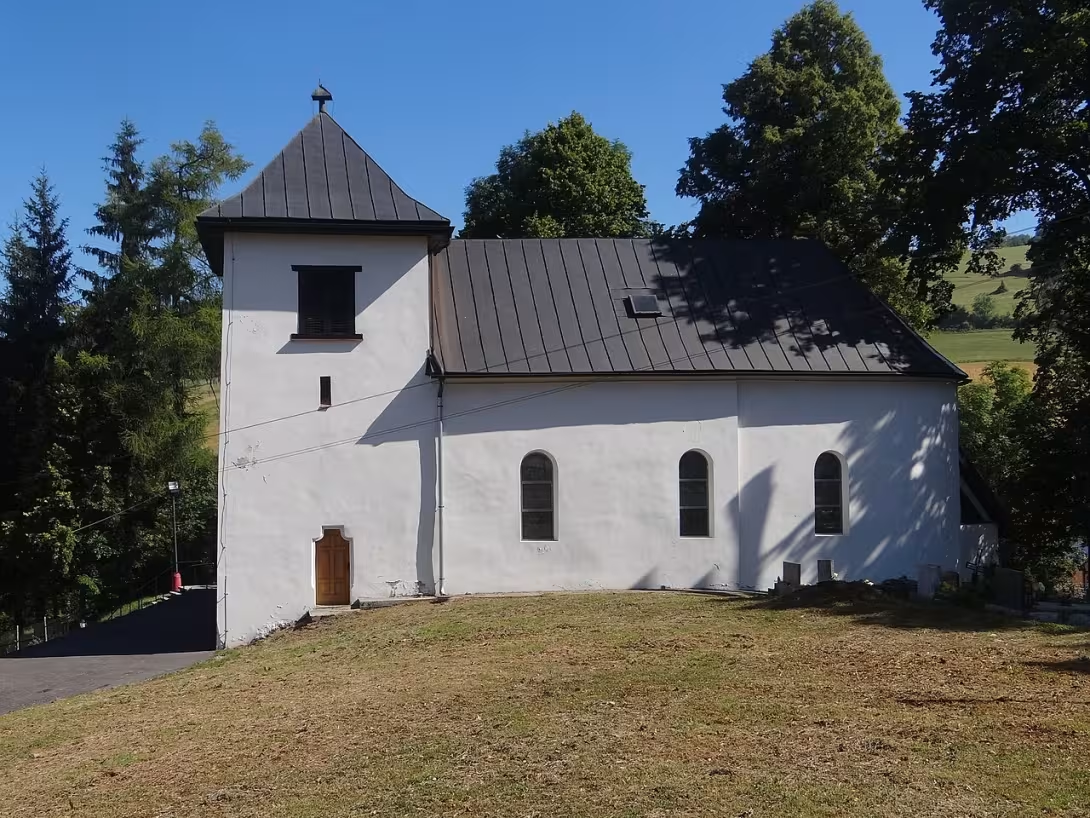
The Roman Catholic Church of the Holy Trinity in Vyšný Kubín is a late Gothic building from the end of the 15th century. It is located in the western part of the village of the cemetery. The building is registered in the Central List of Monument Fund under number 259/1.
The church was probably created as an earthly object. The foundations of the building come from the end of the 15th century. In 1697 it was rebuilt. Further adjustments were made in the 18th century and after 1833. The last comprehensive renewal took place in 1994.
It is a single-boat building with a newer segmental closure Presbytery. On the west side of the ship stands a low Renaissance tower covered with a needle. The facades of the object are smooth. Entrance to the interior is via the late-gothic saddle portal in the podvaží.
Interior equipment combines elements of several styles. The main altar is late baroque. It includes a Gothic statue of the Most Holy Trinity from the mid-15th century and a group of 17th century angels. The side altar of Saint Anna and the pulpit with relief of evangelizers dates back to the early 18th century. The organ wardrobe is dated to the 18th century. There is a painting from the time of the Protestants.
The decoration is complemented by the image of Christ on the cross from the end of the 17th century and Baroque painting on glass from the middle of the 18th century. In the interior there is a stone epitaph of Jozef Kubínyi and his wife Amalia from 1792. In 1941 Jozef Hanula made the painting of the church.
In the tower there is a gothic bell from the end of the 15th century by the bell-seeker J. Weigl. The church serves religious purposes as part of the parish Dolný Kubín. There is a cemetery in the area.
Tehdy a dnes
Drag the slider and compare how the monument might have looked when it was built with the view today.

The historical view on the left is a visualisation generated by artificial intelligence and serves as inspiration.
Historical Milestones
- 1697
- reconstruction of the church
- 1792
- the creation of the stone epitaph of Joseph Kubínyi and his wife Amalia
- 1833
- the church after this year
- 1941
- interior painting by Joseph Hanul
- 1994
- restoration of the church
Restoration history
| Years | Type | Extent | Condition after restoration |
|---|---|---|---|
| 2007 |
Reštaurovanie
kostol sv.Trojice |
Časť obnovená komplexne | dobrý |
| 2007 |
Obnova a reštaurovanie
kostol sv.Trojice |
Čiastočná | dobrý |
Source: Monuments Board of the Slovak Republic — open data, licence CC BY 4.0
Interesting facts
- The church was probably created as an earthly object and its foundations come from the end of the 15th century. - Entrance to the interior is via the late-Gothic saddle portal, which is located in the space under the tower. - Part of the main altar is the Gothic statue of the Most Holy Trinity from the middle of the 15th century, which complements the late baroque decoration. - On the railing of organ empora there is a painting originating from the period of Protestants. - In the tower there is a gothic bell from the end of the 15th century, made by bell-eater J. Weigl.
Guide
The guide was voiced by a synthetic voice created by artificial intelligence.
Show guide text
The text was prepared by artificial intelligence and has not been editorially reviewed. It may contain inaccuracies.
I warmly welcome you to Vyšný Kubín, the picturesque corner of our Orava, where history is not only written in books, but firmly engraved in the stones you see in front of you right now. You stand in a place that radiates deep peace and respect to the ancestors. In front of you is the church of the Trinity, surrounded by an ancient church cemetery. Before we dive into the details of his architecture, stop for a moment and see this atmosphere. Do you feel the strange harmony between building and surrounding nature? This church isn't here by chance. He is a silent witness for centuries who has survived the transformations of regimes, generations and artistic styles. When you look at his silhouette, you see not only the sacral structure, but also the symbol of the continuity of life in this village.
Let's go back in time together now. Although today's church pattern bears traces of several rebuildings, its roots go much deeper than it might appear at first sight. Experts assume that the foundation of this temple dates back to the late 15th century. At that time it was probably created as an earthly object, which means that its construction was initiated and financed by the local nobility. The gentlemen of that time suffered to have a decent place for prayer and a last rest in the vicinity of their seats. It was this connection with the earthly state that gave the church its original character and meaning, which it maintained within the region for long generations. Imagine the work of medieval masters who laid stone to stone here in harsh oravic conditions to create this spiritual harbor.
Now I ask you to come closer to the building itself and pay attention to its architectural details. If you look at the space below the tower, you will see one of the most precious elements of the exterior. It's a late-Gothic saddle portal. Note its characteristic shape and precise working stone. It is through this portal that enters the interior and it itself serves as an imaginary gate between the outside world and the sacred temple space. This portal is a direct reference to the period of late gothic, when emphasis was placed on verticality and elegance lines. It is fascinating to realize that this is the door that people went through hundreds of years ago, seeking comfort or hope, just as visitors do today.
When you look at the overall composition of the church, you will notice that it has undergone a major reconstruction in a thousand six hundred ninety seven. It was the Baroque period that brought new impetus to architecture, although in this region it was often mixed with traditional elements. Other important adjustments followed the year one thousand eight hundred thirty-three, when the church gained additional layers of its historical identity. Any such remodeling was a reflection of the needs of believers and aesthetic feelings of the time. Despite these changes, the building preserved its compactness and dignity, which is enhanced by the presence of the church cemetery. It is not only a place of rest, but an integral part of the entire area, which is perfecting its historical value.
Now draw your attention to the details that tell the stories of specific people. The history of this place is closely linked to the important personalities that shaped the history of Vyšné Kubin. One of the most striking evidence of this connection is the stone epitaph from the year one thousand seven hundred ninety-two. This monument belongs to Joseph Kubínyi and his wife, Amalia. The Kubínyi family was one of the most important noble families in the region and their name is inextricably linked with this village. The epitaph is not only a work of art but also a testimony to the love, respect, and status that the family enjoyed. When you look at it, try to imagine life in the eighteenth century, when great emphasis was placed on gender representation even after death. This stone reminds us that there are real human destinies and emotions behind every historical monument.
If you had the opportunity to look inside the church, your eyes would undoubtedly be caught by the painting of the interior. It comes from the year thousand nine hundred forty one and its author is none other than the famous Slovak painter Jozef Hanula. Hanula was a master of sacral art and his work in this church gives the space a unique artistic value. His handwriting is recognizable in the fineness of the lines and depth of the spiritual message he put into the paintings. It is a fairly modern element compared to medieval foundations, which only confirms that the church of the Holy Trinity is a living organism that has constantly evolved.
I also have one real attraction for you, which is one of the greatest treasures of this place. Part of the main altar is the Gothic statue of the Holy Trinity, which dates back to the middle of the 15th century. Think about it for a second. This statue is older than the very main building of the church you see today. She survived all wars, fires, and reconstructions. He's a silent witness who was here long before the contemporary form of the village was formed. The fact that it is preserved in such a state and still forms the heart of the altar is a small miracle and proof of the immense respect that the locals had for it over the centuries. This statue links the Gothic past with the present and gives the entire hallmark of excellence.
In modern history the church has undergone extensive renovation in the year thousand nine hundred ninety-four. This reconstruction was necessary to preserve the memory for future generations. Thanks to it, we can still admire the cleanliness of its lines and the stability of its construction. The restoration was made with a sense of historical truth, taking care not to suppress the original spirit of the site. This is the result of the efforts of the community and experts who cared that this jewel of Orava did not fit into the dust of oblivion.
We are slowly approaching the conclusion of our joint tour before the Church of the Trinity. I believe that now that you know his story, you are looking at this construction with different eyes. It's not just an old church on a hill anymore, it's a crossroads written in stone, wood and color. It is a place where Gothic meets the Baroque, noble pride with humble faith and the art of old masters with the work of modern restorers.
Before you leave, I recommend a short walk around the church cemetery. Take a walk between the tombstones, read the names and see the peace that reigns here. There may be other small details that will complement the picture of life in Vyšné Kubín in past centuries. Every corner of this area has something to say, just listen carefully.
Thank you for your attention and for choosing to spend your time getting to know our cultural heritage. I hope you can take not only nice pictures from Vyšné Kubín, but especially a feeling of deeper connection with our history. I wish you a pleasant rest of the day and many other inspirational discoveries on your travels. Goodbye.
Tips for visitors
The best time to visit the Church of the Holy Trinity in Vyšné Kubín is during sunny spring or autumn days, when the surrounding nature of Orava offers a magical atmosphere and pleasant temperatures for wandering. The surroundings of the church cemetery provide a deep view of the history and architecture of the region.
Public transport is also available, you can find the ideal connection in the current timetables for the region.
Take with you comfortable shoes suitable for outdoors and on the sloping terrain around the cemetery. You will also appreciate the drinking regime, the smaller snacks and clothing adapted to variable mountain weather in Orava.
For photographers this sacral building offers the best lighting conditions during the early morning or late afternoon, when the side sunlight beautifully highlights the architectural details of the church and historical tombstones at the cemetery.
Families with children can take the visit as a pleasant walk associated with discovering local history. Children will enjoy the quiet environment of the old cemetery and views of the surrounding scenery, while older visitors will appreciate the silence and spiritual atmosphere of this place.
Frequently asked questions
Can the monument be visited?
Religious buildings are usually open mainly during services; at other times a visit is normally arranged with the parish or the operator. We have not verified specific times.
Where is the monument?
Location: Vyšnokubínska 12/4, Vyšný Kubín, Žilinský kraj. The map on this page shows the exact spot.
Why is the monument protected?
It is listed in the Central List of the Monuments Fund of the Slovak Republic as a national cultural monument (ÚZPF no. 313-259).
For children
Imagine a world where there are no phones, tablets, or electricity. It's about five hundred and twenty-six years ago, the year is a thousand and five hundred, and this is the time when a mysterious building grows up on the picturesque Oravec. Imagine the dark forests, gnashing wooden cars on the field roads and knights in shiny armor. That's when the story began to be written, and it's until today, and it's waiting for you.
Nearby
🏰 Historic sites (161)
- Pomník padlého partizána 1944 0.1 km
- Pamätník matke Pavla Országha Hviezdoslava 0.2 km
- Kubínyiovský kaštieľ 0.3 km Mjr. Archipova 196/25 web
- Kubínyiovský kaštieľ 0.4 km Hviezdoslavova 117/5 web
- Kúria vyšnokubínskeho komposesorátu 0.4 km Vyšnokubínska 35/64 web
- Rodný dom Pavla Országha Hviezdoslava 0.6 km web
- Martin Kukučín 1.4 km
- Kúria Jána Bencúra 1.4 km web
- Rodný dom Martina Kukučína 1.4 km +421 908 130 841 web
- Martin Kukučín 1.4 km
- Dobákovský kaštieľ 1.5 km
- Rodný dom Pavla Bujnáka 2.3 km
- Marcin Barnáš 2.XI.2003 2.5 km
- Pavol Országh Hviezdoslav 2.7 km
- Pamätník SNP 2.8 km
- Oravská galéria 2.8 km Hviezdoslavovo námestie 1690/11
- Kúria Alexa Zmeškala 2.8 km
- Moricov kaštieľ 2.9 km
- Evanjelický a. v. kostol 2.9 km web
- Janko Matúška 3.0 km
🍽️ Restaurants and dining (222)
- Malvázia 0.1 km
- Pohostinstvo u orla 0.2 km
- Kaštieľ Kubínyi 0.3 km +421 948 000 634 web
- Fresh Corner 1.3 km
- Siesta 1.4 km +421 903 730 108
- Hostinec u Eriky 1.4 km
- penzion Siesta 1.6 km
- Radnica 2.6 km
- Penzión Marína 2.8 km web
- IL Veliero 2.8 km
- MoQ 2.9 km +421 918 580 665
- Minibar Oravia 2.9 km
- Lucia 2.9 km
- Moja Kaviarnička 2.9 km Gäcelská cesta 1754 +421918064170 web
- Penzion Koliba 3.0 km Gäceľská cesta 2667/4 web
- Libresso 3.0 km
- Miesto 3.1 km +421 911 288 218
- Café u Kiki 3.2 km
- TOPKA - Coffee & Coctail Bar 3.2 km
- Oáza 3.2 km Radlinského 1733/33 +421 908 999 900 web
🏨 Accommodation (137)
- Kaštieľ Kubínyi 0.3 km +421 948 000 634 web
- Penzión Zemianska kúria 0.4 km +421 903 399 500 web
- Chata Kuzmínovo 2.8 km
- Rozprávková dedinka 2.9 km
- Ubytovanie Valika 3.0 km
- Penzión Koliba ** 3.0 km
- Ubytovanie Kováč 3.0 km
- Ubytovanie Radka 3.0 km
- Hotel Park**** 3.1 km +421 918 913 012 web
- Ubytovňa Kopačka 3.3 km
- Hotel Orava 3.6 km web
- Penzión Kika 3.7 km
- Tatranský ranč 5.3 km
- U Sovy 6.3 km Beňovolehotská 2144/39
- Chata Triangel 6.7 km +421 948 949 949 web
- Chalupa Víkend 6.7 km Družstevná 376/19 web
- Hotel Belez 7.0 km
- Turistická ubytovňa Vartáš 7.1 km
- Perníková Chalúpka 7.6 km +421 908 275 738 web
- Chata Pinus 7.7 km +421905944253
🚲 Rentals and sport (47)
- Zimný štadión 3.2 km
- Intersport 3.4 km
- Elitebike 3.4 km
- Termal 8.3 km
- Dvoranka 8.4 km +421 948 948 113
- Sokolovňa 11.1 km
- Šport bazár 11.2 km
- Bycikle a sport Melek 11.3 km
- TOP Sport 11.3 km
- ITOCA 11.4 km
- Javorka 11.4 km
- Fitness California 11.5 km +421 44 432 26 04 web
- Koniareň 11.7 km Zarevúca 7/7
- Poľovníctvo pod Chočom 11.8 km
- Intersport 11.8 km web
- Sportisimo 11.9 km
- Terrabike 11.9 km +421 908 763 538 web
- SPORT shop 11.9 km
- Mestká plaváreň 11.9 km
- Adamsport 12.0 km
🥾 Hiking and nature (771)
- Kostol Najsvätejšej Trojice 0.0 km Vyšnokubínska 233/4
- Dúbrava 0.7 km
- Archeopark Mokrý Kút 0.7 km
- Siatiská 1.1 km
- Tupá skala 1.4 km
- Ostrá skala 1.7 km
- Vrchy 1.7 km
- v Brale 1.8 km
- Bralo 1.9 km
- Vŕšok 1.9 km
- pri ceste 2.2 km
- v Jazvinách 2.2 km
- Kuzminovo 2.2 km
- Vajcovka 2.4 km
- Pastierska útulňa 2.5 km
- Starý potok 2.5 km
- Park Dejateľov 2.7 km
- Strmý chodník 2.8 km
- Kostrmanka v Choči 3.2 km
- Park Martina Kukučína 3.2 km
Thematic route
1. St. Trinity Church Type: Sacral monument Why it is worth visiting: This historic church and the church cemetery in Vyšný Kubín represent the main destination of the trip, which stands out for its architecture and peaceful atmosphere linked with local history.
Seasonal recommendations
Spring brings to the surroundings of Vyšné Kubin waking nature, when melted snow turns into fresh greenery and meadows under Oravský's beginning slowly stained with the first spring flowers. The lighting is very clean and sharp during this period, which is ideal for photographing the historical details of the exterior of the church of St. Trinity and the adjacent cemetery. Since the weather is variable and the wind blows colder from the mountains, choose layered clothing and strong, waterproof shoes, as the grassy terrain around the sacral structure can be soaked after rain. You rarely meet tourists, so do not miss the quiet morning hours when there is perfect peace of mind.
Summer months surround the monument with lush vegetation and rich green trees that create a pleasant contrast to the stone architecture and wooden elements of the cemetery. The sun rises early in the morning and warms the landscape early in the morning, while the afternoon rays penetrate through the branches and create interesting games of shadows on the church facade. During this period you will appreciate light airwear, but do not forget to cover your head and plenty of drinking water, because shaded surfaces directly in the area are limited. The best time to visit are early mornings or late evenings, when temperatures are milder and the surrounding mountain nature is the most peaceful.
Autumn paints the surrounding oravian landscape in warm shades of yellow, orange and brown, giving the whole sandy place a melancholy and deep atmosphere. Lighting is soft during the day, often accompanied by morning fog, which slowly roll over the valley and create great scenery for sentient observers. However, temperatures fall sharply, especially when wind blows, so warmer windproof clothing, hats, and gloves are essential. Plan your visit for the afternoon, when the low autumn sun warms pleasantly and illuminates the cemetery from a picturesque side angle.
Winter transforms Vyšný Kubín on a quiet snow fairy tale in which the church of St. Trinity and old tombstones perform in sharp contrast with the white cover. Nature is completely silent and the atmosphere is extremely quiet, interrupted only by the crackling of snow under your feet. The light day is very short and the sun is rapidly falling behind the horizon, while the snow layer reflects the light and creates a bright, almost radiant scenery. For this walk, you must equip yourself with high quality winter clothes, thermal laundry, warm waterproof footwear with non-slip soles and warm drink in the thermosec. The ideal time to visit is at noon when visibility is the best and air temperature reaches the daily maximum.
Visualisations and artistic views


The visualisations are generated by artificial intelligence and serve as inspiration.
Photographs from the area
Real photos taken near the monument

Source and licence are given for each image.
Visitor Tips
No tips yet. Be the first!
Log in and add your tip.
Location on Map
More monuments – Vyšný Kubín
Show all in the town


Visitor photos
No photos yet. Be the first to add a photo from your visit!
Log in and add your photo or leave a rating.
You get more points for a visit verified in the app — we can tell from the GPS that you are there.
Reviews and comments