








Turecký most Road bridge
The Turkish bridge is located in the village Poltár, Banská Bystrica region. According to data from the Register of Monuments of the Slovak Republic (ÚZPF), it is considered a national cultural monument and comes from the first years of the 19th century.
The bridge, whose registration number according to the Monument Office of the Slovak Republic is ÚZPF 528, is a stone bridge designed for passing vehicles and pedestrians. Details of its construction characteristics, such as disposition, flooring, floor plan or used material, are not available.
The bridge is located at Green in the village Poltár. Specific data on the cadastral territory and date of declaration of the bridge as a national cultural monument are not provided. Information on the protection belts or the conservation zone is missing as well as more detailed information on its current state and use.
The Turkish bridge is part of the village Poltár and represents an architectural heritage from the first years of the 19th century. Its location in the district of Banská Bystrica makes it accessible to visitors who are interested in historical and architectural monuments of Slovakia.
Tehdy a dnes
Drag the slider and compare how the monument might have looked when it was built with the view today.
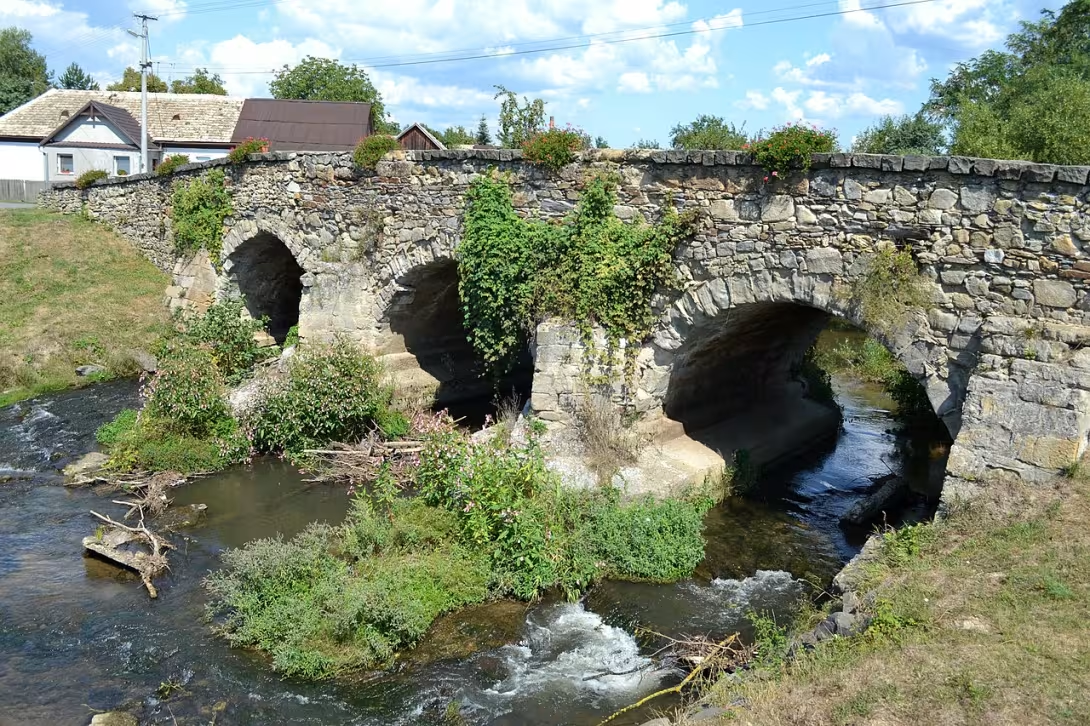

The historical view on the left is a visualisation generated by artificial intelligence and serves as inspiration.
Historical Milestones
- 1900
- Alleged year of construction of the bridge by source
- around 1800
- Construction of a stone road bridge in Poltár
- 1990-years
- Inclusion of the bridge in the Slovak National Register of Monuments
Guide
Show guide text
The text was prepared by artificial intelligence and has not been editorially reviewed. It may contain inaccuracies.
Welcome to Poltár, the heart of the Banská Bystrica region, where history meets everyday life. Right now, you are standing in front of a place that, although at first glance, may seem subtle, carries the silence of many past years. Before you lies the Turkish Bridge, a road bridge that has long served as a link and a witness to time. Stop for a moment, take a breath and see the atmosphere of this place. When you look at it, you may see only a functional structure that allows you to move from one bank to another, but in fact, two worlds are facing you, a combination of roads and stories that have met here for generations.
When we try to remember exactly when this bridge came into being, we encounter a wall of silence. Chronology of its construction is not exactly documented, which makes it one of the local mysteries. We do not know the names of architects who designed its form, nor the names of builders who put their strength and skill into every detail of this structure. Perhaps they were local masters, perhaps traveling builders who were passing through our region at the time. It is this unknownness that gives the Turkish bridge some charm and mysticism. In analogue with other historical buildings in our region, we can only imagine what layers of history this bridge has survived. He witnessed changes in political order, economic booms and periods of decline, and before what became part of the current Poltára, he probably served people at a completely different time when the rhythm of the day determined the sun and the needs of transport were much easier but also more critical.
Now, please take a focused look at the architecture of this object. Since it is a road bridge, its main task has always been functionality and resilience. Look at his overall acquaintance and the way he fits into the surrounding terrain. Perceive his lines and how he connects both sides of the turnkey. Note how time left its mark on the surface of the building. Every crack, every change in the color of the material is like a wrinkle on an old man's face that talks about the storms, frosts, and thousands of feet and wheels that have gone through it. Watch how the bridge connects with the country around you. It's a harmonious connection that doesn't control space, but complements it. Look at how the structure of the bridge relies on the foundation and how it bears the weight not only physical but also historical. Although we do not have detailed architectural plans, the very presence of a bridge in this space tells us about the strategic importance of this place for communication within the community and the wider surroundings.
Although in historical records unknown specific personalities that would be directly connected to the Turkish Bridge, we can imagine thousands of anonymous characters who stopped here. Imagine the merchants who crossed this bridge on their way to the nearest cities with wagons full of goods. Imagine the locals walking to work or to their loved ones every day. There may have been soldiers standing here, perhaps travelers from faraway countries who found a short moment of rest at this point in their journey. This bridge was not just a building block, but a social area where there might have been a change of news, where promises were moved, or where people would be out of town. He is a silent observer of human destinies who has seen everything but has not said anything. Right this anonymity of builders and users makes the Turkish Bridge a universal connection symbol that belongs to everyone who passes through it.
And now we're getting to the most interesting one - the name itself. Why is this bridge called Turkish? It is in this name that the greatest mystery of this place is hidden. In our parts, in the Banská Bystrica region, memories of the period of Ottoman expansion and Turkish wars are deeply rooted in history. Could it have been that the bridge was created at a time when Turkish troops passed through this territory? Or may the name refer to a legend, trade routes traveled by East buyers, bringing with them exotic goods and foreign customs? Perhaps the name Turkish Bridge is merely a folk name that came from misinterpreting an old term or from the influence of someone who once lived and came from distant countries. None of these assumptions are fully documented today, which makes the Turkish Bridge a local riddle. When you're walking on it now, try to think which of these versions seems most likely to you. Often the truth is somewhere in the middle, hidden in forgotten fairy tales that have been told from generation to generation, until they finally turned into the simple title that we see today in maps and guides.
The Turkish bridge is a reminder that not every monument needs gold details, large inscriptions or known names to have its value. Its value lies in its durability, its ability to survive centuries and still fulfil its role. It is an example of how a common road structure can become a symbol of continuity. When you look at it, you don't just see the bridge, but you see the link between the past and the present. It is a place where time stops and we can feel humility before what remains of our ancestors, even if we do not know exactly who they were.
Before I say goodbye and let you go further, I will invite you to enjoy this moment again. Go through the bridge slowly, perceive the sound of the water beneath it and feel stability under your feet. Let yourself be guided by your imagination and try to fill those blank spaces in the history of this bridge with your own thoughts. Maybe it's you who'll feel something the rest of us do.
The Turkish bridge in Poltár remains a silent road guard. Thank you for letting me accompany you in this brief meeting with history. I now invite you to continue to discover the beauty of the Banská Bystrica region and to look for other hidden treasures waiting to be discovered. I wish you a pleasant journey, an inspirational journey, and don't forget that every path we go through teaches us something new about ourselves and the world that surrounds us. Let this day bring you many new experiences. Goodbye and good trip.
Tips for visitors
The best time to visit the Turkish bridge is in the autumn months when the country around Poltár is the most beautiful and the light is ideal for photography. Sunny morning or evening offers the best conditions for fun photography images.
If you choose public transport, it is best to find actual real-time connections via an internet search engine or mobile applications.
When you visit the monument you will get a better impression if you have sunglasses and a water drawer with you. If you have an interesting camera or mobile phone with a good lens, you can enjoy shooting this historic bridge.
Photography of the Turkish bridge is best from various angles, especially from the side of the water. Morning or evening light gives the bridge a romantic effect. The surrounding forests and horizon are also a good background for photography images.
In the vicinity of the Turkish bridge is the historic church of St. Nicholas, which can be visited. For families with children it may also be interesting to visit the zoobal in Poltár, which offers various activities and educational programs for children.
Frequently asked questions
Can the monument be visited?
This is a structure in a public space that can usually be seen from outside free of charge. We have not verified that this particular one is freely accessible.
Where is the monument?
Location: Zelené, Poltár, Banskobystrický kraj. The map on this page shows the exact spot.
Why is the monument protected?
It is listed in the Central List of the Monuments Fund of the Slovak Republic as a national cultural monument (ÚZPF no. 327-528).
For children
Imagine being teleported to the past. It's not a science fiction game, it's a real journey of time. It's 1900. Exactly 126 years ago, a new history began to be written here. At the time, no one had smartphones, Internet, or electric wheels. The world was quieter, slower and full of completely different sounds.
Nearby
🏰 Historic sites (30)
- Uhorské Ceriny 3.4 km
- Kúria - rodinný dom 3.5 km
- Kúria 5.1 km
- Temetodomb 8.3 km
- Kúria 9.1 km
- Ozdín 9.8 km
- Horkovicsova kúria 9.9 km web
- Obecné múzeum 10.3 km +421474291122 web
- J.F.Pustovgar 10.4 km
- Kaštieľ Dolná Slatinka 11.4 km Dolná Slatinka 271/1 web
- Pohanské pohrebisko v Cinobani 11.8 km
- Kaštieľ Opatová 12.1 km
- Slovenský dvojkríž 12.1 km
- Kaštieľ Prónayovcov 12.2 km A. S. Jegorova 202/3
- Kaštieľ Vidiná 12.2 km Zvolenská 123/74 web
- Malovesský kaštieľ 12.7 km Zámocká 54/6
- Kamenná pevnosť na Striebornej 12.9 km
- Kaštieľ Hrachovo 13.3 km Mieru 46/44A
- Kaštieľ Podrečany 13.7 km
- Novohradské múzeum a galéria 13.9 km
🍽️ Restaurants and dining (94)
- Fresh Corner 0.6 km
- Billiard Bar 0.8 km Sklárska 769/82
- Pizzeria and Café Bar 0.8 km Sklárska 740/70
- Orient Bar 0.8 km Sklárska 704/63
- Gogo Bar 0.8 km Sklárska 783/84
- Sweet House 0.9 km +421 915 620 741
- X-Bar 1.1 km
- KPU 1.4 km Obrancov Mieru 486/32 +421 918 220 999 web
- Park café 1.4 km +421 905 701 054
- Pizzeria Kukučka 3.9 km
- Hostinec u Majerov 6.0 km
- Malý Paríž 7.2 km
- Bufet na stanici 7.5 km
- Koliba Ožďany 9.5 km
- Bufet Huta 10.0 km
- Bistro TÜNDE 10.1 km
- Krčma u Ďobana 10.4 km Námestie SNP 50/17
- EURO motorest 11.9 km
- Fresh Corner 12.0 km
- Halier 12.0 km
🏨 Accommodation (14)
- Penzión Iveta 1.3 km Družby 30/20 web
- Ranc MEGI 3.5 km
- Camping Never Finished 4.8 km +421 948 190 997 web
- Miraj Resort 12.1 km +421 473 337 103 web
- Salaš pod Maginhradom 13.6 km +421 903 346 733 web
- Novohrad 13.6 km +421 47 433 1211
- Hotel Slovan 13.6 km +421 474111716 web
- Penzión Pé7 13.6 km +421 940 312 411 web
- Hotel Clavis 13.7 km +421 47 4303838 web
- Hotel Reduta, Best Western 14.0 km +421 47 433 1237 web
- Reduta 14.0 km
- Chata Hámor 14.2 km web
- Pelikán 14.2 km +421 474 330 871 web
- Poľovnícka chata pod Maginhradom 14.9 km +421 903 347 633
🚲 Rentals and sport (10)
- Telocvičňa 6.6 km
- Cyklo SPORT 12.4 km
- Wellness & spa Pod Maginhradom 13.6 km +421 910 717 172 web
- Športová hala 13.7 km
- ssFitness 13.8 km
- Sportcentrum 14.0 km +421 917 840 926 web
- Tenisová hala 14.1 km Maxima Gorkého
- MAX Fitness & Spinning Centrum Lučenec 14.1 km Gorkého 1
- Hillex Studio 14.1 km
- Interbike 14.2 km
🥾 Hiking and nature (126)
- Balajka 2.0 km
- Baranov vrch 2.6 km
- Haškovka 3.0 km
- Dlhý briežok 3.1 km
- Maštinec 3.1 km
- Háj 3.2 km
- U Kurčíkov 3.3 km
- Dubec 3.7 km
- Maštinská voda 3.7 km
- Maštinská voda 4.0 km
- Prameň Pod dubom 4.3 km
- Kozol 4.3 km
- Bôriček 4.5 km
- Kozí vrch 4.6 km
- Nad Vinicou 4.8 km
- Šťavno 4.9 km
- Vinica 5.0 km
- Slaný vrch 5.1 km
- Šťavica pod brezinami 5.2 km
- Hrb 5.3 km
Thematic route
Thematic cruise route: Turkish bridge and around Poltár
1. Turkish bridge (Road bridge) - Type: Historical bridge - Why is it worth visiting: The bridge connects the historical part of Poltár with the surrounding area. Its architecture and history are part of the understanding of the village's past.
2. Old Path - Type: Historical route - Proč is worth a visit: A traveler can walk the old way from the Turkish bridge, which offers a view of historical and architectural elements of the village Poltár.
3. Old Town Hall - Type: Historical monument - Proč is worth a visit: The Old Town Hall is an important historical building near the Turkish Bridge. It's an example of Renaissance architecture.
4. State Museum in Poltár - Type: Historical Museum - Proč is worth a visit: The museum offers an overview of the history and culture of the area, including exhibits from the time of use of the Turkish bridge.
5. Surroundings of the Turkish Bridge - Type: Natural and historical zone - Proč is worth a visit: The surrounding area offers a peaceful view of the town Poltár, which is harmoniously cast into the region.
This route offers a combination of historical and cultural experiences.
Seasonal recommendations
Jaro: A flowering nature surrounds the Turkish bridge in Poltár. Flowers and young leaves of trees make up a pleasant fragranced air. Mild lighting is ideal for shooting without too much sunlight. It is recommended to wear a slack jacket or a cloak as the weather may be irregular. The best time to visit is morning or afternoon.
Leto: In summer, the Turkish bridge is visited by tourists looking for escape from the heat. The atmosphere is full of life and sunlight, allowing longer hours of crossing the bridge. During this period can be in memory of many people, so we recommend a visit earlier in the morning or later in the afternoons. Practical advice includes wearing sunglasses, sunscreen and sufficient drinking water. Slighter clothes are suitable.
Under: In the winter, the Turkish bridge becomes romantic due to colder air and yellow-white nature. The dazzling sunlight in this period is ideal for shooting sessions. Practical advice includes wearing warmer clothing and possibly hats or a jacket to protect against cold. The best time to visit is early mornings.
Winter: In winter, the Turkish bridge surrounds the freezing, beautiful landscape. Sunlight in this period is mild and creates a pleasant environment for visitors. Practical advice includes wearing warm clothes, including jackets, gloves and protective hats. The best time to visit is in the mornings or afternoons.
Visualisations and artistic views


The visualisations are generated by artificial intelligence and serve as inspiration.
Visitor Tips
No tips yet. Be the first!
Log in and add your tip.
Location on Map
More monuments – Poltár
Show all in the town

Visitor photos
No photos yet. Be the first to add a photo from your visit!
Log in and add your photo or leave a rating.
You get more points for a visit verified in the app — we can tell from the GPS that you are there.
Reviews and comments