

calvinist church Church and wall
The Calvinist church and the castle wall in the village Chotín in the Nitra region are Baroque-Classicist sacral buildings from 1792. The building is registered in the Central List of Monument Fund of SR under numbers 12 044/1 (church) and 12 044/2 (church fenced).
The church is a single-boat building with a round cap, entrance hall and a small extension at the cap. Facades are divided by a lysene frame. In the interior there is a flat ceiling; only the hall under the tower is encircled by a rolling vault with lunettes. The stone wall of the wall comes from the same period.
In 1856 the building burned down, resulting in repairs between 1857 and 1862. During the reconstruction was built a square tower with neo-baroque mine, which mounted on the terrace roof ledge with clock. On the tower there is lining the entrance portal of pink marble with a jewel and the Common Era 1792. It was originally located on the front and moved to the tower in 1862.
The inside of the church is on three sides of the village, knapped with a wooden Protestant empora on cast iron columns. Wooden pulpit with a resonant roof decorated with Hungarian folk motifs comes from 1857. The table of the Lord from red marble was made in 1897 in memory of András Zajos, who worked for 12 years as a Presbyter of Chotin Eclesia. The baptistery of red marble with wooden age dates back to the late 19th century. On the inner wall is placed a board for the 400th anniversary of the founding of the Protestant Church (1517 - 1917).
On the outer side wall is a white marble memorial tablet from 1934, dedicated to Calvinist parish priest and galleryman Márton Szentpéteri. There are three bells in the tower, which in 1922 was cast by Richard Herold in Komotau. They replaced the original bells that were seized in World War I to cast cannons. According to the inventory of monuments from 1967 belong to the inventory also tin ceremonial plate from 1681, four tin cone from 1783 and a ceremonial cover from 1786.
Major repairs were made in 1912 and 1992. The church is located in the southeastern part of the village, is in good condition and still serves its purpose.
Tehdy a dnes
Drag the slider and compare how the monument might have looked when it was built with the view today.
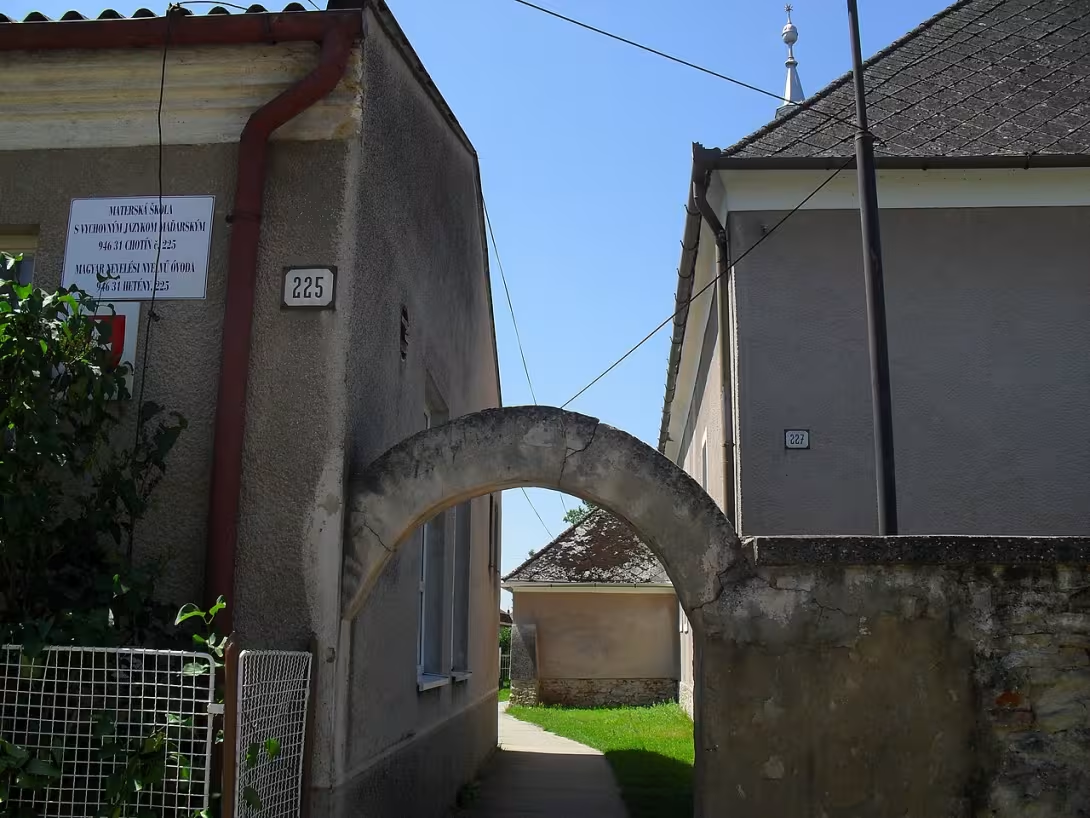
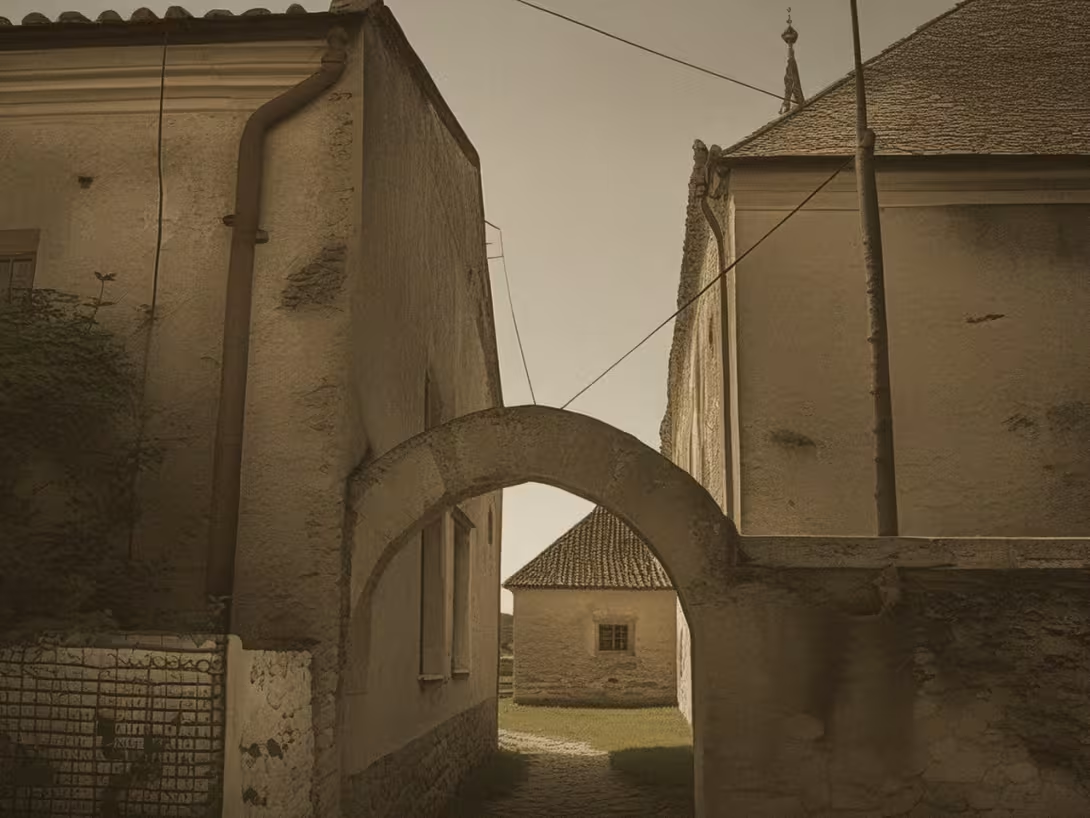
The historical view on the left is a visualisation generated by artificial intelligence and serves as inspiration.
Historical Milestones
- 1792
- construction of the church and the wall
- 1856
- the sacral object burned down
- 1857
- wood pulpit made from hungarian folk motifs
- 1857
- start of repairs after the fire
- 1862
- complete repairs and construction of a square tower
- 1897
- the production of the Lord's Table from red marble in memory of András Zajos
- 1912
- major object repairs
- 1922
- hanging three bells from Richard Herold from Komotau
- 1934
- installation of a memorial plaque to commemorate the priest an
Interesting facts
- It is a Baroque-Classicist sacral building from 1792 with a rock wall. - In 1856 a square tower with neo-baroque mine and clock was built during subsequent repairs. - The wooden pulpit from 1857 is decorated with Hungarian folk motifs. - The table of the Lord from red marble from 1897 was founded in memory of Presbyter András Zajos. - Three 1922 bells replaced the originals that were seized in World War I for casting cannons.
Guide
Show guide text
The text was prepared by artificial intelligence and has not been editorially reviewed. It may contain inaccuracies.
Welcome to Chotín. Right now you are facing an important monument to local sacral architecture, which is the Calvinist church. When you look at it, you will immediately notice that the building is complemented by a stone wall that surrounds the object and gives it a sense of utility and separation from the surrounding space. It is a place that bears in itself traces of time, faith, and perseverance of the local inhabitants who cared for this temple even when difficult moments came.
Let's now look at how this church originated and what its historical context is. The building you see before you dates back to 1792. During this period, not only the church itself was created, but also the mentioned wall. It is a building that combines elements of baroque and classicism, giving it a balanced and elegant look. Although we do not know exactly who the architects of this building were, their work with space and material has created a dominant that still defines the character of this part of the village.
If you look closer to the architecture now, I suggest you take your attention especially to the tower. If you notice it, you will find that its present appearance is the result of dramatic events from the 19th century. Originally the church looked different, but in 1856 it was a disaster and the sacral object burned down. The fire left deep footprints, but the community didn't give up. Already in 1857 intensive repairs began, which lasted several years. It was during this reconstruction, which was completed in 1862, that a square tower was built. Look up to finish it. You'll see the neo-baroque mine and the clock that has been measuring time in Chotín for decades. This tower is a symbol of recovery and a new beginning after a catastrophic fire.
Now I invite you to imagine the interior of this temple, because there are also objects inside with a fascinating story. One of the most important elements is the wooden pulpit. It was produced in 1857, shortly after the fire, during the time when the church returned to life. What makes her special is her decorating. The pulpit is decorated with Hungarian folk motifs, which testifies to the cultural currents and traditions that existed in the region. It is a beautiful example of how folk art and local identity were slipped into sacral space.
Another important detail to draw your attention to is the Table of the Lord. This object is not only a functional part of the liturgy, but also carries a monument character. The table of the Lord is made of red marble and its production dates back to 1897. It was created in memory of András Zajos, which makes it not only a religious object, but also a historical document about the personality that was important to the local community. The contrast of red marble in the interior of the church creates a strong visual accent and reminds us that each generation added something of its own to this space.
When we stop over the overall atmosphere of this place, you may find one interesting thing interesting. The whole complex with a wall creates a feeling of a closed, sanctified area. In combination with neo-baroque mine towers and details in the interior you can see the layering of different periods. From the original Baroque-Classicist foundation from the end of the eighteenth century, through the dramatic fire and subsequent restoration in the middle of the 19th century, to the replenishment of the marble table at the end of the century. It's a story of how the building changes with people who find their spiritual center in it.
Note how harmoniously this church fits into the country of the Nitra region. Although we do not know the names of concrete builders, their work has survived for centuries and today also tells us about the aesthetic perception of the time. The stone wall that surrounds you now is not just a physical obstacle but a line between everyday life and a place of meditation.
I hope this short trip to history has helped you to better understand the importance of the Calvinist church in Chotín. It is a place where architecture, faith and folk art unite. Now you can continue to explore the surroundings peacefully, to perceive the silence of the area, and perhaps to think in a spirit of thought of the people who laid the first stones here over two hundred years ago. Thank you for your attention and we wish you a pleasant crush in the next discovery of the beauties of the Nitra region.
Tips for visitors
Visit the Calvinist church in spring or summer. In this period, the surrounding area is in the flower and natural light highlights the architecture of the wall. You come to Chotín by car or public transport; check your current links in the internet search engine.
We recommend shoes with fixed soles suitable for movement around the wall. Since this is a sacral structure, dress appropriately.
Photos from the exterior capture the overall disposition of the church and the wall. The facade is best taken early in the morning or before the sunset.
Families with children can study the history of Calvinism and the architecture of the wall structures during a walk around the memorial, which will complement the school knowledge.
Frequently asked questions
Can the monument be visited?
Religious buildings are usually open mainly during services; at other times a visit is normally arranged with the parish or the operator. We have not verified specific times.
Where is the monument?
Location: č. 227, Chotín, Nitriansky kraj. The map on this page shows the exact spot.
Why is the monument protected?
It is listed in the Central List of the Monuments Fund of the Slovak Republic as a national cultural monument (ÚZPF no. 231-12044).
For children
Close your eyes and imagine you're passing through time. You travel deep into the past, exactly 234 years back. We're in 1792. There are no cars, no phones or asphalt roads around you. There's only horses and chariots rattleing on rocky paths. Right now in Chotín there is something special. You're standing in front of a building that looks so elegant that kings might start looking at it. It's a Calvinist church that grew proudly toward the clouds.
Nearby
🏰 Historic sites (164)
- Štefan Sečéni 0.0 km
- Trojičný stĺp 5.1 km
- Kaštieľ Zichyovcov 5.3 km Dulovská cesta 178/7
- Pomoc cudzích miest po povodni 5.9 km
- sv. Ján Nepomucký 6.0 km
- Celemantia 7.2 km
- Pamätník obetiam II. svetovej vojny 7.3 km
- Brigetio őrtorny, Limes 7.4 km
- sv. Vendelín 7.6 km
- Pamätník obetiam II. svetovej vojny 7.7 km
- Brigetio Kohors castrum 7.7 km
- Pamätník oslobodenia 7.8 km
- Kaštieľ Fesztyovcov 7.9 km
- Večná sláva bojovníkom 8.1 km
- Trojičný stĺp 8.1 km
- Jókai Mór 8.1 km
- Sv. Ján Nepomucký 8.1 km
- Kúria rodu Javor 8.2 km Komárňanská 51/103
- Mikuláš Konkoly-Thege 8.2 km
- Római kori középület romjai 8.3 km
🍽️ Restaurants and dining (162)
- J&J 5.1 km
- St. Petrus Vini 5.7 km +421 949 152 811 web
- Zelená žaba 5.9 km
- Biely kôň 6.1 km
- ARTÉZ Čárda Iža 6.1 km +421 910 575 642
- Duna büfé 6.6 km
- Fajn shop café 7.4 km
- Nová krčma 7.8 km
- Twins 7.9 km
- Bar Anička 7.9 km
- espresso esso sudán 8.0 km
- Fresh Corner 8.1 km
- Aréna 8.1 km
- Sistag 8.3 km
- Bufet Santa Fe 8.3 km
- Kelt Internet Cafe 8.3 km
- Termál 8.4 km
- Kudy Kebab 8.4 km
- Kaštieľ Steiner 8.4 km +421 35 760 22 19
- Mixi 8.5 km
🏨 Accommodation (29)
- Agroturistická ubytovňa 5.1 km
- Penzión Bokroš 5.6 km +421 918 674 590 web
- St. Petrus Vini 5.7 km +421 949 152 811 web
- Divá Kačica - Reštauracia a Pensión 7.3 km +421907472434 web
- Hotel Carrier 8.5 km
- Rekreačná chata Alenka 8.9 km web
- Hubert Varga 9.4 km Jókaiho 28/19 web
- Penita Restaurant & Pension 9.5 km +421 (0)905 311 714
- Banderium 9.7 km
- Villa Centro 9.8 km Eötvösova 989/5 +421 905 66 00 11 web
- A7 Apartments Komárno 9.8 km +421 915 512 007 web
- Lehár 9.9 km web
- Litovel 9.9 km web
- Olymp 9.9 km web
- Hotel a multifunkčné centrum Danubius 9.9 km web
- Peklo 10.2 km Platanová alej 2436/2436 web
- Hotel Thermál 10.3 km
- Szekeres penzión 10.3 km Svätojánska 3127/12 +421 905 431 665 web
- Solaris Kemping és Üdülőházak 10.4 km Táncsics Mihály utca 34-36 +36 30 563 5841;+36 34 342 551 (extension 13) web
- Aqua 10.5 km
🚲 Rentals and sport (28)
- MOL Nyrt. 7.8 km
- Kajak & kanoe klub Komárno 8.2 km
- Klub turistov Kormorán Komárno 8.7 km web
- Rekreačný neplavecký bazén 9.2 km
- Výukový bazén "Castiglione" 9.2 km
- Plavecký bazén "Castiglione" 9.3 km
- Bazén s termálnou vodou s masážnymi vírivkami 9.3 km
- Detský bazén 9.3 km
- Bazén s termálnou vodou 9.3 km
- Športovo Relaxačné centrum, Bagota 9.5 km
- Univerzitná športová hala 9.5 km
- City Sport 9.7 km
- Arena sport 9.7 km
- Patince 9.7 km
- Krytá plaváreň 10.2 km Eötvösova 3155/41 web
- Piko 10.2 km +421 948 045 115 web
- RC Comorra Off Road Track 10.4 km
- Sportcsarnok 10.4 km
- Thermal 10.4 km
- Zimný prístav Komárno 10.5 km
🥾 Hiking and nature (78)
- Marcelovský park 3.1 km
- Postriežka 5.6 km
- Cinkot 6.4 km
- Holica 6.5 km
- Bašov kopec 7.1 km
- Park Dulovce 7.4 km
- Stará hora 8.1 km
- Postriežka 8.2 km
- Jazierko 8.2 km
- Hurbanovský park 8.5 km
- Najjužnejší bod Slovenska 8.7 km
- Námestie Kossutha 9.2 km
- Bohatský park 9.2 km
- Kostol Božského Srdca Ježišovho 9.2 km Františkánov 84/33
- Evanjelický a. v. kostol 9.4 km Františkánov 77/17 web
- Anglia 9.4 km
- Abov 9.5 km
- Nádvorie Európy 9.5 km
- Kaplnka sv. Anny 9.5 km Jókaiho 2/2 web
- Rác kert 9.6 km
Thematic route
The proposed thematic route within the monument area:
1. Calvin church - Reformed church in which you can see architecture and interior. 2. Garden Wall - Historical fortification, which testifies to the defence character of the complex. 3. Courtyard and area - Walk around buildings in Chotín, where you will see the scope and layout of the area.
Seasonal recommendations
In spring, the surroundings of the Calvinist church in Chotín will wake up to life, and nature around the wall will start to bloom. The sun provides natural lighting during this period, which highlights the details of the historical masonry. We recommend visiting the place in the morning. Due to variable spring weather, it is advisable to wear layers and wear comfortable shoes.
The summer season brings intense lighting and rich colors of the country of Nitra region. In the main season there may be more visitors around the sights. We recommend arriving early in the morning or late in the afternoon to avoid the strongest heat. It is practical to wear a hat and water, while clothing should be light and airy.
Autumn is a period of colorful contrasts in Chotín, when the leaves of the trees around the church change color to gold and red. Soft autumn light creates suitable conditions for photographing the wall. Due to colder morning and evening temperatures, it is advisable to wear a warmer sweater or light jacket. During this period the attendance is lower.
Zimą acts sacral building and its fortification stricter, especially if the landscape covers the snow. The atmosphere is quiet and freezing. When visiting, choose warm, waterless clothing and high quality winter shoes to avoid colding while circumventing the exterior of the monument.
Visualisations and artistic views


The visualisations are generated by artificial intelligence and serve as inspiration.
Photographs from the area
Real photos taken near the monument


Source and licence are given for each image.
Visitor Tips
No tips yet. Be the first!
Log in and add your tip.
Location on Map
More monuments – Chotín
Show all in the town



Visitor photos
No photos yet. Be the first to add a photo from your visit!
Log in and add your photo or leave a rating.
You get more points for a visit verified in the app — we can tell from the GPS that you are there.
Reviews and comments