








františkánsky kláštor Monastery
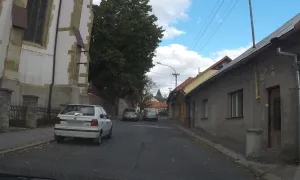
Franciscan monastery and the Church of All Saints in Humenné in Prešov region are Gothic sacral complex from the 14th and 15th centuries. The complex was founded by the Drugets family who supported the arrival of the Franciscans in Humenné. Originally, both buildings were dedicated to the Virgin Mary.
In 1529, the city suffered a major fire, with the church and monastery completely burned down. The monastery died on time. The restoration took place only after the arrival of the Jesuits in Humenné. In 1642 the southern chapel was added to the church. In 1676, the armies of Imrich Tököli burned down. The repairs were completed at the end of the first period of the 18th century. In 1735 a marble altar was built into the enchanted southern chapel. In 1765 the ship was encircled and organ chorus was built, which confirms the number above the entrance portal. Common interior repairs took place in 1816, 1906 and 1911. During the last repair of 1911 the original three-letter and flaming circles of Gothic windows were replaced by faithful copies and a modified shield of entrance facade following the 14th century pattern.
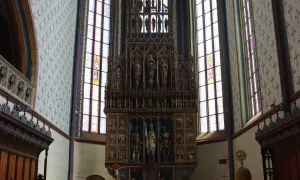
The entrance to the church is located on the west side next to the monastery. The west facade consists of a smooth triangular shield with falling and cross. The atrium contains an entrance portal with blind tympanum and two blind windows with refractive arches, while the Gothic discoveries of the portal are preserved. On the facade there are two broken windows with circles in the form of a three leaf and a double plaque. The main ship and the presbyterium have a common gable roof, on which is located the sanctusník. The bell tower has broken windows with rings. On the south side there is a side chapel with a polygonal cap and a gable roof. The church is based on one divided pillar with roofs. Gothic windows with broken arch are decorated with stained stains of the work of Mikuláš Klimčák. The monastery is a three-wing building, which together with the northern wall of the church consists of a courtyard, a so-called paradise garden, surrounded by a cross corridor.
The church is a one-ship Gothic building with a polygonally completed sanctuary. Architectural elements date back to the 15th century. In the end of the presbytery there is a late-gothic star vault with a shiny slender ribs, in the other two fields there is a net vault. The ribs end on pyramidal brackets. The ship has baroque vaults on the wall pillars. The chapel has a Baroque pseudogothic vault with stucco ribs forming Gothic starfish. In the western part of the ship there is a baroque cliff with boils and the hallway is encircled by wall. The two-storey building of the monastery preserves elements from the 17th and 18th centuries, while the rooms have ridge vaults.
The main altar in the sanctuary rests on four columns of red marble and stone menze. It is a neo-Gothic wooden work by Jozef Riffeser Altábauer from 1900 Tirol, depicting the Hungarian patrons who pay tribute to the Virgin Mary: the kings of Stephen, Ladislav and Imrich, Queen Elizabeth and Blah. Margita of the Arpads. On the sides are Saint Gerard and Asrik. In the middle there is a double Tabernaculum that is fluffed by four Gospelists and four Gothic angels. Virgin's Altar Mary Karmelska from 1900 from Tirol is a neo-Gothic, made of stone and artificial stoneware with red marble; it contains statues of Our Lady of Carmelska, St. Anna and Theresa. Saint John's altar Nepomuk is neo-Gothic of stone and artificial stone with marble columns. It contains statues of St John Nepomuk, Anton Paduansky and Bonifác made of white stone, while the relics of St Bonifác are stored under the minzam. The altar of the Holy Cross is a neo-Gothic stone object from Tirol.
The area is registered by the Monument Office of the Slovak Republic under the number ÚZPF 110. It consists of the church of Roman Catholic All Saints and the Convention of Franciscans and Jesuits. The construction testifies to the historical development of religious life in the region and preserves the elements of several architectural eras.
Tehdy a dnes
Drag the slider and compare how the monument might have looked when it was built with the view today.
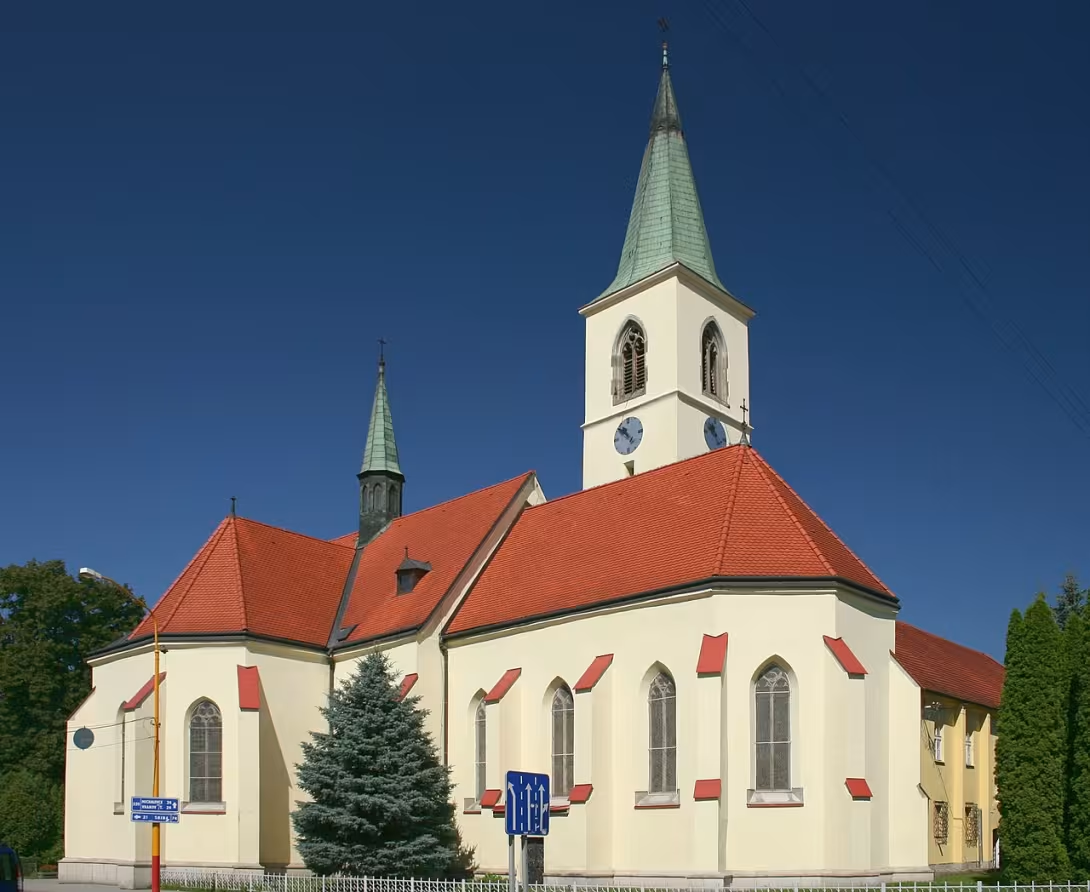

The historical view on the left is a visualisation generated by artificial intelligence and serves as inspiration.
Historical Milestones
- 14th century: the arrival of Franciscans in Humenné at the initiative of the Drugets
- 14th and 15th centuries: building a church and a monastery
- 1529: complete burnout of the monastery in a major city fire
- 1531: early extinction of the franciscan monastery
- Restoration of the monastery upon the arrival of the Jesuits
- 1676: Reburn after the destruction of Imrich Tököli's troops
- end 1.third 18th century: repair of the monastery
Restoration history
| Years | Type | Extent | Condition after restoration |
|---|---|---|---|
| 2022 |
Obnova
farský kostol Všetkých svätých |
Čiastočná | dobrý |
| 2019 |
Obnova
farský kostol Všetkých svätých |
Časť obnovená komplexne | dobrý |
Source: Monuments Board of the Slovak Republic — open data, licence CC BY 4.0
Artistic features
-
vitráž dekoratívna s nápisom — Nápis
sklo, vkladanie do siete · moderna · 1951-1960 -
vitráž figurálna štylizovaná — Anjeli
sklo, vkladanie do siete · moderna · 1951-1960 -
vitráž dekoratívna s nápisom — Nápis
sklo, vkladanie do siete · moderna · 1951-1960 -
vitráž figurálna štylizovaná — Narodenie Krista
sklo, vkladanie do siete · moderna · 1951-1960 -
vitráž figurálna štylizovaná — sv.Matúš Evanjelista,sv.Marek Evanjelista
sklo, vkladanie do siete · moderna · 1951-1960 -
vitráž figurálna štylizovaná — Anjeli
sklo, vkladanie do siete · moderna · 1951-1960 -
vitráž figurálna štylizovaná — Mojžiš,sv.Ján Krstiteľ
sklo, vkladanie do siete · moderna · 1951-1960 -
vitráž figurálna štylizovaná — sv.Juraj
sklo, vkladanie do siete · moderna · 1951-1960 -
vitráž figurálna štylizovaná — sv.Cyril,sv.Metod
sklo, vkladanie do siete · moderna · 1951-1960 -
vitráž figurálna štylizovaná — Zmŕtvychvstanie Krista
sklo, vkladanie do siete · moderna · 1951-1960 -
vitráž dekoratívna s nápisom — Nápis
sklo, vkladanie do siete · moderna · 1951-1960 -
vitráž figurálna štylizovaná — sv.Lukáš Evanjelista,sv.Ján Evanjelista
sklo, vkladanie do siete · moderna · 1951-1960 -
vitráž figurálna štylizovaná — Zbor spievajúcich anjelov
sklo, vkladanie do siete · moderna · 1951-1960 -
vitráž figurálna štylizovaná — sv.Peter,sv.Pavol
sklo, vkladanie do siete · moderna · 1951-1960
Source: Monuments Board of the Slovak Republic — open data, licence CC BY 4.0
Heritage surveys
-
2019 — Architektonicky-historícký výskum
Čiastkový pamiatkový výskum
Interesting facts
- Franciscan monastery and All Saints Church are Gothic sacral complex from the 14th and 15th centuries. The complex was founded by the Drugets family who supported the arrival of the Franciscans in Humenné. - In 1529, the city suffered a major fire, with the church and monastery completely burned down. - After repairs at the end of the first third of the 18th century, a marble altar was built into the enchanted southern chapel in 1735. - Gothic windows with broken arch are decorated with stains of the work of Mikuláš Klimčák.
Guide
Show guide text
The text was prepared by artificial intelligence and has not been editorially reviewed. It may contain inaccuracies.
Welcome to Humenne, the heart of Eastern Slovakia. You are facing one of the oldest and most important sacral complexes in this region. In front of you, the gothic structure has preserved its dignity for centuries. It's a Franciscan monastery, along with the Church of All Saints. Since you are just in front of this monument, take a moment to see the overall atmosphere of the place. Although accurate dating is not clearly established in historical records, we can safely say that it is a work from the 14th and 15th centuries. This timeline is crucial for understanding the context in which this building originated.
To understand why the Franciscans are here, we need to look at the history of Humenné. At this time Humenné was an important city that developed under the auspices of prominent noble families. It was the Drugets' family that played a key role in setting up this complex. These powerful gentlemen supported the coming of the Franciscan Order into the city. Why the Franciscans? This counsel, founded by Saint Francis of Assisi, was known for his poverty, humility, and closeness to ordinary people. The presence of such monks was valuable to the urban population, since the Franciscans devoted themselves not only to prayer but also to education, preaching and social assistance. The Drugets ' family demonstrated not only their piety but also their political and economic strength. Support to the monastery was an investment in the mental and cultural life of the city.
Now that we know who initiated this construction and why, let's see what you see in front of you. The complex consists of a church and monastic complex. Although the details of architecture may be difficult for a layman at first sight, pay attention to the overall shape and material. It is a gothic construction, which means that you look for characters typical of this period, such as pointed arches or vertical orientation of the space. Since the exact names of architects are unknown, we can only admire the craft skills of builders who worked in the 14th and 15th centuries. Looking at the facade, note how the building integrates into the surrounding environment. Humenné has a rich building history and this complex is an integral part of it.
The history of this building, however, was not painless. One of the most important points in the chronology of this place is the year 1529. This year the city of Humenné suffered a big fire. It was a tragic day that changed the kidneys of the city. The fire was so strong that the church and the Franciscan monastery completely burned out. Imagine this scene: the flames surrounding the Gothic walls, the smoke rising to heaven and the loss of invaluable artifacts and books found in the monastery. This was a huge loss for the city and for the council. The fire in the 16th century was a common threat to the wooden buildings, but the loss of the sacral centre was particularly painful.
After this tragedy, however, the story does not end. The Franciscans and the city decided to rebuild the building. Repairs lasted and in the late 16th century the complex was again operational. This restoration is a testimony to the determination and faith that led people back then. Although the original Gothic form could be partially lost or modified during reconstruction, the basic character of the building was preserved. Today, when you look at it, you see the outcome of this long process - the original foundation, the disaster and the subsequent restoration.
The very fact that this building survived such a shocking fire and is still standing is an interesting thing to do with it. In many cases, after a complete burnout of the building, it would be stormed and a new one, often in a different style. However, there has been reconstruction, indicating that the original Gothic structure was sufficiently firm or that the restoration was carried out with respect to the original spirit of the site. The church of all saints has its symbolism. Understanding this festival and its connection with the Franciscan tradition can be another source of inspiration for the visitor.
When you look around, you will find that the monastery is not an isolated building, but is part of a living city. Humenné is a town with a long history that has preserved its charm and authenticity. A walk around this complex allows you to see how medieval and early-age layers of history intersect with modern life. The Franciscans worked here for centuries and their presence affected the cultural and spiritual life of the region. Although you cannot meet monks in traditional robes today, as in the past, the atmosphere of silence and respect surrounding sacral monuments is still felt.
Why is it important that we protect and visit these places? Because they're physical testimonials of the past. Every stone, every wall bears the story of the people who lived here, prayed and worked. The Druget family, Franciscan monks, builders who repaired fire damage - all these groups of people left their mark. When you stand before this monument, you are part of this chain. Your presence here today is a continuation of tradition of admiration and respect for history.
If you have the option, take time to observe the details that interest you. There is no need to be a historian to appreciate the beauty and durability of this building. Just stop and take a deep breath and let the environment affect you. Humenne offers many other monuments and places worth visiting, but this complex of Franciscans and the church of All Saints is undoubtedly one of its gems.
Finally, I would like to say that history is not just about dates and currencies. It's about the feeling it makes us feel. When you say goodbye to this place, let not only the image of the Gothic walls but also the story of determination, faith and restoration remain in your memory. The fire in 1529 was a turning point, but not an end. It was the beginning of a new chapter that led to what you see today.
I wish you a pleasant continuation of the trip after Humenne. May these places bring you peace and inspiration. If you continue your walk, be sure to note how the city buildings are changing and how the legacy of the past is manifested today. Humenne is a city that deserves to be discovered slowly, with respect to its history.
Thank you for
Frequently asked questions
Can the monument be visited?
Religious buildings are usually open mainly during services; at other times a visit is normally arranged with the parish or the operator. We have not verified specific times.
Where is the monument?
Location: Brestovská 113/3, Humenné, Prešovský kraj. The map on this page shows the exact spot.
Why is the monument protected?
It is listed in the Central List of the Monuments Fund of the Slovak Republic as a national cultural monument (ÚZPF no. 412-110).
For children
Imagine that you will reach the old town of Humenné from the 14th and 15th centuries, where everyone can see a beautiful Franciscan monastery. This monastery is like a hidden treasure full of secrets and adventures. It is a place where heroes met with prayers and miracles in the past.
Nearby
🏰 Historic sites (73)
- sv. Štefan Pongrác 0.0 km
- Vihorlatské múzeum 0.2 km Námestie slobody 1/1 +421577752240 web
- Bitka pri _Humennom 0.2 km
- Mons. Alexius Toronský 0.2 km
- Oslobodenie mesta 0.2 km
- Milan Rastislav Štefánik 0.3 km
- Pamätník vďaky, družby a vítazstva 0.3 km
- Ladislav Grosman 0.3 km
- Obchod na Korze 0.3 km
- Galéria mesta Humenné 0.4 km Gorkého 1556/3
- Pamätník 1.sv. vojny 0.4 km
- Expozícia ľudovej architektúry a bývania (skanzen) 0.4 km web
- sv. Ján Nepomucký 0.5 km
- Underbridge Gallery 0.5 km
- Praveká mohyla 1.1 km
- Coop Art Gallery 1.1 km Družstevná 24
- Grófka 2.4 km
- Partizánskej skupine Pugačeva 4.2 km
- Spomienkové miesto milovníkov prírody 4.3 km
- Jasenov 5.2 km
🍽️ Restaurants and dining (75)
- Duna Cafe 0.1 km
- Off Road Pub 0.1 km
- U Baka 0.2 km
- Bistro Atlantik 0.2 km Mierová 35/15 +421 917 042 695
- Daisy 0.2 km
- Bowling 0.2 km
- Pionjer 0.2 km Mierová
- Bergamo 0.3 km
- KP-12 0.3 km
- Slovakia 0.3 km Gorkého 1555/1
- Freddie's Pub 0.4 km
- Dukla 0.4 km web
- History Art & Music Club 0.4 km +421 918 538 954 web
- Kaviareň Harlekýn 0.4 km +421 905 577 194
- Annam Ázijská reštaurácia 0.4 km 26. novembra 5126/5
- Jezz cafe 0.4 km
- L-Cis 0.5 km
- Pizza & Kebab Fontána 0.5 km
- Bon Bon chocolateria & caffee 0.5 km
- 66 Burger 0.6 km +421 915 145 433
🏨 Accommodation (21)
- Milénium 0.6 km Štefánikova 5308/39 web
- Karpatia 0.7 km Čsl. armády 1377/26 web
- Alibaba 0.7 km
- Penzión Aston 1.9 km
- Admiral 7.4 km
- Chata Zálomka 8.3 km web
- Chemik 8.6 km
- Janka 10.8 km
- Madagaskar 11.2 km
- Chata Šumná Voda 13.0 km +421 904 903 844 web
- Chata Klin 13.3 km web
- Chatová osada Zrub 14.2 km
- Penzión Odysea 14.2 km
- Táborisko rekreačná oblasť Vinianske jazero 14.3 km
- La Rosa 14.4 km
- PZ Čičva 14.4 km
- Penzión Prameň 14.4 km
- Hotel Vinnay 14.4 km
- Vila Jazero 14.5 km
- Penzión Lucus 14.6 km
🚲 Rentals and sport (11)
- diamir 0.5 km
- Intersport 1.1 km
- Mestská športová hala 1.1 km Chemlonská 5907/7
- Atletický štadión 1.1 km Hrnčiarska web
- 1. Tenisový klub Humenné 1.1 km
- Krytá plaváreň 1.1 km Chemlonská 1963/4 web
- Kúpalisko Humenné 1.2 km web
- Elite Trainings Fitness Club 1.3 km
- YogiWay 1.9 km web
- Biokúpalisko 3.1 km
- LACO - Požičovňa vodných bicyklov 14.5 km
🥾 Hiking and nature (229)
- mini modely kostolov 0.0 km
- Park pri kaštieli 0.2 km
- Park Mieru 0.3 km
- Kalvária 0.5 km
- Kalvária 0.7 km
- Výhľad z cintorína 0.7 km
- Park Jednička 0.7 km
- Park blahoslavenej Zdenky Schelingovej 0.9 km
- Šibeničná hora 1.5 km
- Kotnová 1.8 km
- Studnička Barančov (1. geostudnička) 1.8 km
- Barancov 1.9 km
- Holá hora 1.9 km
- Studnička Hubková 2.5 km
- Hubková 2.6 km
- Sihotok 2.8 km
- Sokol 3.1 km
- Nad Lazčíkom 3.1 km
- Čiernuška 3.2 km
- Potoky 3.6 km
Thematic route
Thematic tour route from Humenné
1. Franciscan monastery Type: Historical monument Why it is worth visiting: Visit interiors with frescoes and church.
2. St. Nicholas Church Type: Church Why it is worth visiting: Church with artistic elements.
3. Urban Museum Type: Museum Why it is worth visiting: In the museum you will learn about the history and culture of Humenné. The exhibition depicts the life of the city in the past and present.
4. Park at the monastery Type: Park Why it is worth visiting: Park intended for rest and walks.
5. Humenne Square Type: City Square Why it is worth visiting: Square with city architecture and visitor attractions.
The route leads through the historical and cultural monuments of Humenné.
Seasonal recommendations
Jaro: The Franciscan monastery in Humenne in spring will turn into a lively and full color natural paradise, where various herbs and trees blossom. It is an ideal time for visitors who love natural beauty when the roads in the monastery are especially accessible. Practical advice: visit the monastery in the morning, when the temperature is comfortable and the crowds are not as dense as in the following hours; it is recommended to wear lightweight clothes with a scarf or jacket for any cold windy moments.
Leto: In summer, the Franciscan monastery is in the town of Humenne, where visitors seek escape from the heat. The monastery area offers a cool space idealized for relaxation or short movements after the monastery. In the main summer season you may be able to experience more attendance, so it is good to arrive early in the morning or at the end of the day. Practical advice: wear soft clothing and a protective coat against sunlight inflammation; keep hydrated, especially in the upper temperature.
Podzim: Franciscan Monastery in Humenne is in the foothills beautiful with a specific atmosphere when falling leaves change the color of the surroundings and add romantic and meditative tone to the monastic environment. It is an ideal time for long - suffering visitors to visit peacefully without other attractions that could increase crowds. Practical advice: wear a warm jacket and shoes suitable for irregular surfaces because cold or day rains may come; trips during sunny days are the most acceptable.
Winter: In winter it offers a Franciscan monastery in the Humenné atmosphere when the surrounding area is covered with snow and the trees reveal their cold pits. Monastery prostor becomes a place for meditation and relaxation in a pleasant, winter environment. Practical advice: wear top layers of clothing and protective footwear on snow or ice; plan your visit at a time when the sun is above the horizon.
Visualisations and artistic views


The visualisations are generated by artificial intelligence and serve as inspiration.
Photographs from the area
Real photos taken near the monument


Source and licence are given for each image.
Visitor Tips
No tips yet. Be the first!
Log in and add your tip.
Zdroje a literatura
The factual basis for this text was the article na Wikipedii, whose authors are Wikipedia contributors. The article is available under the licence CC BY-SA 4.0.
Location on Map
Visitor photos
No photos yet. Be the first to add a photo from your visit!
Log in and add your photo or leave a rating.
You get more points for a visit verified in the app — we can tell from the GPS that you are there.
Reviews and comments