








ľudový dom Vernacular house
In the village Podhranice in the Nitra region there is a folk house, which is classified as a national cultural monument under the number of ÚZPF 233-1529. According to data from the Monument Office of the Slovak Republic, this object comes from the first half of the 20th century and its architecture belongs to the category of folk architecture.
The area registered under number ÚZPF 1529 consists of one object. It is a folk house with brick structure, which was created in the early 20th century.
The monument is situated at No. 224 in the village of Pohranice. Its location is determined by coordinates 48.33258, 18.18228. The building is protected as a national cultural monument.
This house is a preserved example of folk construction in the village of Pohranice. It is an object that documents the architecture of the time.
Tehdy a dnes
Drag the slider and compare how the monument might have looked when it was built with the view today.
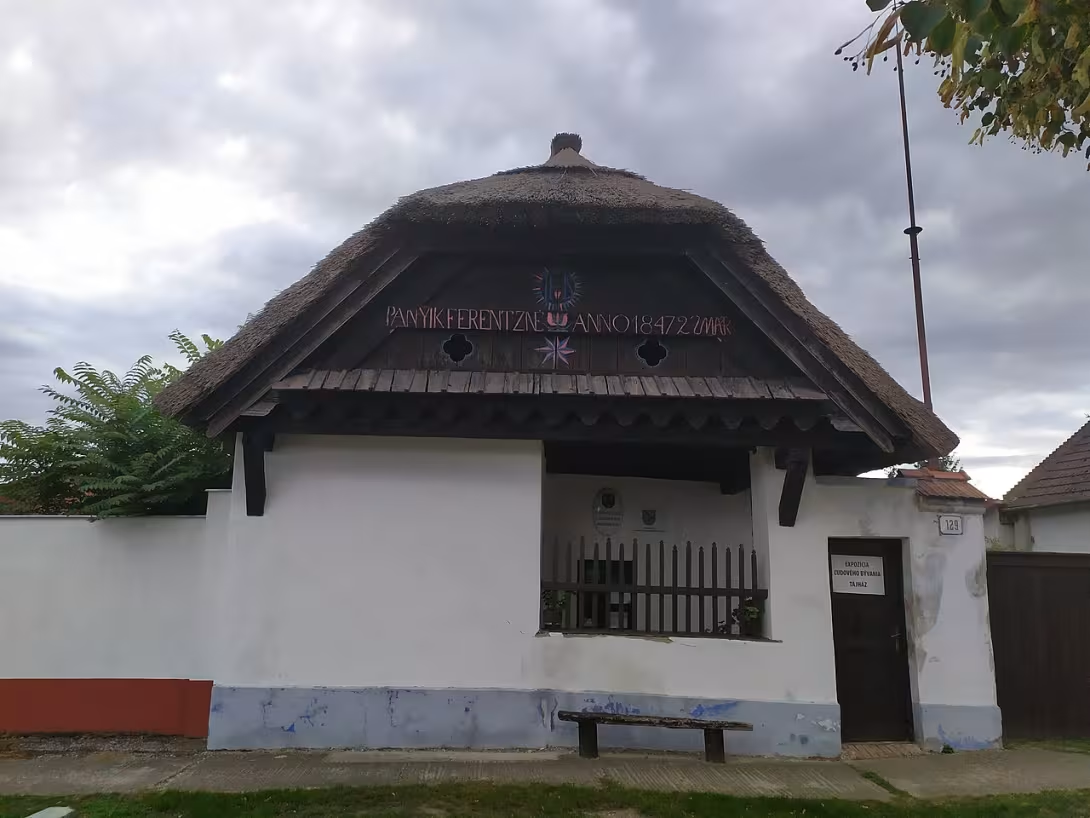

The historical view on the left is a visualisation generated by artificial intelligence and serves as inspiration.
Historical Milestones
- 1900-1950
- Creation of a folk house with a brick structure in the village of Pohranice.
- 2000
- The beginning of the 21st century, the period when the object was probably included in the register.
Guide
Show guide text
The text was prepared by artificial intelligence and has not been editorially reviewed. It may contain inaccuracies.
Welcome to the Border. You have just stopped at a place that offers you an opportunity for a short stop moment and a look to the depth of time. You stand by the House of Folk, an object that carries the silent power of tradition and authenticity. Look at it. At first glance, he may seem like an ordinary structure, but if you look at it knowing that he is a living witness to history, he will begin to reveal his secrets to you. Feel this atmosphere. In this part of the Nitra region, where history meets everyday life, this house has its inalienable place.
When you look at his silhouette, you might wonder exactly when it was built. It is one of those questions, but history does not give us an immediate answer. The exact period of creation of this house remains unknown. Neither the names of the architects who outlined his form in his lines nor the names of the people who made his construction. This may seem like a lack of information, but in reality it is this uncertainty that is fascinating. This house does not belong to one particular year or one famous builder. It belongs to all those who lived here and to all those who respect the folk's. It is a product of collective consciousness, a result of an age-old tradition that has evolved naturally in this country.
Let's take a closer look at his architecture together. Although we do not have precise architectural plans, you can notice right now what is so typical for folk architecture - harmony and functionality. See how this structure is incorporated into your environment. Look at her facade. Notice how the texture works and how light breaks. In folk architecture it was not about the perfection of geometric lines, but about the ability of the building to resist time and at the same time be a solid part of the landscape. Feel this simplicity that hides immense depth. Every detail you have right before your eyes is the result of a pragmatic approach to life, where every part of the building had its purpose and each line was dictated by the needs of the people who lived here.
Now that you have looked at the overall shape of the house, pay attention to its details. Look at the way the construction meets the soil under your feet. Perceive the stability it radiates. Although we do not know the names of the specific persons who built this house, we can imagine their hands, their efforts and their efforts to create a home that is safe and durable. This house is not just a set of materials, it is an expression of the lifestyle of people who once lived here their days, seasons and centuries.
Although there are no big names in the historical records of this place that are written in gold in the textbooks, here is the greatest story. It's the story of strangers. It's a story of everydayness that forms the very basis of our culture. Every corner of this house, every wall you now observe, reflects the lives of the inhabitants of the Piers. You can imagine the rhythm of their work, the silence of their evenings and the noise of their days. This house witnessed the joys and concerns of ordinary people who built their lives here without the need for glory or great monuments. It is this anonymity that gives the place a special, almost sanctified character.
And here we come to something you might be interested in. There's a mystery that this folk house carries inside. It's this unknown chronology, this empty chapter in our records. What happened to the names of those who lived here? Why were their stories lost in time? This uncertainty makes us think. What is time, anyway? Is it just a corollary of years, or is it something more? Perhaps this house exists precisely to remind us that not everything in life has to be named and registered precisely in order to have value. Some things are perceived with the heart, not in documents. This silent presence unknown is what makes this object alive and fascinating even after long years.
Stop for a moment and just feel the environment. Get carried away by the atmosphere of this place. The folk house is not just a monument, it is a bridge between us and those who were before us, although no one knows their names anymore. It is an invitation to discover our own roots and to understand that history is not only great battles and royal courts, but mainly life in its purest, easiest form.
I believe that this brief look at the House of Folk gave you space to think about and to experience the rest of your visit more receptively. Let yourself be inspired by this silent witness of the past. Continue to discover the Plots and see the beauty in every detail that offers you the way. Thank you for being with us. We wish you a pleasant and rewarding rest of the day.
Tips for visitors
The least visitors are during autumn and spring. In the morning and late afternoon they provide scattered light suitable for shooting facades and courtyards.
It can be reached by public transport or by car.
Visitors should take comfortable shoes and water.
In a 30-minute drive there is a municipal museum and historical church.
The surroundings of the house are suitable for families with children, because the terrain is flat and the space is open.
Frequently asked questions
Can the monument be visited?
This is a residential or farm building, not a museum with opening hours. Please view it from public space and respect the owners' privacy. We have no information about access to the interior.
Where is the monument?
Location: č. 224, Pohranice, Nitriansky kraj. The map on this page shows the exact spot.
Why is the monument protected?
It is listed in the Central List of the Monuments Fund of the Slovak Republic as a national cultural monument (ÚZPF no. 233-1529).
Nearby
🏰 Historic sites (157)
- János Esterházy 0.1 km
- Dávajte pozor! 2.0 km
- sv. Ján Krstiteľ 2.9 km
- Padlým v 1. a 2. svetovej vojne 2.9 km
- Kaštieľ Malanta 2.9 km
- sv. Vendelín 3.1 km
- Múzeum Podzoboria 3.1 km +421 907 890 753
- Múzeum Jánosa Esterházyho 3.5 km web
- Hrádok Ťúkol 4.5 km web
- Hradisko Žibrica 4.6 km
- Milan Zbranek 5.3 km
- Tribečské múzeum minerálov 5.7 km +421 948 099 555 web
- Hradisko Zobor 5.7 km
- SNP 5.8 km
- Miléniový pamätník 5.8 km web
- Karol Duchoň 5.9 km
- Múzeum rodu Forgách 5.9 km web
- sv. Július 5.9 km
- Kaštieľ Forgachovcov 6.0 km web
- Slovenské poľnohospodárske múzeum 6.0 km web
🍽️ Restaurants and dining (344)
- Mlyn u Anastázie 0.1 km web
- Hostinec u Zemanov 3.2 km
- REŠTAURÁCIA PENZIÓNU LAPÁŠ U HOFFERA 4.3 km +421 903 444 583 web
- Hrnčiarovská pizza 4.5 km +421 911 523 966 web
- Krčma u bosorky 4.6 km
- kaviareň lúčky 4.9 km
- U Krba 5.2 km
- Zoborská dreváreň 5.3 km +421 908 131 071
- Fajn shop café 5.5 km
- Café Bar Koker (u Trnku) 5.5 km
- U Traka 5.5 km
- Mikov dvor 5.7 km
- Pohostinstvo Orion 5.7 km
- Záhrada 5.7 km
- Tremes 5.8 km
- Gypsy pub 5.8 km
- Restaurant Flash 5.8 km
- Autopresso nonstop 5.8 km
- KEBAB BISTRO 5.8 km Chrenovská 5152/34
- Žalár 5.8 km
🏨 Accommodation (67)
- Penzión Lapáš u Hoffera 4.3 km
- Penzión Lux 5.1 km Gorazdova 1586/58 web
- Penzión u krba 5.2 km Gorazdova 472/56 web
- Ubytovanie 5.3 km
- Ubytovanie Pri strelnici 5.5 km
- Vila Hubert 5.5 km
- Ubytovanie Zobor 5.5 km web
- Penzión Tofi 5.6 km web
- Pohoda 5.8 km
- Zámok u Grófa 5.9 km +421 903 223 525 web
- Hotel tenis 6.1 km
- Vila Aria 6.2 km web
- Zoborská pivnica 6.3 km
- Zámocká koruna u Hoffera 6.3 km
- Zlatý Kľúčik 6.3 km
- ARTin 6.3 km Svätourbanská 2565/49 web
- ŠD Hospodárska 8 6.5 km
- Ubytovňa Dara 6.5 km
- Hotel Agroinštitút 6.8 km +421 37 7910 111 web
- Internát SPU 6.8 km
🚲 Rentals and sport (51)
- Terra Klub 5.2 km +421 948 570 714
- SKI DOMIVO 5.3 km
- Športový areál 5.5 km
- Oprava bicyklov 5.7 km
- Cyklopoint 5.9 km
- Belda sport 5.9 km +421 907 947 362 web
- Tenisové kurty Chrenová 6.0 km web
- Gym klub 6.0 km
- Fit Club Olympia 6.0 km Chrenovská 22/16
- HOPLALAND 6.1 km web
- Endura 6.1 km
- EXIsport 6.7 km
- Sportisimo 6.7 km
- 4F 6.8 km
- Belda Sport 6.8 km
- Intersport 6.8 km
- Hoplaland 6.8 km web
- SOC Trade 6.8 km
- Fanshop HK Nitra 6.8 km
- Jump Arena 6.8 km web
🥾 Hiking and nature (85)
- Kolíňanský vrch 2.0 km
- Kadaň 2.6 km
- Kolíňanská čertova diera 3.3 km
- Prameň Gáborka 3.8 km
- Vápenník 3.9 km
- Brezina 3.9 km
- Zvislá jaskyňa 4.0 km
- Haranč 4.1 km
- Žibrica 4.5 km
- Božia Studňa 4.9 km
- Janikovská studnička 4.9 km
- Janíkovský kopec 5.1 km
- Perpác 5.2 km
- Vašinovský park 5.6 km
- Zobor 5.6 km
- Zobor 5.7 km
- Prameň na Martinskej 5.7 km
- Via Ferrata Zobor 5.8 km web
- Zobor 5.8 km
- Pyramída 5.8 km
Thematic route
Route of folk house in the border
1. Folk House (Foundations) - destination route with original equipment. 2. Church of St. Michael (Pohranice) - neobaroque church from the 18th century on the outskirts of the village. 3. Castle (Handscapes) - ruins of the castle from the 17th century, which now function as a museum centre.
The route is approximately 2 km long and begins at the folk house, where there are exhibitions about the history of the village. The road to St. Michael's Church takes about 10 minutes on foot, the castle is a few minutes walk away. The whole shop lasts about an hour.
Seasonal recommendations
Seasonal recommendations for visiting the historical monument.
Panatka: Folk House (Folk House), Border, Nitriansky region Status:
JARO: The specific lighting is through flowering greenery and sunny days. The atmosphere is full of optimism and effort. Practical advice: visit the memory in the time before the weather when the crowds are smaller. The best time to visit is morning or afternoon.
LÉTO: Specific is warm weather and fruitful fields. The atmosphere is full of energy and joy. Practical advice: Don't remember the excellent clothes against sunlight and remember that crowds are larger than in other seasons.
SUBSIDISATION: The specific lighting is shiny through daylight and green nature. The atmosphere is full of effort and present. Practical advice: Visit the memory before winter when the crowds are smaller. The best time to visit is morning or afternoon.
ZIMA: Specific is snow weather and dark nature. The atmosphere is full of mysticism and effort. Practical advice: Remember warm clothing and remember that crowds are larger than in other seasons. The best time to visit is morning or afternoon.
Visualisations and artistic views


The visualisations are generated by artificial intelligence and serve as inspiration.
Visitor Tips
No tips yet. Be the first!
Log in and add your tip.
Location on Map
More monuments – Pohranice
Show all in the town


Visitor photos
No photos yet. Be the first to add a photo from your visit!
Log in and add your photo or leave a rating.
You get more points for a visit verified in the app — we can tell from the GPS that you are there.
Reviews and comments