








mariánsky stĺp Statue
The Marian column in Gbely, located in Trnava region, is a national cultural monument (ÚZPF 601). The area dates from before 1761, some elements were completed in the 19th century. It is located in the bishop Čársky Square in the cadastral territory of Gbely.
The area consists of twelve objects. The basic pillar is polygonal and comes from the Baroque period. On it stands the statue of the Virgin Mary Immaculata, the ultimate Baroque work from the same period. Other statues of saints - St. Sebastian, St. Vendelín and St. Florian - are folk Baroque works from the 19th century. There are also spears of some statues from 1992-1993, such as the spear of St. Sebastian, St. Anton Paduan and St. Florian. In addition to statues there is also relief of St. Rozálie, folk Baroque work from the 19th century.
The building characteristics of the complex are simple. The pillar has a polygonal form and serves as a supporting structure for statues. The material is probably stone or marble. The area has no other building elements such as towers or floors.
The Marian column is protected under the Cultural Monuments Act and is now in good condition. It is located on the square of Bishop Čársky in Gbely.
Tehdy a dnes
Drag the slider and compare how the monument might have looked when it was built with the view today.
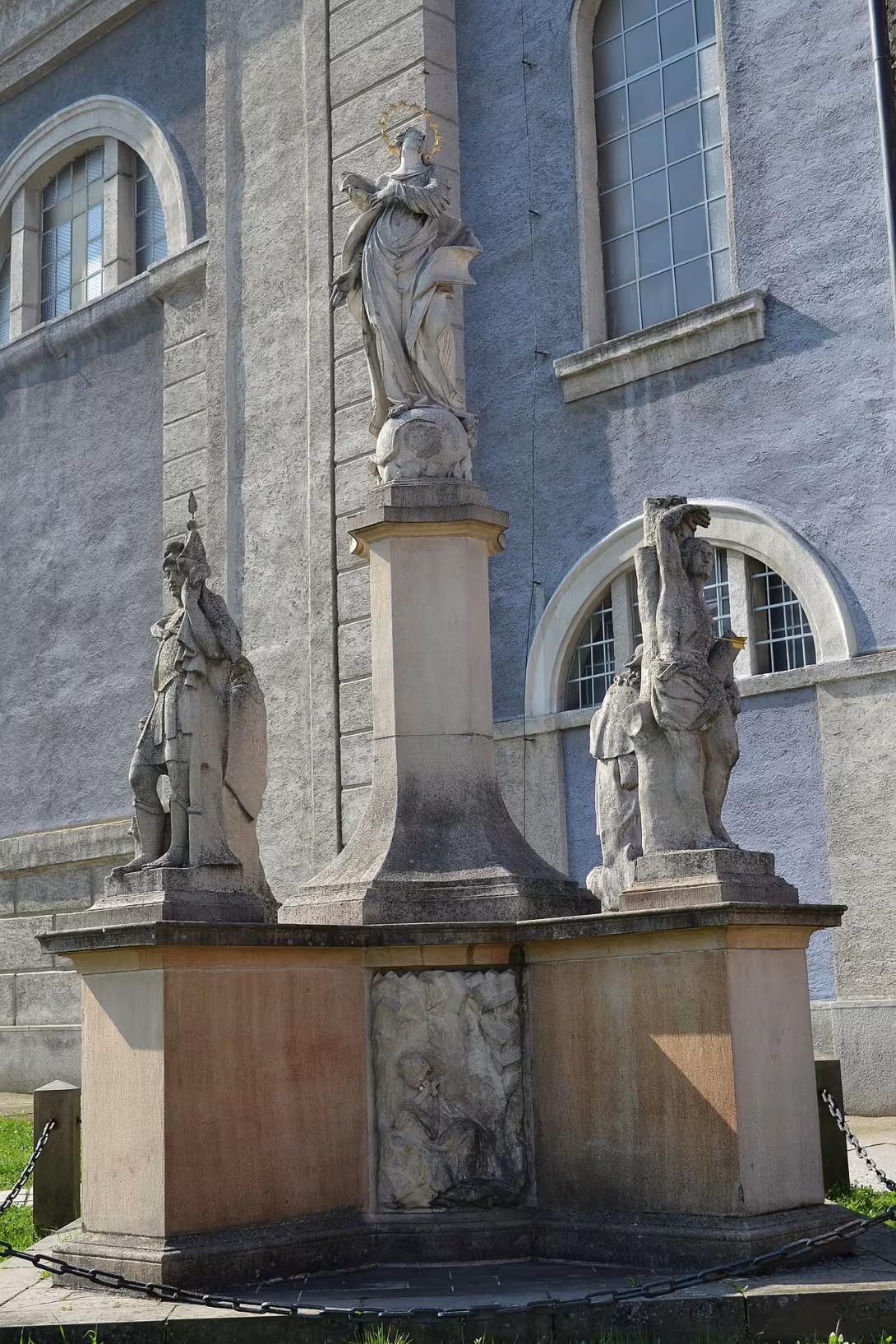

The historical view on the left is a visualisation generated by artificial intelligence and serves as inspiration.
Historical Milestones
- Original sculptures and columns from before 1761
- Replica sculptures and fences 1992-1993
Interesting facts
The area consists of 12 objects, some of which are original from the 18th century and some are copies from the 20th century
The original pillar is polygonal and is part of the Marian column
Guide
Show guide text
The text was prepared by artificial intelligence and has not been editorially reviewed. It may contain inaccuracies.
You can see in Gbely where one of the quiet but very symbolic monuments of our region is known in front of you. You are standing in front of a Marian column that, as a colonized guard, watches the surrounding fields and forests. This column, which has been here ever since it was remembered, is one of those places that has been squeezed into the memory of local people as a symbol of the whirlwind, respect and social life of past centuries.
Let's move closer and look at him with attention. Before you is a simple but very purposeful building - a pillar with a Marian statue on top. The statue of Our Lady, which has been here since then, is a typical example of Baroque art, which has spread in our regions in the 17th and 18th centuries. Note how the image is placed to be seen from the far - from - the - eye view of such an approach was typical of the Marian columns, which served as reference points for both believers and as protective symbols against adverse forces.
There is no written testimony about when and why this pillar was built. However, the Marian columns began to spread in our regions during the anti-reformation period when the Catholic Church sought to strengthen its influence and unite believers. These structures served as places of prayer but also as symbols of determination and whirlwinds. In Gbely, such a column became part of local life, with its meaning being sold orally from generation to generation, as one of the few written, undocumented but very lively traditions.
Nyni pay attention to the material itself and to the details before you. The pillar is built of local stone, which is typical of many Marian columns in our regions. Note how the statue of Our Lady is placed on the top - often it is a typical Baroque composition, where Our Lady is depicted with Jesus in her arms, or as a full-handed lady symbolizing protection and grace. In this case, although specific details are not known, it is clear that this is a typical example of such buildings, which were built with the intention of strengthening the spiritual life of the community.
However, the sprouting stories associated with this place are orally sold rather than preserved in writing. The Marian columns were often a place of respect, but also a place where public prayers, processions, and other religious activities were held. In Gbels, such a column became part of local life, with its meaning being sold from generation to generation. Some local people remembered the past practice of public prayers and processions associated with various religious saints, especially the Virgin Mary's Square.
One of the attractions that comes together here is the fact that many Marian columns were built during the period when baroque architecture was developing in the country. This column, although not known by its author, is an example of how art and religion interacted. Note how the statue of the Virgin Mary is located to be visible from the far - such an approach was typical of the Marian columns, which served as orientation points for both believers and as protective symbols against adverse forces.
An interesting mystery that unites here is the fact that some Marian columns were built at a time when baroque architecture was developing in the country, but even though specific details are not known, it is clear that this is an example of folk architecture that was sold from generation to generation. Some historians assume that many of these columns were built without written documentation, but their meaning was very strong and deeply rooted in local social life.
Let's go see the surroundings of the column. Note how the natural beauty and climate, typical for this part of the Trnava region, are preserved here. This column is located near the fields and forests, giving it a unique atmosphere. In the past, there have been various religious and social events associated with this place.
Before we say goodbye, we would like to invite you to stay in the Gbels for a few more minutes. Take a look at the nature that has been preserved in this climate. This Marian column is just one of many examples of how religion and folk culture interacted in our regions. This preserved local traditions and memories, which are now one of the most valuable heritage of our village.
As we say goodbye, we would like to tell you that this pillar is just one of many examples of how religion and folk culture in our regions have interacted. This preserved local traditions and memories, which are now one of the most valuable heritage of our village. Thanks to you for visiting and interested in our history. As we say goodbye, we would like to tell you that this pillar is just one of many examples of how religion and folk culture in our regions have interacted. This preserved local traditions and memories, which are now one of the most valuable heritage of our village.
As we say goodbye, we would like to tell you that this pillar is just one of many examples of how religion and folk culture in our regions have interacted. This preserved local traditions and memories, which are now one of the most valuable heritage of our village. Thanks to you for visiting and interested in our history. As we say goodbye, we would like to tell you that this pillar is just one of many examples of how religion and folk culture in our regions have interacted. This preserved local traditions and memories, which are now one of the most valuable heritage of our village.
As we say goodbye, we would like to tell you that this pillar is just one of many examples of how religion and folk culture in our regions have interacted. This preserved local traditions and memories, which are now one of the most valuable heritage of our village. Thanks to you for visiting and interested in our history. As we say goodbye, we would like to tell you that this pillar is just one of many examples of how religion and folk culture in our regions have interacted. This preserved local traditions and memories, which are now one of the most valuable heritage of our village.
-- -
* (Note: The text has been modified to be smooth and without repetition. If you want, we can even shorten it or edit it to a shorter text suitable for the audio printer.) *
-- -
Adjusted, smoother version for audio feeder:
You can see in the Gbels where one of the quiet but very symbolic monuments of our region stands before you. Before us, the Marian pillar is known, which, as a colonized watchman, watches the surrounding fields and forests. This column, which has been here ever since it was remembered, is one of those places that has been squeezed into the memory of local people as a symbol of the vortex, respect and social life of past centuries.
Looking at him with attention is simple but very useful. Before you there is a simple building - a pillar with a Marian statue on top. The statue of Our Lady, which has been here ever since, is a typical example of folk architecture that has been sold from generation to generation. Note how it is located to be visible from the distance - such an approach was typical of the Marian columns that served as reference points for believers.
There is no written correctness about when and why it was built today. However, the Marian columns began to spread in our regions during the anti-reformation period when the Catholic Church sought to strengthen its influence and unite believers. In Gbels, such a column became part of local life, with its meaning being sold orally from generation to generation.
Nayni take a look at the material and details before you. The pillar is built of local stone, which is typical of many Marian columns in our regions. Note how the statue of Our Lady is located on the top - often it is a typical Baroque composition that symbolizes protection and grace.
The sprouting stories associated with this place are sold orally rather than preserved in writing. The Marian columns were often a place of respect, but also a place of public prayers and processions. In Gbels, such a column became part of local life, with its meaning being sold from generation to generation.
An interesting mystery is the fact that some Marian columns were built without written documentation, but their meaning was very strong and deeply rooted in local social life. Note how this column is located near nature, which gives it a unique atmosphere.
Before we say goodbye, we would like to invite you to stay in the Gbels for a few more minutes. Take a look at the nature that has been preserved in this climate. This Marian column is just one of many examples of how religion and folk culture interacted in our regions.
Thanks to you for visiting and interested in our history. As we say goodbye, we would like to tell you that this pillar is just one of many examples of how religion and folk culture in our regions have interacted. This preserved local traditions and memories, which are now one of the most valuable heritage of our village.
Tips for visitors
Marian Column in Gbely
Best visit time The ideal is to visit the column in the morning or at sunset. In the summer months avoid the people when the sun can be too hot.
Car arrival is recommended because public transport to Gbely is not easily accessible from every location. Information on public transport connections can be found on the official site of the municipality.
What to take with you Clothes by the time of year - in the summer months light, in winter cold. Footwear suitable for uneven terrain. You can take the bags for photography or a note bookcase.
Photography The best photos get from different angles around the column, especially from the front, where the statue is best visible. Details such as reliefs or inscriptions are interesting. The best light is in the morning or evening sun.
What to Visit Around There are few attractions around Gbely. For further visits, it is recommended to go to the surrounding towns, such as Trnava or villages with other historical monuments or natural attractions.
Tips for families with children The column can be interesting for children in terms of history and architecture. You can explain to them the meaning of such monuments. In the surroundings you can win with children for a small adventure, such as searching for children's children or shooting different angles. If possible, go to nature, where children can run around and run out of energy.
Frequently asked questions
Can the monument be visited?
This is a structure in a public space that can usually be seen from outside free of charge. We have not verified that this particular one is freely accessible.
Where is the monument?
Location: Nám.bisk.Čárskeho, Gbely, Trnavský kraj. The map on this page shows the exact spot.
Why is the monument protected?
It is listed in the Central List of the Monuments Fund of the Slovak Republic as a national cultural monument (ÚZPF no. 216-601).
For children
In Gbely, where today the green landscape lies, there was a small village that focused on agriculture a few centuries ago. It was not until 1720 that citizens lived a simple life here that their fate changed an epidemic that chose many lives. Fear of danger, people prayed and asked Virgin Maria for protection. According to tradition, she appeared to them and showed that they did not have to be afraid. That was the signal for the construction of the Marian pillar - the monument to their whirlpool.
Nearby
🏰 Historic sites (366)
- Mestská veža 0.0 km Štefánikova 91/1 +421 3 32 36 440 web
- Trojičný stĺp 0.0 km web
- sv. Jozef 0.1 km web
- slachta.gallery 0.1 km +421 905 663 320 web
- Obetiam 2. svetovej vojny 0.1 km web
- Ján Sambucus 0.1 km web
- sv. Anton Paduánsky 0.1 km web
- Pieta 0.1 km web
- sv. František z Assisi 0.1 km web
- Výklad 0.2 km
- Anton Hajduk 0.2 km web
- Anton Bernolák 0.2 km web
- Ján Ondruš 0.2 km web
- Pamätník poľnohospodárstva 0.3 km web
- Juraj Haulík 0.3 km web
- sv. Ján Nepomucký 0.3 km web
- Panna Mária s holubicou 0.3 km web
- Pomník SNP 0.3 km web
- Štefan Moyses 0.3 km web
- Titus Zeman 0.3 km web
🍽️ Restaurants and dining (289)
- Hedon 0.0 km +421 911 830 113 web
- Antico 0.0 km
- Thalmeiner 0.0 km +421 949 210 537 web
- Pastis 0.1 km +421 902 010 010
- Per Tutti 0.1 km +421 948 279 721 web
- Akadémia 0.1 km +421 911 025 196 web
- Čajovňa pod klenbou 0.1 km +421 950 491 131
- City 0.1 km
- Pizza Aura 0.1 km
- Lumin 0.1 km
- Maxim 0.1 km
- WOK Sushi 0.1 km
- 3anglo 0.1 km +421 911 602 502
- Charlie 0.1 km +421 915 338 926
- Prison Pizza 0.1 km +421 949 859 006 web
- Špacírka 0.1 km +421 915 897 187 web
- Domáce langoše 0.1 km
- Palacinky u kocúra 0.1 km
- CrepChik 0.1 km
- Hollywood Burger 0.1 km +421 948 412 501 web
🏨 Accommodation (36)
- Barbakan 0.2 km +421 335 511 847 web
- Holiday Inn 0.2 km Hornopotočná 8217/5 web
- MAX PLAZA 0.3 km Štefánikova 111/21 +421 948 709 710 web
- Dependance Patriot 0.4 km Jeruzalemská 294/3 +421905773366 web
- Penzión Patriot 0.5 km +421335512511 web
- Hotel LONDON 0.5 km web
- Hotel Phoenix 0.6 km Kapitulská 458/16 web
- Hotel Dream 0.6 km Kapitulská 454/12 web
- La Pension 0.6 km +421 911 655 500 web
- Elements 0.6 km
- Hotel Arena 0.7 km
- Hotel SHEYLY'S 0.8 km Klempova 2390/2 +421 905 360 036 web
- Hotel IMPIQ 0.9 km web
- Empire 1.0 km web
- Penzion OAZA 1.1 km
- Ubytovňa Nukleon 1.2 km +421 915 961 719
- Ubytovňa ŽOS 1.5 km +421 915 124 670
- Lux 1.6 km web
- Ubytovňa Domov 2.3 km Zelenečská 6748/113 +421 911 756 244 web
- Koliba 2.8 km Kamenný mlyn 5788/8 web
🚲 Rentals and sport (88)
- LBikes 0.3 km +421 908 414 025 web
- Zelený Kríčok 0.4 km web
- Cyklocentrum PLUS 0.4 km Rybníková 1A +421 915 912 903 web
- Rybníková - Mestská športová hala 0.5 km web
- Mobility RM JET 0.5 km +421 948 909 609 web
- Cyklocentrum Trnava 0.5 km +421 907 722 989 web
- Detský bazén 0.5 km
- Relaxačný bazén 0.5 km
- Kľudový bazén 0.6 km
- Výplavový bazén 0.6 km
- Sports Direct 0.6 km web
- Mestská športová hala 0.6 km Rybníková 576/15 web
- Plavecký bazén 0.6 km
- Severovýchodná veža - Parkovisko 0.6 km web
- Sport centrum Pohoda 0.6 km Rybníková 7499/15B web
- UCM 0.7 km web
- T. Vansovej - Merkur 0.7 km web
- Intersport 0.8 km
- BouldroFka 0.8 km Trstínska cesta 1672/1 web
- Lanové centrum - Slávia 0.8 km web
🥾 Hiking and nature (30)
- Univerzitný parčík 0.1 km
- Bernolákov sad 0.3 km
- Bernolákov sad 0.4 km
- Park Bela IV. 0.5 km
- Park Slovenského národného povstania 0.6 km
- Park Slovenského národného povstania 0.6 km
- Ružový park 0.6 km
- Kalvária 1.0 km
- park Janka Kráľa 1.4 km
- Oddychová zóna Štrky 2.6 km
- Park Blavská 7.3 km
- Geometry Dash Tree 8.1 km
- Borová hora 8.4 km
- 6.8.1945 9.5 km
- Zámocký park 9.9 km
- Háj 11.0 km
- Háj 11.2 km
- Umelý kopec 11.5 km
- Rozhľadňa 11.8 km
- Záhrada ruží 11.9 km
Thematic route
Marian column in Gbely
1. Marian column - Baroque statue of the Virgin Mary from the 18th century on the main square in Gbely. It is one of the important monuments of the village and a suitable place for short prayers or photographs.
2. Church of St. Nicholas - The parish building right next to the pillar. It has a simple interior with historical furniture and painting. The visit is connected with Marian culture and village life.
3. View of Trnavské vrchy - The view of the green slopes and forests of the Trnavský kraj is spread from around Gbel. Suitable place for a rest period or a short breakup.
*The trail is simple and suitable for a short trip, which will be washed out in a few hours. *
Seasonal recommendations
The Marian column in Gbely takes on a special occasion in spring. Surroundings are going to life, trees are greening, and grass is gaining fresh color. Contrast with a stone statue creates a pleasant atmosphere. It is advisable to use scattered lighting without sharp shadows. It is advisable to count on rapid temperature changes when visiting - layered clothing and waterproof jacket are recommended. In the spring months, the number of visitors is lower, which allows you to observe the details of the statue. The best time to visit is noon, when the rain cloud field often retreats and the sun penetrates the clouds.
In the summer there is the biggest rush and the highest temperatures. The statue is surrounded by a leaf that provides shade in hot days. Clear lighting highlights the texture of the stone, but longer becoming can be uncomfortable. In the summer months, especially in Sunday afternoons, larger crowds are welcome, for example due to holiday dates and school trips. For a comfortable visit it is advisable to arrive early in the morning when it is cooler and place quieter. Clothing should be light, breathable and bright, supplemented with sufficient fluid intake and sun protection, such as a hat or glasses.
A partial visit to Gbeľy is characterized by warm colors of falling leaf and colder air. The Marian column stands out against the background of gold and red tones, creating a romantic and beautiful impression. The lighting is lower and warmer, the sun tends to hide behind the horizon. The number of visitors is falling significantly, allowing an intimate experience. Clothes should be layered, with emphasis on insulation and wind resistance, as mornings and evenings are cool. The best time to visit is noon, when it is warmest and the sun still illuminates the surroundings.
In the winter months a visit to the Marian column offers an experience of silence and peace. If the snow covers the surrounding area, it becomes the center of white land. Lighting is short and weak, the sun rises late and sets early, which measures the available time window for a visit. The number of visitors is minimal, often there is no one else. Clothing should be very warm, including winter jackets, gloves, caps and warm shoes. The best time to visit is the parallel around noon, when it is the warmest outdoors and the sun most illuminates the surroundings.
Visualisations and artistic views


The visualisations are generated by artificial intelligence and serve as inspiration.
Photographs from the area
Real photos taken near the monument


Source and licence are given for each image.
Visitor Tips
No tips yet. Be the first!
Log in and add your tip.
Location on Map
Visitor photos
No photos yet. Be the first to add a photo from your visit!
Log in and add your photo or leave a rating.
You get more points for a visit verified in the app — we can tell from the GPS that you are there.
Reviews and comments