








meštiansky dom Burgher house
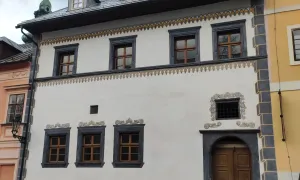
Radový burgher's house in Banská Štiavnica in Banská Bystrica region is a protected object from the first half of the 19th century. The monument office of the Slovak Republic records it under the number ÚZPF 3351. The building documents the construction development and urban transformation of the urban environment from the period of classicalism.
In the 19th century, the number of urban inhabitants grew, resulting in the development of residential construction. Houses during this period followed the traditions of city palaces in tectonics, embodiments and crossings. Banská Štiavnica had a specific structure; burgher houses often involved older unorganized buildings and between the buildings remained narrow streets. The cellars were dug into the rock subsoil. Sometimes they crossed into the halls that remained after previous mining activities. Home in Banska Štiavnica is a characteristic location in a violent terrain.
Architectural and building types of burgher houses evolved from the Middle Ages through the Baroque to the 19th century. In the Middle Ages, wooden houses prevailed, more solvent owners built brick buildings. Typological forms consisted of tower houses as part of the defence system, chamber houses with longitudinal floor plan and black kitchen, hall houses, transit houses and houses with height to store grain or wet sensitive goods. In the 17th and 18th centuries (baroque) the nobility rebuilt neighbouring houses in city palaces with landscaped front courtyards and representative staircases. In the 19th century, rentals and pavilion houses with central courtyards, on the outskirts of the city's poverty houses or iron houses were created. Later, the original objects went through the modernization of the partition, while many preserved the commercial function.
The monument office of the Slovak Republic registers the building as one building unit under the number 3351/1 - house burgher, row, from the first half of the 19th century. Architectural and historical research in this field is based on expert surveys and publications.
Tehdy a dnes
Drag the slider and compare how the monument might have looked when it was built with the view today.
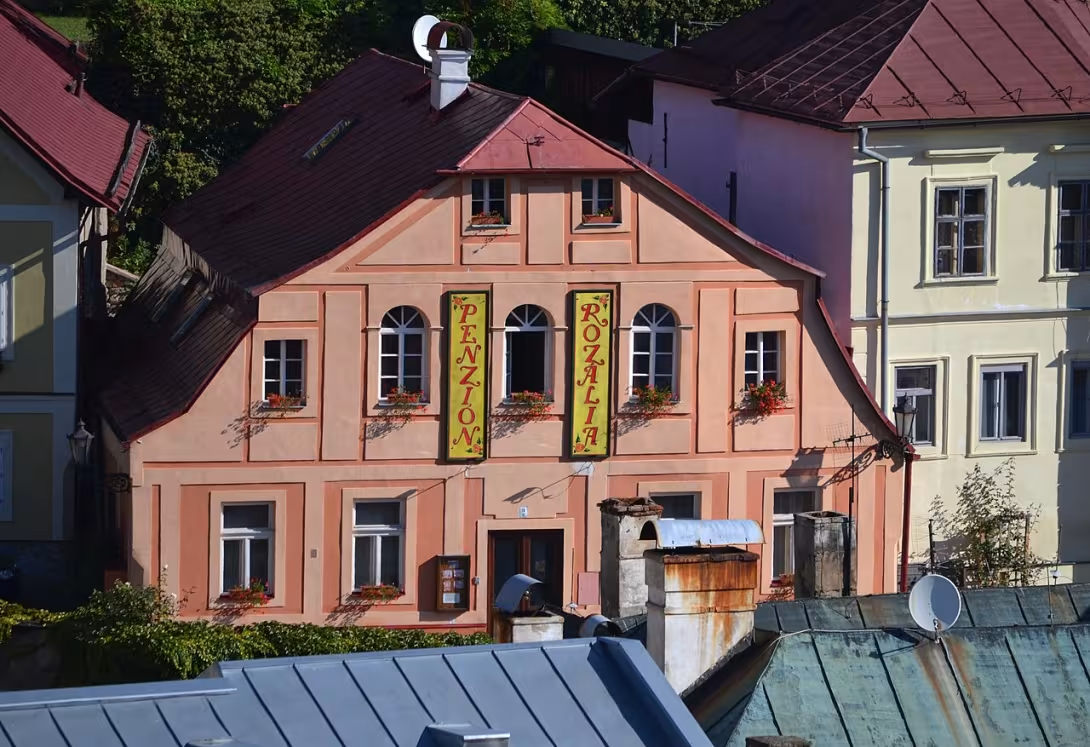

The historical view on the left is a visualisation generated by artificial intelligence and serves as inspiration.
Historical Milestones
- 1200-1500
- Medieval development of Banská Štiavnica and first brick houses
- 1650
- Baroque adjustments of burgher houses and noble palaces
- 1825
- Construction of a terraced townhouse in the classical style
- 1900
- Later modifications and modernization of the object
Interesting facts
- Radový burgher's house in Banská Štiavnica is a protected building from the first half of the 19th century, which records the Monument Office of the Slovak Republic under the number ÚZPF 3351. - The cellars of burgher houses in Banská Štiavnica were dug into the rock subsoil and sometimes moved to the halls, which remained after previous mining activities. - Houses in Banská Štiavnica are characterized by a situation in a rough terrain.
Guide
Show guide text
The text was prepared by artificial intelligence and has not been editorially reviewed. It may contain inaccuracies.
Welcome to the heart of the historical Banská Štiavnica, a city that is a living chronicler of the century eyes and mineral treasures. You are standing right in front of one of these quiet but extremely important witnesses of the past - the burgher's house. Look at it now, as it stands in this narrow-slovak street, and try to imagine the lives that have flowed, the steps that have been taken along these paths, and the voices that once resonated. This object is not only a building of stone and mortar; it is a fragment of a wider story of the city, which was formed in the rhythm of mining, trade and continuous development.
Now that you are looking at this facade, you may see only a harmonious facade, but in fact there are centuries of change. The history of this place did not begin when this particular house was built, but long ago. Even between 1200 and 1500, during the medieval development of Banská Štiavnica, the first brick houses began to appear here. At the time, the city was built from the foundations, in the rhythm of the first great prosperity, when the small settlement became a significant center. Over time, in the 17th century, about 1650, the city's face began to change under the influence of the Baroque. At that time many burgher houses and noble palaces were adapted to this rich, dynamic style form, which gave the town its unmistakable elegance and depth.
However, what you have right before your eyes is the result of a different era. Nowadays you can see a terraced burgher's house, the current form of which dates back to 1825. During this period, there was no wave of classicalism in architecture. If you now notice the lines of the building, try to look in them for the classicistic order that is typical of this style. Classicism brought mildness, symmetry, and peace to architecture. Houses like this were built to form a coherent, solid street line, creating a sense of stability and urban order. This object is not just a random building, it is a protected monument which is part of the national cultural heritage and is registered under the number ÚZPF 3351. It is proof that even the ordinary townhouse had its weight and importance within the overall urban planning of the city.
But do not be deceived by his calm appearance. In 1900 this building went through other modernizations and modifications, which gave it the current character you see today. It is fascinating how architecture can adapt to the new needs of the time while preserving its historical soul.
When we talk about burgher houses in Banská Štiavnica, we must remember that their function has always been double. It was not only about places to live, but also often about jobs, business or crafts. Although we do not know the names of specific owners who lived in this house, we can imagine them as people who formed the middle class of this city - enterprising townspeople who cared for the prosperity of Štiavnica. Their lives were linked to the rhythm of the city, with incoming raw materials and outgoing goods.
Now, however, I would urge you to imagine something that is not visible directly on the surface. Let's try to look under your feet, deeper underground, where you can't see each other, but where another history is taking place. One of the greatest secrets and the greatest fascinating properties of burgher houses in Banská Štiavnica are their cellars. Those aren't regular. In many cases, they were deeper than could be imagined, as they were deep into the rock bed on which the city stands. This rock base is both unique and unpredictable.
In some homes, these cellars sometimes continued to connect with old huts. Yes, you heard correctly - these underground spaces could be directly linked to the underground mining world, which under the city was experiencing its best times. Imagine the atmosphere: cold, quiet passages in the rock that lead deep into the earth, linked to life above the surface. This created a fascinating, almost mystical link between urban life and dangerous but rich underground. This fact gives every burgher's house, even to the one standing before you, a certain amount of mystery. It's like another, invisible part of the city is throbbing under your feet.
When you continue your tour, try to stop at other buildings in this row. Notice how details change, how the rhythm of facade changes, but at the same time how the same atmosphere of the city that can cope with time remains. Banská Štiavnica is not only a museum; it is a place where history meets the presence in every stone block and every street.
I hope this short look at the life of this townhouse has helped you to better understand the place you are in. Be carried away by the beauty of these streets and continue to discover the hidden treasures this city offers. Any next step can lead you to another story waiting to be revealed. I wish you a pleasant walk and let Štiavnica surprise you with its beauty.
Tips for visitors
The best time to visit Banská Štiavnica and its historic burgher houses is during the early morning when the streets are quieter. Be sure to take comfortable tight shoes with you, as the streets and courtyards are paved and often rise up a hill. The most suitable for photography are underpasses, historical portals and views of the roofs of burgher houses from elevated slopes in the morning sun. For families with children, we recommend considering the route according to the physical fitness of children, as the terrain in the city is quite rugged.
Frequently asked questions
Can the monument be visited?
This is a residential or farm building, not a museum with opening hours. Please view it from public space and respect the owners' privacy. We have no information about access to the interior.
Where is the monument?
Location: Dolná ružová 218/4, Banská Štiavnica, Banskobystrický kraj. The map on this page shows the exact spot.
Why is the monument protected?
It is listed in the Central List of the Monuments Fund of the Slovak Republic as a national cultural monument (ÚZPF no. 322-3351). It is part of a UNESCO World Heritage Site.
Nearby
🏰 Historic sites (232)
- Dom Maríny 0.1 km
- Židovská synagóga 0.1 km
- Morový stĺp 0.1 km
- Mariánsky stĺp 0.1 km
- Cesta v čase 0.1 km web
- Andrej Kmeť 0.2 km
- Banské múzeum 0.2 km web
- SNP 0.2 km
- Kammerhof 0.2 km
- Galéria Jozefa Kollára 0.2 km +421 918 990 449 web
- Vzbura baníkov v roku 1852 0.2 km
- Galéria Schemnitz 0.2 km
- sv. Ján Nepomucký 0.2 km
- Sándor Petőfi 0.2 km
- Kalmán Mikszáth 0.2 km
- Andrej Sládkovič 0.2 km
- Starý zámok 0.2 km web
- Dominikánsky kláštor 0.2 km
- Hugo Heincz 0.2 km
- Anton Péch 0.2 km
🍽️ Restaurants and dining (163)
- Divná pani 0.1 km +421 45 679 09 45 web
- Stará škola 0.1 km
- Svätá Barborka 0.1 km
- Cigar Bar 0.1 km
- Eleuzína 0.1 km web
- Reštaurácia Pizzeria Marína 0.1 km +421 0911 533 337 web
- Trotuar Cafe 0.1 km
- U Böhma 0.1 km
- Pivovar ERB 0.1 km +421456921147 web
- Bansky Dom 0.1 km
- Archanjel Cafe Bar 0.1 km web
- Reštaurácia Gallery 0.1 km +421 45 692 12 52
- Coburg coffee & burger 0.1 km
- RUINbar 0.1 km web
- U Jašteríc 0.2 km
- Lemberg 0.2 km Radničné námestie 10 +421 911 220 126 web
- Art Cafe 0.2 km Akademická 327/2 web
- Reštaurácia Matej 0.2 km Akademická 329/4
- Čajovňa Klopačka 0.2 km +421 905 980 499 web
- Reštaurácia Monarchia 0.2 km web
🏨 Accommodation (106)
- Penzión Rozália 0.0 km +421 948 221 213 web
- Apartmán Zlatý dvor 0.1 km
- Bristol 0.1 km Andreja Kmeťa 123/11
- Penzión Cosmopolitan II 0.1 km web
- Boutique Hotel ERB 0.1 km +421 456 789 555 web
- Penzión Matej 0.2 km
- Gavalier Design Rooms 0.2 km +421 903 222 309 web
- BARCADAM 0.2 km Námestie sv. Trojice 17/13 +421 908 965 202 web
- Penzión Resla 0.2 km
- Subyt 0.2 km
- Hotel Grand Matej 0.2 km
- Penzión Tomino 0.2 km
- Skautský dom 0.2 km Antona Pécha 69/2 +421905382885 web
- Penzión Na trojici 0.2 km Námestie sv. Trojice 21/17
- Penzion Nostalgia 0.3 km Ing. Štefana Višňovského 208/3
- Skautský dom 0.3 km web
- Villa Botanica 0.3 km web
- Salamander 0.3 km
- Black M 0.4 km Kutnohorská 603/1 +421 910 947 187 web
- Ubytovanie Tatiana 0.4 km
🚲 Rentals and sport (18)
- Diana poľovnícke potreby 0.6 km
- Ortler sport 0.7 km
- BS-Rent 0.8 km +421 948 908 737 web
- MK bike service 1.0 km +421 904 494 573
- Pontónová plaváreň na Klingeri 1.2 km
- Tanad sport 1.3 km
- Bikepro - Hotel Salamandra 3.0 km web
- ŠK Lesy Banská Belá 4.1 km
- Požičovňa vodných bicyklov 6.6 km
- Sedací bazén 7.8 km
- Detský bazén 7.8 km
- Rekreačný bazén 7.8 km
- Jaskynný parný kúpeľ 7.9 km
- OFK Štart Prenčov 11.0 km
- Lodenica Hliník nad Hronom 12.7 km
- Cyklosport 3000 13.3 km Májová 280/3
- Bazén Ďuricov majer 14.3 km
- Plážové kúpalisko Žiar nad Hronom 14.3 km
🥾 Hiking and nature (592)
- Banka lásky 0.1 km web
- Kaufhaus šachta 0.1 km
- Z Hornej ružovej 0.1 km
- Michal štôlňa 0.1 km
- Z Dolnej ružovej 0.1 km
- História mesta (reliéf) 0.1 km
- Banskoštiavnicky betlehem 0.2 km web
- Od Červeného kríža 0.2 km
- Na centrum 0.2 km
- Z Lichardovej 0.2 km
- Z Vodárenskej 0.2 km
- Z Katovej 0.3 km
- Cherubín dedičná štôlňa 0.3 km
- Glanzenberg dedičná štôlňa 0.4 km web
- Park SNP 0.5 km
- Z Vodárenskej 0.5 km
- Na kalváriu 0.5 km
- Nad Reslou 0.7 km
- Žigmund šachta 0.7 km Na Zigmund šachtu 1647/15
- Hybalka 0.7 km
Thematic route
I propose a thematic walking route focused on historical architecture and burgher life in Banská Štiavnica.
1. Townhouse (House of the Town) - Type: Historical building / museum building - Why it is worth visiting: This destination of the route shows Renaissance and Baroque architecture. Visitors will come closer to the lives of rich mining townsmen in the past.
Since the list of surrounding attractions does not contain other specific places, the route closes directly in the historical center of Banská Štiavnica.
Seasonal recommendations
Spring in Banská Štiavnica brings awakening of nature and historical streets surrounded by green green greenery surrounding the slopes. Lighting during the spring months is clean, which highlights details of the Renaissance and Baroque architecture of the burgher house. During this period you will only meet with the minimum number of tourists, so the tour takes place in a quiet atmosphere. Wear layered clothing and tight shoes, as the tiles can be slippery. The best time to visit the interior is morning.
Summer belongs to the main tourist season, when the historic centre revives and sunlight creates contrasts between light and shadow. The atmosphere is lively, full of bustle from open cafes and terraces. We recommend you come first thing in the morning before opening time to avoid crowds and enjoy cooler air in the interior of the burgher house. Choose lightweight clothing, remember to sunglasses and head covers to move outside. In the afternoon it is advisable to look for refreshment in the shady corners of the yard.
Autumn turns nature into a colorful panorama and soft, golden light gives melancholy touch to the townhouse. The atmosphere in the city is calmer, ideal for a deeper knowledge of history without haste. The mornings are cold, so warmer clothing, an ideal windproof jacket, and long trousers are essential. The best time to explore the exteriors and surrounding terraces is afternoon.
Winter conceals Banská Štiavnica in silence, snow cover contrasts with dark roofs and walls of the burgher house. The lighting in December and January is early, and the atmosphere is made up by the light of street lamps reflected in snow. Due to cold weather and shorter daily time, a more limited opening time should be envisaged. Wear a winter jacket, a hat, gloves, and warm footwear with non-slip soles. The best time to visit the interior is around noon.
Visualisations and artistic views


The visualisations are generated by artificial intelligence and serve as inspiration.
Photographs from the area
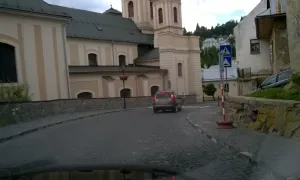
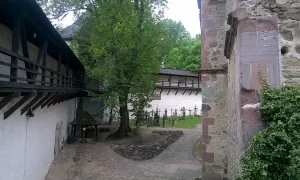
Real photos taken near the monument

Source and licence are given for each image.
Visitor Tips
No tips yet. Be the first!
Log in and add your tip.
Location on Map
More monuments – Banská Štiavnica
Show all in the town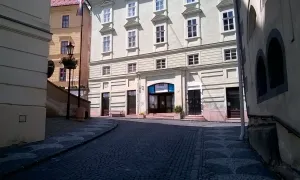

Visitor photos
No photos yet. Be the first to add a photo from your visit!
Log in and add your photo or leave a rating.
You get more points for a visit verified in the app — we can tell from the GPS that you are there.
Reviews and comments