








Missing Curia Manor
The missing curio is a national cultural monument located in the village Čerenčany in the Banská Bystrica region. It is a building from the second half of the 19th century, namely from 1860, which, from the point of view of architectural style, we recommend new-classicism.
The area of the monument is registered by the Monument Office of the Slovak Republic under number ÚZPF 11373. It consists of one object, which itself is a curio. This object is kept in the register as a solitaire.
The curio is located at Samuel Kollár 67/63 in the village Čerenčany. The exact location of the object is determined by coordinates 48.40627, 19.99111.
The building represents a concrete example of the neoclassical architecture of the middle 19th century within the Banská Bystrica region. Its presence is complemented by the building fund of the village Čerenčany.
Due to the status of the national cultural monument, the object is an important point for anyone who is interested in historical buildings in this location. We recommend visiting this place to all interested in architecture from the period of neoclassicism.
Tehdy a dnes
Drag the slider and compare how the monument might have looked when it was built with the view today.
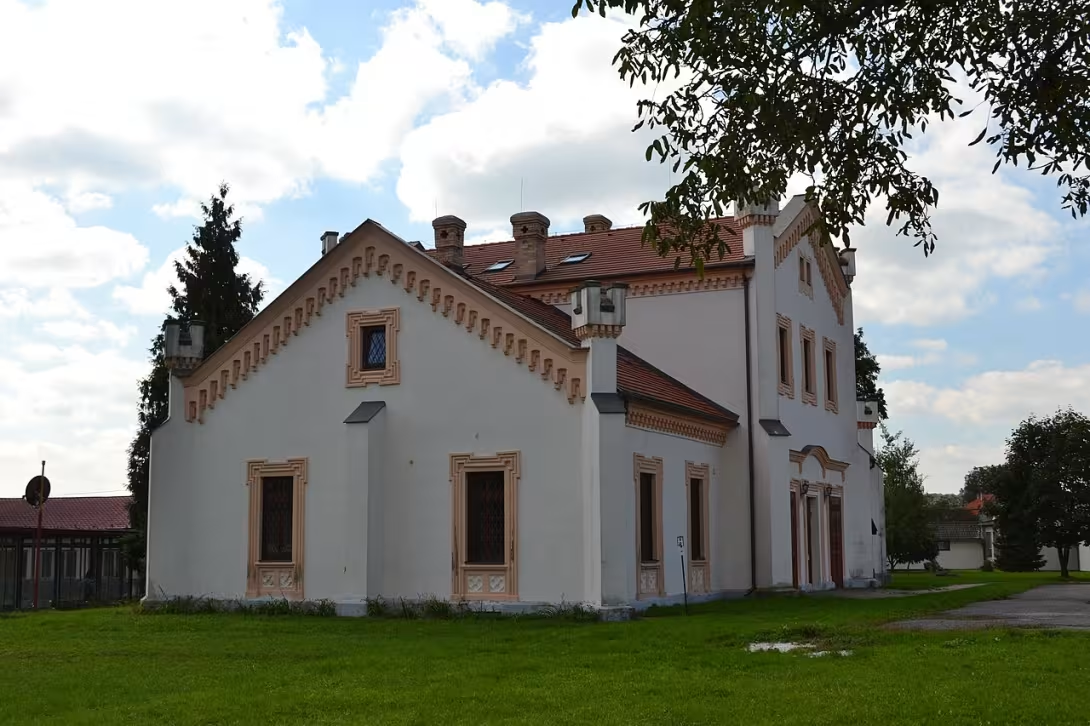

The historical view on the left is a visualisation generated by artificial intelligence and serves as inspiration.
Historical Milestones
- 1860
- The position of Missing Cure in Čerenčany in the New Classicist style as a significant building of the middle 19th century.
- round 1860-1900
- The missing curio was one of the representative buildings of neoclassicism in the Banská Bystrica region, typical for the period after 1850.
- 1963
- The missing curio was included in the list of national cultural monuments of the Slovak Republic (the registration number of the ÚZPF 11373).
Interesting facts
- The missing curio is a national cultural monument from 1860. - The building belongs to the architectural style of New Classicism. - The area of the monument consists of one object, which is kept in the register as a solitaire. - The building represents a concrete example of the New Classicist architecture of the middle 19th century in Banská Bystrica region.
Guide
Show guide text
The text was prepared by artificial intelligence and has not been editorially reviewed. It may contain inaccuracies.
Welcome to the village of Čerenčany, in the heart of Banská Bystrica region. Right now you are standing in front of the Missing Curia, an object that carries the silence of past times and the atmosphere of historical domination. When you look at the building, you will see a building in front of you that stands out from the surroundings with its dimensions and position and shows that the power and administration of local estates was once concentrated in this place. At the moment, take this first impression from a building that welcomed you with its presence and invites you to lock up on who lived here and what events took place in these walls. Let us now try to understand the historical context of this place. Although the exact chronology of the formation of the Missing Curie is not exactly documented today, the name itself tells us what type of building it is. In the historical context of Slovak architecture, the curies were the residences of lower nobles or rulers of estates. It wasn't so full of locks, but at the same time it was a little more than just ordinary houses. They were centres of l administration, where local disputes were settled, taxes collected and land managed. Missing Curia in Čerenečany thus represents a fragment of socialism equipment that defined life in Slovak countryside for centuries. Nyni pay attention to the architecture itself. When overlooking the facade and the overall layout of the building, note its balance and the way it fills the space. Although we do not know exactly who the architects who designed the project are, it can be seen that the building was supposed to give the impression of stability and authority. Look at the details of the facade and see the rhythm of windows and doors. It is these elements that tell us how functionality was perceived in combination with representativeness at the time. Note how the building stood in connection with the surrounding terrain, which was typical of the curies, because it had to be easily accessible to visitors and local residents who came here to see their affairs. If we are looking for specific stories and personalities associated with this place, we must admit that the history of the Missing Curse is covered with a certain secret. Many details about the specific owners or important personalities that have crossed over have disappeared over time or are not specified in the available records. However, it is this lack of names and data that gives the site a certain charm. Imagine how many generations of people have survived their happy and unfortunate moments, how many important decisions have been made here, and how many mysteries are hidden in these walls. Every stone in this building is the center of stories that no one can tell exactly, but that you still feel the air around you. And here we come to the greatest mystery of this place. While many monuments are written from A to Z, the Missing Curia remains unknown to us. It is fascinating that a building with such a significant presence in the country can also be so quiet about its details. What happened to the archives? Who were the people who built it? This ignorance forces us not only to be passive receivers of information, but to become detectives of our own history. Now that you look back at the building, try to imagine what life in this house would have looked like hundreds of years ago. Who would stand on the terrace, who would walk in the hallways and what would they talk about in the chambers? The missed curio is such a silent witness to the time that teaches us humility before what we have lost in our memory, but it also motivates us to maintain what remains. It is a place where the reality of material construction meets the space for our imagination. I allow you to embrace the atmosphere of this historic place for a few moments now. Go around the building slowly, see its size relative to you, and give yourself a moment of meditation on how the world was changing around this cure until you got here. I hope you were interested in this short trip in depth of time and that you felt the spirit of this extraordinary place in the Chereneans. Thank you for your attention and I wish you a pleasant continuation in your discovery of the beauty of Banská Bystrica region. May you prosper in your next journey and let every new point of your traveling hand you new knowledge. Goodbye.
Tips for visitors
A good time to visit is autumn, when deciduous trees around the curry change color and create contrast with the facade. Spring brings green nature, but autumn is often more attractive to photographers. Transport is the easiest by car on roads in Banská Bystrica region. When arriving by public transport check the current connections in the search engine, as lines and times are changing. Solid footwear is recommended for unpaved roads and grasses, as well as plenty of water, as drinking water sources are not available around. Photograph the facade in the morning or late afternoon when side light highlights architectural details and texture of plasters. Take a remote scan to capture a building in the country. In the vicinity of Cherenčian, focus on the nature and atmosphere of the village. The location is suitable for a short walk trip with children. Due to the unknown state of the object and the absence of children's equipment we recommend our own refreshments and toys.
Frequently asked questions
Can the monument be visited?
Some buildings of this kind are open for guided tours, others serve another purpose or are privately owned. We have not verified whether and when this monument is open – please ask the operator.
What are the opening hours and admission?
We have not verified the opening hours or admission. Current information is published by the operator.
Where is the monument?
Location: Samuela Kollára 67/63, Čerenčany, Banskobystrický kraj. The map on this page shows the exact spot.
Why is the monument protected?
It is listed in the Central List of the Monuments Fund of the Slovak Republic as a national cultural monument (ÚZPF no. 329-11373).
For children
The Secret of Missing Curie
Nearby
🏰 Historic sites (82)
- Kúria 0.0 km Samuela Kollára 67/63
- Hrad Sobôtka 1.4 km
- Pamätník SNP 2.5 km
- Pamätník obetiam holokaustu 2.9 km
- Blaha Lujza 3.2 km
- Žigmund Luxemburský 3.2 km
- Padlým v 1. svetovej vojne 3.2 km
- Hatvani István 3.2 km
- Mestská galéria 3.2 km
- Ferenczy István 3.2 km
- FRANCISCI Ján 3.3 km
- Sándor Petőfi 3.3 km
- Tompa Mihály 3.3 km
- Pamätník padlým sovietskym vojakom 3.3 km
- Gemersko-malohontské múzeum 3.3 km
- Bohuslav Nosák-Nezabudov 3.4 km
- Samo Vozár 3.4 km
- Ladislav Bartolomeides 3.4 km
- Juraj Palkovič 3.4 km
- Daniel Gabriel Lichard 3.4 km
🍽️ Restaurants and dining (72)
- Shell Cafe 1.7 km web
- Tanker 2.1 km
- Zoraya Restaurant & Caffé 2.2 km web
- Fresh Corner 2.5 km
- Le Monde 2.9 km
- PIZZA ZÁPAD 2.9 km
- Fresh Corner Restaurant 2.9 km
- Babalu 3.0 km
- Reštaurácia Meštiansky dom 3.1 km web
- Ventura cafe & restaurant 3.1 km web
- La Cubana 3.1 km
- Reštaurácia Čierny Orol 3.2 km web
- Pizzeria Drak 3.2 km Sídlisko Rimava web
- Hausbrandt 3.2 km
- Kongo Pub&Restaurant 3.2 km
- Tatra 3.2 km
- midpoint 3.3 km
- Caffe In Bar 3.3 km web
- Retro bar 3.3 km
- Bistro Negril 3.3 km
🏨 Accommodation (24)
- RS 2.1 km
- Meštiansky dom 3.1 km
- Tatra 3.3 km Hlavné námestie 27/7
- Zlatý býk 3.5 km web
- Kaštieľ Penzion & Restaurant 3.6 km +421 948 606 715 web
- Hotel Carrera 3.8 km web
- Salaš pod Maginhradom 4.4 km +421 903 346 733 web
- Turistická ubytovňa 4.5 km Školská 872/17 +421915978068 web
- Poľovnícka chata pod Maginhradom 4.5 km +421 903 347 633
- Nikola 6.8 km
- Hubert 6.8 km
- Penzión Zelený dom 6.8 km Kurinský les - nádrž 2350 +421918693594
- Kurinec 6.9 km
- Drieňok Teplý Vrch 10.4 km +421 47 201 0133 web
- Oliver 11.0 km
- Ormet 11.1 km +421 475 696 278 web
- Camping Never Finished 11.3 km +421 948 190 997 web
- Chata Lujza 12.3 km Červenej armády 68/25 web
- Ascona club 12.8 km
- Nostalgia 12.9 km web
🚲 Rentals and sport (12)
- Sportisimo 2.3 km web
- Zimný štadión 2.7 km
- Kolkáreň 2.8 km
- Mestská plaváreň 2.8 km
- Bowlcentrum 2.9 km web
- TJ MLADOSŤ Relax 3.0 km Športová 2045/1A
- Požičaj ebike 3.9 km
- ŠK Tempus 3.9 km
- Wellness & spa Pod Maginhradom 4.2 km +421 910 717 172 web
- Jazdecký areál Kurinec 7.0 km
- Termálny bazén 7.0 km
- Člnkáreň 7.2 km
🥾 Hiking and nature (125)
- Mestská záhrada 2.7 km
- Banka 3.0 km
- Alej dejateľov 3.4 km
- Háj 3.6 km
- Čerenčianska hora 3.7 km
- Kamenný Janko 3.9 km
- Stráň 3.9 km
- Šibeničný vrch 3.9 km
- Maginhrad 4.7 km
- Veľký vrch 4.7 km
- Studnička Magine slzy 4.9 km
- Babin vrch 5.8 km
- Matúška 5.9 km
- Vinica 6.0 km
- Romanov vrch 6.1 km
- Dračia studnička 6.4 km
- Peziš 6.4 km
- Studnička pri Kurinci (Mníchov prameň) 6.5 km
- Čelo 6.6 km
- Martinov vrch 6.9 km
Thematic route
Thematic cruise route: Curia in Čerenečany and its surroundings
1. Missing Curia Cultural monument - Renaissance curio from the 16th century. Interiors with wooden ceilings, stone staircases and original furniture testify to the life of the then noble families.
2. St. Nicholas church in Čerenečany Sacral building - Gothic-Renaissance church from the 15th century, which was later rebuilt. It has original frescoes and baroque elements.
3. Monument area of Čerenčiansky castle (ruins) Historical building - The remains of the castle from the 16th century, which served as the seat of noble families.
4. Cherry trailer Local architecture - Municipal semi-trailer with houses that preserved folk architecture.
5. Surroundings of the Cherencian creek Natural unit - Surroundings of the stream suitable for walk between historical monuments and observation of local flora and fauna.
The route connects the main monument with places in the immediate vicinity.
Seasonal recommendations
The spring visit to the Cerenčany curio is accompanied by the fading nature. The surroundings of the building are green, creating a contrast with historical architecture. Lighting is soft and scattered during this period, which is suitable for photography. Due to variable weather we recommend layered clothing. The best time to visit is early morning, when the air is fresh and around quietly.
Summer in Banská Bystrica region brings long days and strong sun, which highlights the texture of facade and greenery. The atmosphere is more vibrant because local and tourists meet here. The afternoon lighting is sharp and creates significant shadow contrasts. We recommend care of hydration, sun protection and wear light, breathable clothing. We recommend a visit at the end of the day when the light is gold and there are fewer people.
The winter season changes the surroundings of the cure to orange, yellow and red shades. The atmosphere is calmer and colder. Lighting is shorter and softer, often cloudy. Waterproof jacket and strong footwear are essential for moisture and cold. The best time is noon when light is brightest and temperatures are highest.
Winter in Čerenčany brings silence and snow, which covers the surroundings and highlights architectural elements of the cure. The atmosphere is without summer rush, which allows you to focus on the details of the object. Lighting is short and cold. Sturdy winter clothing is required, including warm gloves, scarf and shoes with good soles. The visit is recommended at noon when the day is brightest and temperatures are highest.
Visualisations and artistic views


The visualisations are generated by artificial intelligence and serve as inspiration.
Visitor Tips
No tips yet. Be the first!
Log in and add your tip.
Location on Map
More monuments – Čerenčany
Show all in the town
Visitor photos
No photos yet. Be the first to add a photo from your visit!
Log in and add your photo or leave a rating.
You get more points for a visit verified in the app — we can tell from the GPS that you are there.
Reviews and comments