

parish church of the birth of the Virgin Mary Church
The parish church of the Nativity of the Virgin Mary in the village of Madunice in Trnava region is a baroque-classicist building with an older Renaissance core. Its construction development involves rebuilding after natural disasters and interior with elements from different periods.
The first memory of the sacral object in the village comes from 1559. By the 18th century in Madunice was served chapel, which was built around 1728 by a temple boat and an enlarged sanctuarium. In 1755 the ship was rebuilt and a tower was built in 1758. The church served believers from surrounding villages Verešvár, Drahovce and from settlements Baková and Čanadovic.
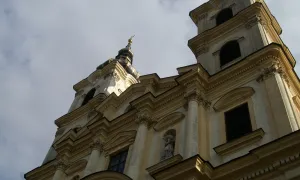
It is a single-ship area with Prussian vaults and segmented presbytery closure. On the north side there is a built-in sacristy and on the west side a built-in tower, which creates a slight rizalit. The tower is covered with an onion helmet on the terrace. Facades are divided by lysene frame and have segmented windows with a jewel. The building is built of stone and burnt bricks and covered with tiles.
Natural disasters affected the construction. In January 1775 the village caught a flood, in which water entered the church up to a height of 95 cm. She destroyed the benches, altars, wardrobes and floors, while the walls cracked. In 1788 canonical visitator stated the need for new construction. The new church was founded between 1799 and 1806 by the priest Joseph Stankovic and Count Jozef Erdödy. Construction costs amounted to 5 855 gold. On May 3, 1843, the church and the parish priest John Hollé burned down, after which the tower was lined with sheet metal.
The interior contains the main Art Nouveau altar of the Birth of the Virgin Mary from the late 19th century with statues of St. Joseph and Imrich. Lateral Rococo altar from the second half of the 18th century bears the sculpture of the Seven Painful Virgin Mary. Another side altar from the late 19th century is dedicated to the Divine Heart with sculptures of St. Francis and with Teresa from Lisieux. The altar of St. Cyril and Methodius was made by Hlohovec carver J. Seilnacht of oak grove Mlíč. There is a Renaissance tomb of God from the 17th century and a Baroque pulpit from the end of the 18th century. The image of the Last Supper is placed above the chorus.
In 1911 a pneumatic organ from Vincent Posťý from Bratislava was installed in the church. Over the years 1900 to 1910 statues of the Holy Heart of Jesus, the Blessed Virgin Mary, St. Anton the Paduan, the Lourdes Virgin Mary and St. Joseph and Jesus were added to the interior. Statues of St. Anton and the Lourdes Virgin Mary was dedicated by madunic believers from America.
The area is registered by the Monument Office of the Slovak Republic under number ÚZPF 938.
Tehdy a dnes
Drag the slider and compare how the monument might have looked when it was built with the view today.
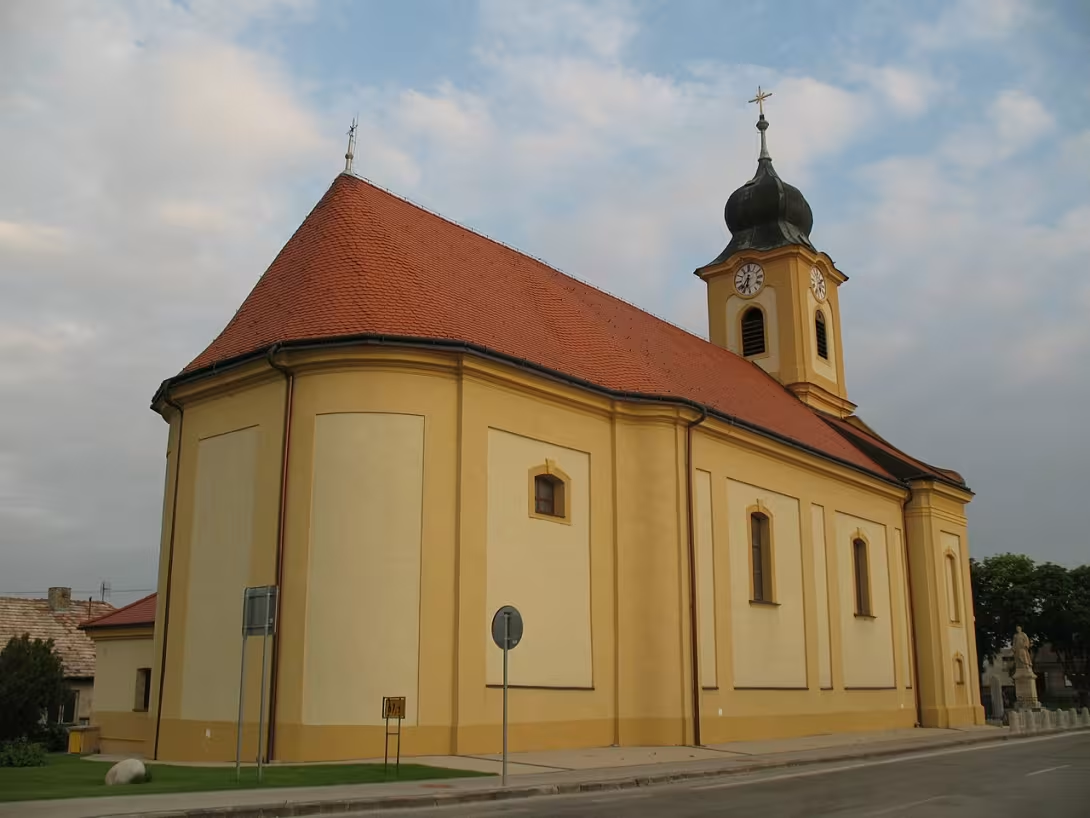
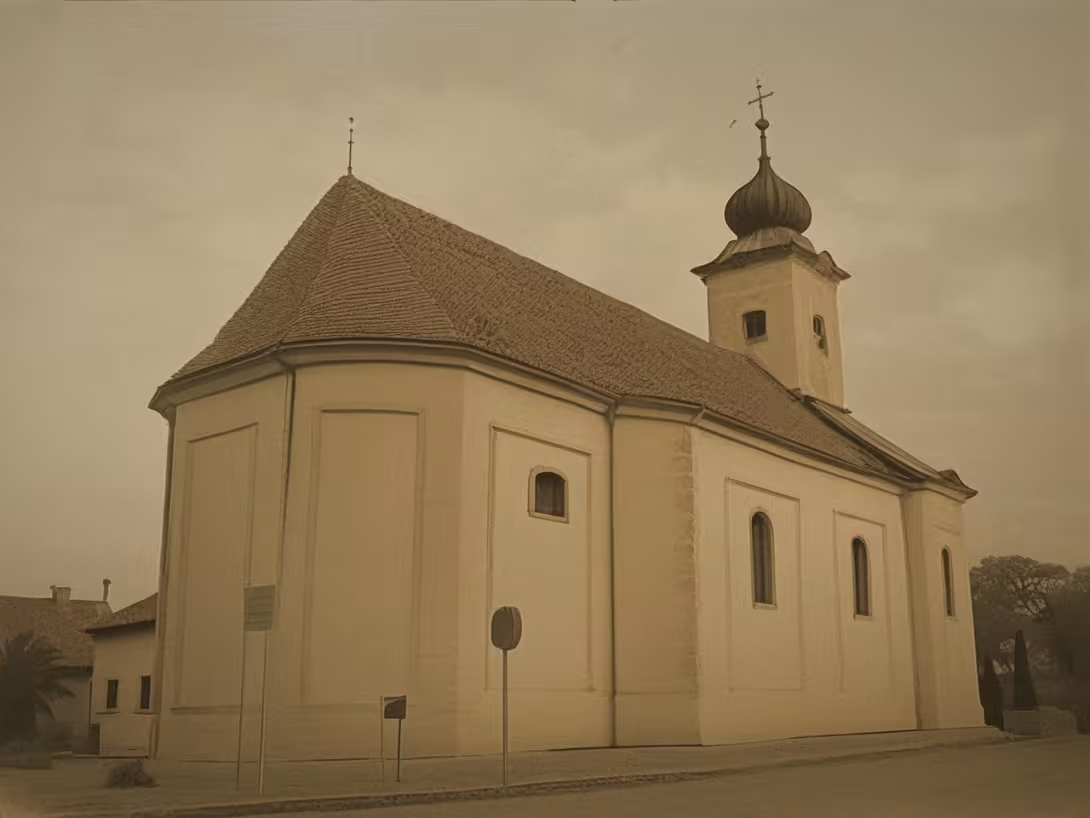
The historical view on the left is a visualisation generated by artificial intelligence and serves as inspiration.
Historical Milestones
- 1559
- first memory of sacral object
- 1728
- enlargement of the building by the sanctuarium and the attachment of the temple ship to the chapel
- 1755
- ship conversion
- 1758
- position of the tower
- 1775
- a major flood in january that destroyed the interior and damaged the walls
- 1799
- the beginning of the construction of a new church made of stone and burnt bricks
- 1806
- completion of the construction of a new church
Interesting facts
- The first memory of the sacral object in the village comes from 1559. - In January 1775 a flood of six inches [95 cm] entered the church, destroying benches, altars, closets, and floors. - The new church was founded between 1799 and 1806 by the priest Joseph Stankovic and Count Jozef Erdödy. The altar of St. Cyril and Methodius was made by Hlohovec carver J. Seilnacht of the grove oak Mlíč. - The statues of St. Anton and Lourdes Virgin Mary were devoted to the temple by believers from the Madonna from America.
Guide
Show guide text
The text was prepared by artificial intelligence and has not been editorially reviewed. It may contain inaccuracies.
Welcome to Madunicach. You stand in front of one of the most important symbols of this village, in front of the parish church of the Virgin Mary Birth. Before you go to his granddaughter, stop for a moment and just look around. Feel the atmosphere of this place, feel the peace that prevails here, and try to imagine how much peace and storm this building has experienced over the centuries. This church is not just a building of stone and bricks; it is a living chronicler of Madunic, a direct witness to history that shaped the lives of the people who lived here before us.
If you look at its present form, you might not imagine that its history is much older than it may seem at first sight. The first clue that leads us to a damn object in this place dates back to 1559. It was not yet this monumental temple that you see today, but probably a more modest object that served the spiritual needs of the local community. From that moment on, however, history began to evolve constantly and the building changed along with the increasing importance of the village.
Let's take a look at this graduation together. In 1728 there was a significant increase in the construction. At that time, the original chapel was fitted with a sanctuarium and a temple ship, which opened up the space to become more holy and more representative. The following years brought further changes. In 1755 the ship was rebuilt and already in 1758 the village began to carry out a tower, which you may still see as the dominant element of this architecture. Each phase of construction was a sign of bloom and an effort to make the place of worship as beautiful and firm as possible.
However, history is not always just a story of growth and prosperity. Sometimes it's a story about survival and how one can rise above a disaster. If you now look at the walls and perceive their strength, try to imagine the freezing January of 1775. That's when Madunice found themselves in the impact of the unpredictable power of nature. The huge flood entered the church and the water reached a height of up to 95 centimeters. Imagine the chaos, the sound of water, and the silence that followed after the water subsided. The flood was not mere superficial damage. It destroyed the benches, altars, wardrobes and damaged the floor itself. Walls that faced moisture and water pressure were also damaged. At that moment, it may have seemed that this holy building was lost, that her soul had been washed up.
But this is where one of the strongest stories of this place begins. When the sky became bright after the disaster, people in Madunicach did not give up. Instead, they decided to build something even more durable. Early in 1799, construction of a new church started. It was no longer just a repair, but a complete reconstruction of new, durable materials - stone and burnt bricks. This process lasted until 1806 and was the result of the efforts of people who believed in continuity and community power in this earth.
In this great restoration, neither a strong leader nor a generous patron would miss. Let us remember the priest Joseph Stankovič, who was the key figure of this restoration. His vision and tireless work in the service of citizens and God enabled a new temple to be born from the ruins of the flood. Count Jozef Erdődy joined his efforts, whose support was essential for the successful completion of this demanding construction. This is a fascinating example of cooperation between the clergy and the nobility, between faith and the political power that led to one common goal - the creation of a solid home for prayer.
Now that you are standing in front of this building, pay attention to its material expression. See that combination of stone and bricks you see. It's not just an aesthetic choice, it's a symbol of resistance. This church is built to withstand the time and natural elements that once inexorably attacked it. When you later move near it, try to see the details of the facade and the overall geometry of the building, which bears the imprint of the time when the new hope was built in Madunica.
There's something strange that might interest you. When you look at this church, you look not just at the building, but at the monument of human will. Every stone you see here is the answer to the 1775 flood. It is a monument to the answer to chaos. Man here has proved that even after a great loss, even after the destruction of altars and furniture, one can begin again, even better than before.
We are at the end of this short journey in front of the façade of the Virgin Mary Birth Church. I believe that this view of history has helped you to better understand where you are now. Now, however, I invite you to continue your discovery. Perhaps you will decide to enter, so that in silence and peace you can experience the atmosphere of this place in person and perceive the beauty of the interior that has been developing for centuries. I wish you a pleasant rest of your passing through Madunicami and may the peace that this church symbolizes so strongly. Goodbye.
Tips for visitors
To visit the parish church of the Nativity of the Virgin Mary is a good spring season or early autumn. Morning or evening light highlights the facade of construction. When visiting, follow appropriate clothing. The whole height of the church can be captured from the space in front of it. Watch the effect of sunlight on the walls when shooting to avoid high contrasts. The surroundings of the church form part of the village of Madunice. You can connect the visit with a walk in the area.
Frequently asked questions
Can the monument be visited?
Religious buildings are usually open mainly during services; at other times a visit is normally arranged with the parish or the operator. We have not verified specific times.
Where is the monument?
Location: Jána Hollého 138, Madunice, Trnavský kraj. The map on this page shows the exact spot.
Why is the monument protected?
It is listed in the Central List of the Monuments Fund of the Slovak Republic as a national cultural monument (ÚZPF no. 213-938).
For children
Close your eyes and imagine pressing the invisible button on the time machine. Boom! It'll take you exactly 227 years back. Cars will disappear around you, asphalt roads and your equipment. You are in the village of Madunice, where the air smells like smoke from fireplaces and in the street you hear only the stunting of horses and the roaring of chariots. It's the end of the 18th century and something big is happening right now.
Nearby
🏰 Historic sites (205)
- sv. Ján Nepomucký 0.0 km web
- Rímskokatolícki kňazi Madunickej farnosti 0.0 km
- sv. Vendelín 0.0 km web
- sv. Florián 0.0 km web
- sv. Róchus 0.0 km web
- Ján Hollý 0.0 km web
- Pamätný kameň prístavby 0.0 km
- Ján Hollý 0.1 km web
- sv. Terézia z Lisieux 0.2 km web
- Pamätník padlých v 1. svetovej vojne 0.3 km web
- Najsvätejšia Trojica 0.3 km web
- Frídeský kaštieľ 1.9 km web
- Trojičný stĺp 2.7 km
- sv. Ján Krstiteľ 2.7 km
- sv. Rozália 2.7 km
- Svätá rodina 2.9 km
- sv. Florián 2.9 km
- sv. Ján Nepomucký 2.9 km
- Padlým v 1. a 2. svetovej vojne 2.9 km
- Zmŕtvychvstalý Kristus 2.9 km
🍽️ Restaurants and dining (271)
- RM 0.1 km
- Važinka 0.1 km P. O. Hviezdoslava 368/8 +421 33 764 41 26 web
- Tango bar 1.9 km
- Pohostinstvo na vŕšku 2.0 km
- Bowling centrum 2.8 km
- Pohostinstvo 2.8 km
- Corona pub 2.9 km
- 3EC reštaurácia Červeník 3.0 km Ružová 2
- Čajka 3.2 km
- Spolková záhrada 3.7 km
- Bistro u Pištov 3.9 km +421908462634
- Jašter 3.9 km
- Penzion Nina 3.9 km web
- Stop Cafe 4.1 km
- Peterská bašta 4.1 km
- Stará Dvojka 4.4 km
- Bufet Diana 4.4 km
- Kebab 4.4 km
- Marvell 4.5 km
- BAR - Žlkovce - Ratkovce 4.6 km
🏨 Accommodation (49)
- Važinka 0.1 km P. O. Hviezdoslava 368/8 +421 33 764 41 26 web
- Kaštieľ Koplotovce - Kaplath 1.9 km +421 33 7300 462 web
- Penzión Inovec / Jalšovské chaty 4.0 km web
- Penzion M.L.K. 5.0 km Osloboditeľov 1227/104 web
- Penzión Pompano 5.7 km +421 33 73 200 26 web
- Hotel Jeleň 5.9 km +421949601251 web
- Quatro 6.0 km
- Eko Park Piešťany 8.3 km Bratislavská 7110/151
- Faraon 8.3 km
- Macho 8.4 km
- Kaštieľ Šalgovce 10.0 km web
- Kaštieľ Dezasse 10.2 km +421 948 196 796 web
- Harmony Resort 10.7 km web
- Hotel Korekt 10.8 km +421 33 774 95 00 web
- Grand Boutique Hotel Sergijo 10.9 km +421 33 773 13 12 web
- Penzión Alegro 11.0 km Odborárska 4116/10 web
- Hotel Harmónia 11.0 km Odborárska 4117/11 web
- Hellene Relax Club 11.3 km web
- Máj 11.4 km web
- Camping Pullmann 11.5 km web
🚲 Rentals and sport (33)
- Termálne kúpalisko 2.1 km web
- Adidas 5.1 km
- Bike4you 5.3 km
- GYMEX | Športové centrum 5.3 km
- AB Fittness 5.8 km
- Montana Sport 5.8 km
- Letné kúpalisko Hlohovec 6.4 km
- Vlnka 10.9 km
- Veslársky klub Sĺňava Piešťany 10.9 km
- Plaváreň 11.2 km
- Bowling center Victoria 11.2 km
- HS centrum 11.4 km
- Zimný štadión Piešťany 11.5 km
- Servis bicyklov Cyklošport 11.8 km Adama Trajana web
- Team Bike 12.3 km +421908616326 web
- SCT GYM 12.4 km Piešťanská 555/12 web
- Spinning 12.5 km
- Sportisimo 12.5 km web
- Motokárová dráha Trebatice 12.6 km
- Welo, s. r. o. 12.7 km
🥾 Hiking and nature (38)
- Nový park 3.8 km
- Sedliská 4.7 km
- Lipiny 4.8 km
- Janovo 5.2 km
- Františkánsky park 5.3 km
- Park R. Dilonga 5.4 km
- Palachnové 5.8 km
- Zámocká záhrada 6.3 km
- Holý vrch 6.5 km
- Šianec 7.1 km
- Gábor 7.2 km
- Šianec 7.6 km
- Kaštieľsky park 7.8 km
- Stredné Šumperky 8.0 km
- Starý vrch 9.7 km
- Vrbina 11.3 km
- Háj 11.4 km
- Havran 11.7 km
- Taličmáne 11.9 km
- Komín 12.0 km
Thematic route
As there are no other sites in the area, I propose a thematic route focused on the main objective and its area:
1. Parish Church of the Nativity of the Virgin Mary - sacral object with characteristic architecture. 2. Interior of the church - space with artwork of the altar and interior. 3. Church area - courtyard suitable for walk and observation of the exterior of the building.
Seasonal recommendations
In spring, the surroundings of the parish church of the Nativity of Our Lady in Madonna will awaken to life and the landscape of the Trnava region of greenery. The sun in this period provides natural lighting that highlights the details of the facade. It is recommended to visit the site in the morning and the kidneys with layers due to variable weather.
Summer season brings intense light and rich colors of nature, which makes it easier to photograph the exterior of the church. Due to high temperatures it is advisable to arrive early in the morning or late in the evening when the air is colder. Practically easy, breathable clothing and sun protection.
Podzim in Madunica is characterized by golden tones of leaves. The low sun creates long shadows and contrasts that add depth to the memory. During the visit it is advisable to choose unpaired shoes and warmer clothing.
Winter season brings silence to the country and snow can highlight the architecture of the church. In Advent time there is a calm mood around, although the days are short and light weaker. Layering clothing, warm shoes and gloves is essential.
Visualisations and artistic views


The visualisations are generated by artificial intelligence and serve as inspiration.
Photographs from the area
Real photos taken near the monument


Source and licence are given for each image.
Visitor Tips
No tips yet. Be the first!
Log in and add your tip.
Location on Map
Visitor photos
No photos yet. Be the first to add a photo from your visit!
Log in and add your photo or leave a rating.
You get more points for a visit verified in the app — we can tell from the GPS that you are there.
Reviews and comments