








roľnícka usadlosť Farmer's farmstead
In the village Senné in Banskobystrický kraj there is a courtyard from the second half of the 19th century. The complex was built in 1883.
The area consists of four objects from 1883. Part of the folk house, barn with stable, chamber with sheepfold and another barn with brick stone structure.
Objects are built according to the principles of folk construction, one of the barns is stone. Details of disposition and flooring are not specified in the registration data.
The building is declared a national cultural monument (identity number ÚZPF 32A-11056). Located in the cadastral area of the village Senné at the address number 3. GPS coordinates are 48.31299, 19.39733.
Tehdy a dnes
Drag the slider and compare how the monument might have looked when it was built with the view today.
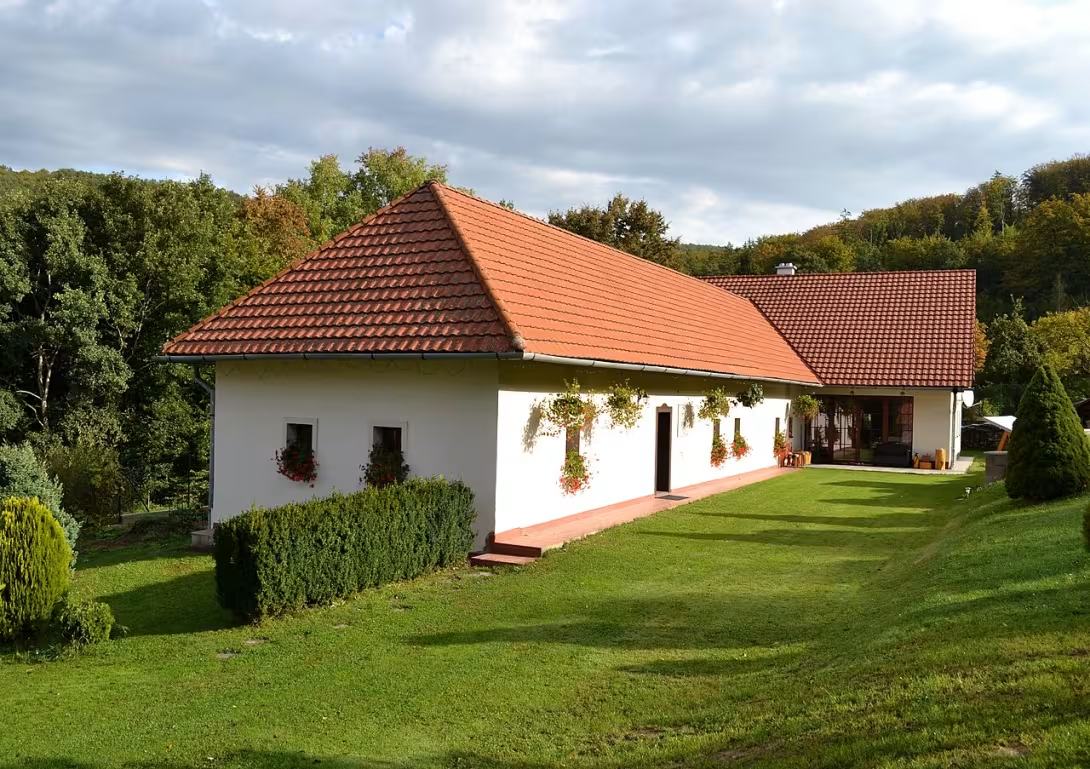

The historical view on the left is a visualisation generated by artificial intelligence and serves as inspiration.
Interesting facts
- The courtyard is located in the village Senné in Banská Bystrica region and was built in 1883. - The complex consists of four objects from 1883: folk house, barn with stable, chamber with sheepfold and another barn with brick stone structure. - Objects are built according to the principles of folk construction, one of the barns is stone. - The court in Senné is declared a national cultural monument with registration number ÚZPF 32A-11056.
Guide
Show guide text
The text was prepared by artificial intelligence and has not been editorially reviewed. It may contain inaccuracies.
Welcome to the village Senné, in the heart of the Banská Bystrica region, where time seems to flow slower and where nature harmoniously complements the traces of human activity. Right now, you are facing a historic farming settlement, a place that is the embodiment of traditional countryside and witness to every effort of generations of people who have been deeply immersed in this soil. When you look ahead like this, you may see only modest buildings in the first moment, but in fact you are looking at the foundation stone of our society, the place where fates, work, and family traditions were intertwined. Feel this atmosphere of peace and try to imagine how this place pulsed with life many years ago.
Although the exact chronology of the establishment is not known today and history has not retained the names of the specific architects who designed it, it is precisely this unknownness that gives the place some charm and versatility. The farmer's court in this area was not the result of the work of one great builder, but rather of the centuries of experience that people passed on from fathers to sons. It was created gradually, adapted to the needs of the management and climate of the Banská Bystrica region. Such settlements arose from the practical need for man, his family, and his livestock to survive in one enclosed or semi-closed area. It was the center of economic life, where everything revolved around the cycles of nature, around sowing and harvesting, around the mention of seasons.
Now that you are right before the settlement, pay your attention to the overall arrangement of the space. Notice how buildings are oriented towards each other. In traditional farming architecture it was not only about aesthetics, but mainly about functionality. Look at the facades and perceive the proportions of buildings. Consider how interior and outdoor spaces have been designed to minimise transitions and maximise work efficiency. Follow the details that are in front of you, see textures of surfaces and the way the buildings fit into the surrounding terrain. Although we do not know exactly when these walls were built, they tell us a story about simplicity and resilience. Notice how the yard creates a natural sense of shelter and security, separated from the world of the outside, but also open to the turning fields.
Looking at these walls, you might wonder who actually lived here. Although history has not preserved the specific names of the personalities taken with this court, this place is filled with the stories of thousands of anonymous peasants. Imagine the morning rising at the dawn of the first star, the smell of the morning dew, and the sounds of the animals that awakened the entire yard. This is where the children were born, the weddings were celebrated, and here they said goodbye to those who left. Every corner of this court bears the mark of a human hand, each pavement or rope bears witness to thousands of hours of hard physical labor. These people were not known from historical textbooks, but they were the ones who fed the county and maintained life in the village of Senné. Their lives were defined by discipline, humility before nature, and a strong sense of responsibility for their family and possessions.
You may now be interested in one interesting thing connected with such unknown history. It is in that we do not know the exact date of creation or the names of owners that the greatest mystery lies. This settlement is like an open book whose pages are faded over time, but we can still read it. The mystery remains what particular events have taken place here, which family secrets have been preserved in these walls, and what dreams people have dreamed of spending their evenings here. It is fascinating to think that you are standing in a place that, for someone, was the whole world, the center of his universe, and today is a fascinating historical document to us. This unfamiliarity forces us to reflect and consider what will remain of us for future generations.
Now let us slowly move forward and perceive the silence that rules in this court today. It's quiet, but it's not empty, but full of goodbyes and meetings. The peasant settlement in Senné reminds us that the true value of history is not only in monumental palaces or large castles, but in such humble places where the real, unfiltered life of ordinary people took place. It is these tiny monuments that give us the best idea of how we lived, how we thought, and how we were connected to the country that surrounds us.
Before I say good-bye and leave you in an abode of discretion, I invite you to go around the settlement on every side. Look at it from different angles, try to imagine where grain was stored, where animals were resting, and where the whole family met at a common table. Feel the game of light and shadow on the facades and try to feel the energy of this place. Let yourself be guided by your intuition and imagination, because at such moments you are becoming part of history.
Thank you for your attention and for devoting time to this silent witness of the past. I hope that the visit to the farmhouse in Senné inspired you and that you are leaving with a feeling of deeper understanding for the roots of our rural culture. I wish you a pleasant continuation in your journey to Banská Bystrica region, many new discoveries and peaceful moments in embrace of our beautiful nature. May you prosper on every path you decide to take right now. Goodbye.
Tips for visitors
The recommended period of visit is summer and autumn, when the weather is usually pleasant and light suitable for photography.
We recommend checking the exact location and availability of places before visiting. You can access the Senné by public transport; check the links in the local search engine.
Take protective clothing, shoes suitable for the terrain, sunglasses and camera. We also recommend bringing drinking water.
The remains of the settlement can be photographed from different angles, especially during sunset.
Near the farmhouse complex in Senné is a folk monument. The place is suitable for families with children thanks to interactive elements and short walks.
Frequently asked questions
Can the monument be visited?
This is a residential or farm building, not a museum with opening hours. Please view it from public space and respect the owners' privacy. We have no information about access to the interior.
Where is the monument?
Location: č. 3, Senné, Banskobystrický kraj. The map on this page shows the exact spot.
Why is the monument protected?
It is listed in the Central List of the Monuments Fund of the Slovak Republic as a national cultural monument (ÚZPF no. 32A-11056).
For children
Imagine you're teleporting to the past right now. It's not a journey through space, it's a journey through time. Try to imagine - it is precisely 143 years since this settlement began to be built. In 1883, the world looked completely different. There were no cars, no phones, no internet. Everything was slower, quieter and full of smell of freshly dug ground and straw.
Nearby
🏰 Historic sites (49)
- Kováčska vyhňa 3.4 km
- Štefan Tuček 3.6 km
- hrad Strahora 5.3 km
- Pamätná tabuľa J. V. Luňáčka 5.4 km
- Kostolisko 7.1 km web
- sv. Ján Nepomucký 7.1 km
- Lajos Kubányi 7.2 km
- Vysťahovanie časti obce Tabáň 7.6 km
- Kostol Lešť 7.7 km
- Kaštieľ Slatinka 8.5 km
- Obecné múzeum miestnych dejín. Pamätná izba Daniela Maróthyho a Eleny Maróthy Šoltésovej 8.8 km
- Ľudové náhrobky Novohradu 8.8 km
- Andrej Hlinka 9.0 km
- Bálint Balassi 9.0 km
- sv. Anton Paduánsky 9.0 km
- Modrý Kameň 9.1 km web
- Múzeum bábkarských kultúr a hračiek 9.1 km web
- Obetiam SNP a 2. svetovej vojny 9.3 km
- Mariánsky stĺp 9.3 km
- Pamätník Zaniknutej Obce Selce 9.3 km
🍽️ Restaurants and dining (44)
- Hradná cukráreň 9.1 km
- Pizzeria & Restaurant Na Zákrute 9.9 km +421 918 038 854
- Hostinec u Kohúta 10.0 km
- Café Tina 11.1 km
- Hostinec u Lubika 11.7 km Boženy Němcovej
- Stop Cafe 11.7 km
- Marťák 11.7 km Boženy Němcovej
- Hostinec Šťuka 11.7 km
- Martiner 11.8 km
- Jedáleň Novohrad 11.9 km +421 47 48 31 793
- Pod vrbou 11.9 km
- Tenis u Milana 11.9 km
- Dilema 11.9 km
- Mafík 12.0 km +421 908 041 230
- Papuča 12.0 km
- Sola 12.0 km
- Cukráreň Ján Pavlov 12.0 km
- Lamami 12.1 km +421 918 426 586 web
- Atila 12.1 km +421 47 48 25318
- Gastro-Hell 12.1 km
🏨 Accommodation (14)
- Hotel Koprovnica 4.6 km +421 474 896 303 web
- Chatky Žabky 8.1 km Hlavná 307 web
- Chata Alexandra 8.4 km areál termálneho kúpaliska web
- Chalupy NATURAL SLOVAKIA 9.8 km web
- Penzión Kaštieľ 12.2 km +421 47 48 311 67 web
- Hotel Dolina 12.2 km
- Ubytovanie na včelej farme 12.6 km
- Penzión u Vinára 12.9 km
- Camping & Glamping Slovakia 13.5 km web
- Kaštieľ LODOMERIA 13.8 km web
- Chata Španí Laz 13.8 km
- Zbrojnica 13.8 km +421 47 4392122 web
- Zámocký hotel Galicia Nueva 14.0 km +421 47 2852 200 web
- Camping Lazy 15.0 km web
🚲 Rentals and sport (4)
- Cyklospol 12.2 km Námestie Augusta Horislava Škultétyho 10
- Biokúpalisko Krtko 12.2 km +421 47 48 30819 web
- Mestská plaváreň 12.2 km web
- K Park 12.3 km
🥾 Hiking and nature (216)
- Vŕšok 0.8 km
- Benčíkov vrch 1.0 km
- Starý háj 1.3 km
- Paušovo 1.4 km
- Starý vrch 1.5 km
- Holý vrch 1.7 km
- Drieňová 1.9 km
- Banisko 2.2 km
- Strážna hora 2.2 km
- Hriechov vrch 2.8 km
- Osevné 2.8 km
- Vanov vrch 2.9 km
- Balkovica 3.3 km
- Imrov kopec 3.5 km
- Facianka 3.7 km
- Budov vŕšok 3.8 km
- Hôrka 3.9 km
- Hrb 4.0 km
- Kopane 4.3 km
- Suchý drieň 4.3 km
Thematic route
Since the given background is empty, I propose a route which focuses exclusively on the monument itself and its immediate surroundings in the village Senné.
Farmhouse (Dvor peasant) This historic object represents an important point of excursion. Visit it first to get an overall picture of traditional architecture and lifestyle of farmers in this part of Banská Bystrica region. Observe construction details that reflect local construction procedures and functional distribution of premises.
Seasonal settlements After an outdoor tour, look at the inner courtyard. This place was the historical centre of family economic activity. Observe the arrangement of the area that indicates where the stables, storages, or areas for drying crops were located.
The surroundings of the building and the park Take a walk around the house. The very environment around the farmyard often contains old trees or garden elements that are part of the original area. This calm space allows for deeper involvement in the atmosphere of the place.
Gateway and access road Complete the tour by observing the entrance part of the area. Historical gates and roads often carry traces of the original arrangement of access to property. It is an ideal point to sum up the impressions of the visit and to understand the context in which this settlement existed.
This compact route inside the area allows you to explore all the available aspects of this particular monument without the need to move to other, unspecified sites.
Seasonal recommendations
In spring the peasant settlement in Senné will wake up with the surrounding nature. Fresh green and soft morning light give the place a feeling of recovery and freshness. We recommend you prepare layered clothes because spring weather is fluctuating in this area. It is best to visit the site in the morning when the air is the cleanest and light most suitable for observing the details of architecture.
Summer brings intense sunlight and rich, dense vegetation to the surroundings. The atmosphere is very lively during this period and long days allow more time to be spent in the place. Due to the high temperatures and increased interest of visitors, it is best to arrive early in the morning or later in the afternoon to avoid heat and crowds. Remember to protect from the sun and enough fluids.
Autumn visit offers nostalgic atmosphere thanks to golden colors of leaves and morning fog that surround historical objects. Lighting is soft and playful in this period, creating ideal conditions for photography. It is advisable to take comfortable shoes and warmer layers of clothing, especially if you plan to be outdoors during falling temperatures in later hours.
Senné is quiet and calming in winter. If snow comes, historical buildings are magical, although the landscape is more visually machined. Since the days are significantly shorter at this time, we recommend planning a visit at noon to use the maximum daily world. Don't forget the warm clothes and check the short opening time before you arrive.
Visualisations and artistic views


The visualisations are generated by artificial intelligence and serve as inspiration.
Visitor Tips
No tips yet. Be the first!
Log in and add your tip.
Location on Map
More monuments – Senné
Show all in the town
Visitor photos
No photos yet. Be the first to add a photo from your visit!
Log in and add your photo or leave a rating.
You get more points for a visit verified in the app — we can tell from the GPS that you are there.
Reviews and comments