

st. Martin's Church Church
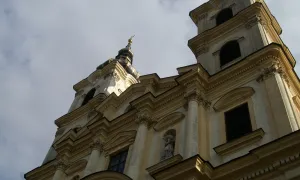
St Martin's church in the village Suchá nad Parnou in Trnava region is a national cultural monument from the first half of the 18th century. It is a baroque church which is part of the local parish and in the register of the Monument Office of the Slovak Republic is kept under the number ÚZPF 1021.
The origins of the temple dedicated to Saint Martin probably date back to the 13th century. Historical sources indicate that the original church in the village was probably Gothic; the local priest is mentioned after 1280 and the parish with the church appears in the roster of the papal tithes from the years 1332 to 1337. Patrocinium church is evidenced by the year 1397. At the beginning of the 18th century, this medieval temple was replaced by a new Baroque building, which was built between 1700 and 1708.
In terms of architecture, it is a baroque building. From the original Gothic church, the western tower was preserved, which was incorporated into a new church. In 1735 this tower was supplemented by an eight-side superstructure, which increased it.
St. Martin's Church of Tours belongs to the parish of Suchá nad Parnou and its current state reflects the interventional construction from the turn of the 17th and 18th centuries.
The object documents the continuity of Christian presence in this location from the Middle Ages to the Baroque period. A visit to this temple makes it possible to see a specific example of a combination of elements from different ages within one building.
Tehdy a dnes
Drag the slider and compare how the monument might have looked when it was built with the view today.
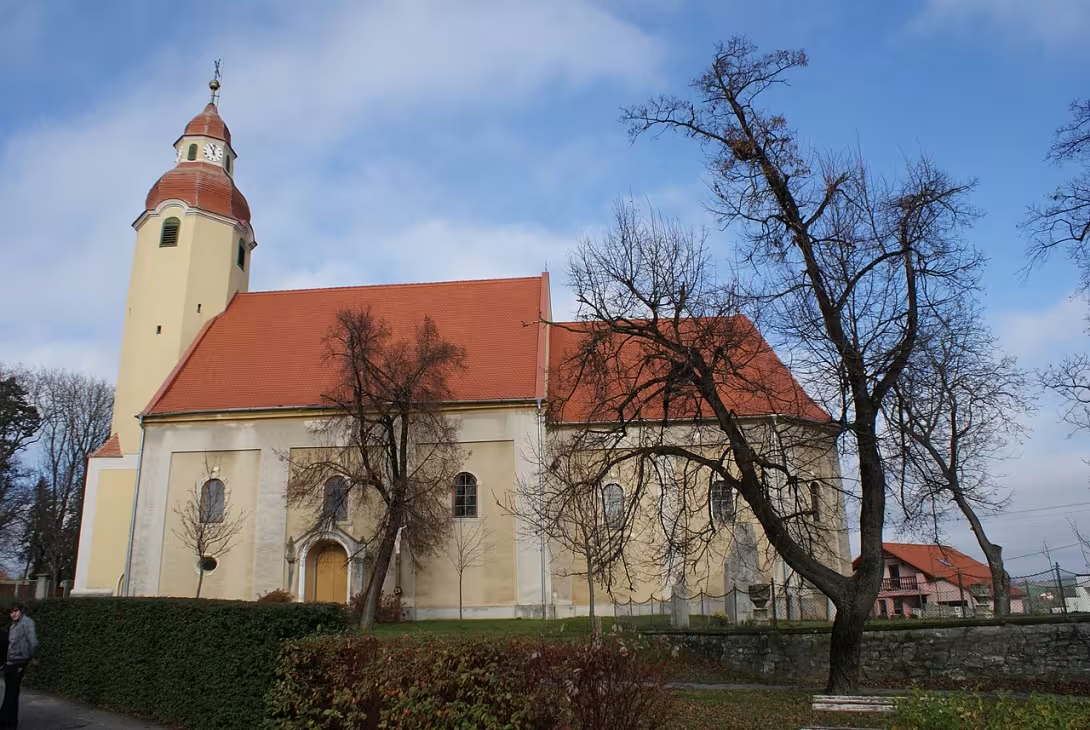
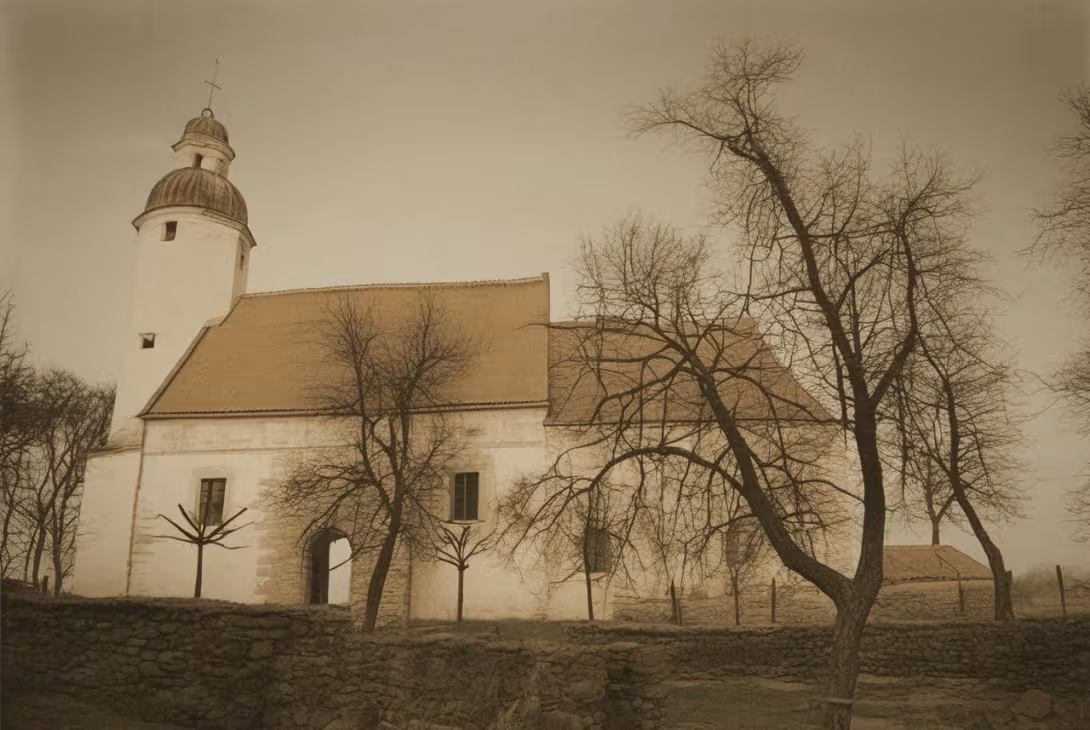
The historical view on the left is a visualisation generated by artificial intelligence and serves as inspiration.
Historical Milestones
- The origins of the temple probably date back to the 13th century.
- The parish with the church is listed in an inventory of papal tithes from the years 1332-1337.
- Patrocinium church is evidenced by the year 1397.
- At the beginning of the 18th century, the medieval church was replaced by a new baroque temple.
- In 1735 the tower was raised by an eight-side superstructure.
Interesting facts
- St. Martin's church is a national cultural monument from the first half of the 18th century. - The origins of the temple probably date back to the 13th century and the original church was apparently Gothic. - The current Baroque building was built between 1700 and 1708. - From the original Gothic church, the western tower was preserved, which was incorporated into a new church. - In 1735 the tower was raised by an eight-side superstructure.
Guide
The guide was voiced by a synthetic voice created by artificial intelligence.
Show guide text
The text was prepared by artificial intelligence and has not been editorially reviewed. It may contain inaccuracies.
You can see in Sucha nad Parnou, in the picturesque surroundings of the Trnava region, where times overlap and history affects the present. You stand before an extraordinary building that deserves your full attention. Before you the poles of St. Martin's Church, a national cultural monument that testifies to the rich architectural and spiritual heritage of this region. Although at first glance this building may seem to be the result of a single period, the reality is somewhat more complex and fascinating. This building is not just a stone and plaster, but a living witness to the changes that have passed through the centuries. Look at the facade and see its overall impression. The Baroque style, which dominates the current form of the church, brings elegance, harmony and a certain ceremony, typical for the European architecture of the first half of the eighteenth century. In order to understand what we are seeing, we need to go back a few centuries. The origins of this temple probably date back to the thirteenth century. At that time the original church was probably built in Gothic style, which was a common style for sacral buildings in our territory. Gothic has brought to architecture the verticalness, light, and certain mysticism that would reflect the attention of believers from the earthly towards the heavenly. However, as is often the case in history, this church has undergone a fundamental transformation. Between 1700 and 1708 there was an extensive reconstruction that gave him the present Baroque form. This transformation was not only an aesthetic adjustment but also reflected changes in the social and religious life of the community. The Baroque Epic led to churches becoming more monumental, with an emphasis on space, light and emotional experience of worship. Now let us take a closer look at the details you can see right in front of you. Although the original Gothic structure has changed, some elements of it have been preserved and today form an interesting contrast with the Baroque facade. The most important of these is the western first original temple, which has been preserved until today. This part of the building is like a bridge between two epochs. When you look at the western side of the church, note the difference in texture and perhaps even in plaster or stone compared to the rest of the baroque structure. This detail is crucial for understanding the patency of the history of this place. The west side often contains entrance portals or windows that may have different shapes and proportions than those typical of Baroque architecture. It's like time here has been compiled by a palm tree where old and new meet in one whole. In addition to the western side, attention is paid to the overall shape and proportionality of the building. The Baroque churches are characterized by smooth lines, rounded shapes and a harmonious ratio of height and width. Although we are not able to accurately identify all architectural elements without a scientific survey, the overall impression is clear. The facade acts in a stable and dignified manner, which is consistent with the purpose of this place. The church has always been the center of community life, a place of prayer, celebrations, sadness and joy. For the inhabitants of Suchej nad Parnou and surrounding villages was and still is an important point of orientation. The history of this church is intertwined with the fates of the entire community. Although the specific names of architects behind the Baroque reconstruction are unknown to us, we know that it was a work that required considerable financial and working resources. Between 1700 and 1708 Europe was on the move, not only politically but also culturally and artistically. Baroque wool, which came from Italian and Austrian architecture, has also spread to the territory of today's Slovakia. Construction workers and craftsmen then worked with the latest techniques of their time to create an area that would meet the Catholic Church's demands for festivities and a clear expression of faith. An interesting fact that deserves your attention is the fact itself that the Gothic element remains in the Baroque building. In many cases, the old parts were completely demolished and replaced with new ones. Here, however, it was decided to preserve the western side. This decision may have had practical but also symbolic reasons. It may have been about saving material and time, but it is also possible that the builders wanted to preserve something of the church's original identity. Thus, this western part is not only an architectural relic but also a historical document. It reminds us that St. Martin's church existed long before it gave it a Baroque form. It is a testimony to continuity that proves valuable in an otherwise rapidly changing world. When you look at the sky above the church, you can imagine the change in appearance over the centuries. In the thirteenth century, you would see steep roofs and perhaps even a tower tower towering over the surrounding countryside. Today we see a baroque facade that is smoother, with emphasis on horizontal lines and light. This transition from Gothic to Baroque is typical for many churches in Central Europe. Barok brought more light and space into the architecture, which was manifested in the interiors of churches, although we are now outside. Still, it is possible to imagine how light is parting on walls and ceilings, creating an atmosphere that promotes spiritual reflection. St Martin's church in Suchá nad Parna is not only an architectural monument, but also a place where past and present meet. For the visitor it is an opportunity to stop, relax from the daily shower and perceive the silence and tranquility that this place radiates. Although we are not able to enter the interior and explore the details of altars, sculptures or painting decorations that could be richer in Baroque style, the facade itself gives us enough incentive to think. It's where history can be touched. Every stone, every plaster has its own story, which is fulfilled over the years. If you look at the surroundings of the church, notice how it is inserted into the country. Churches were often built in elevated places in the past to be seen from a distance and symbolically stand near heaven. Although the exact topographical conditions of this place are not mentioned in the description, it is usual that sacral buildings have a dominant position in the village. This position gives them weight and importance. For the inhabitants, it was where they met, where important things were dealt with, and where the greatest life events were celebrated. Basic themes
Tips for visitors
St. Martin church in the village Dry over steam we recommend to visit late in spring or autumn. Pleasant temperatures and colors of the Trnava region will then highlight the architecture of the building.
We recommend taking a dresser to change the weather and suitable shoes for walks around the village. When entering the building, take care of discreet clothing suitable for sacral space.
Photos of the building in the context of village buildings can be captured around the church. Ideal light for exterior images is during the golden hour before sun flooding, when the walls of the building are illuminated with warm yellow light.
Families with children can connect the visit with short walks around the village. It is a way to involve children in learning local history and architecture in a peaceful atmosphere.
Frequently asked questions
Can the monument be visited?
Religious buildings are usually open mainly during services; at other times a visit is normally arranged with the parish or the operator. We have not verified specific times.
Where is the monument?
Location: č. 56, Suchá nad Parnou, Trnavský kraj. The map on this page shows the exact spot.
Why is the monument protected?
It is listed in the Central List of the Monuments Fund of the Slovak Republic as a national cultural monument (ÚZPF no. 217-1021).
For children
Imagine the way to the past, exactly 326 years back. In the village of Suchá nad Parnou, the church of St. Martin began to be built.
Men in thick baskets and women in long skirts met before the building, which was to be the center of their village. People lived in the rhythm of nature, watching the movement of the sun and listening to the noise of local creeks. St. Martina stood above them and watched everything that was happening around them.
Nearby
🏰 Historic sites (372)
- Obetiam 2. svetovej vojny 0.0 km
- Obetiam 1. svetovej vojny 0.0 km
- Obetiam 1. svetovej vojny 0.0 km
- Immaculata 0.0 km
- Hrdinom SNP 0.1 km
- sv. Barbora 0.3 km
- Kalvária 0.4 km
- sv. Florián 0.7 km
- sv. Ján Nepomucký 0.8 km
- sv. Vendelín 1.1 km
- sv. Urban z Langres 1.2 km
- Obetiam 2. svetovej vojny 1.8 km
- sv. Ján Nepomucký 2.0 km
- Katka 2.2 km
- sv. Florián 2.2 km
- Augustín Nádaský 4.0 km
- Jozef Heriban 4.0 km
- Kostol Krista Kráľa 4.0 km
- Obetiam 1. svetovej vojny 4.0 km
- sv. Florián 4.1 km
🍽️ Restaurants and dining (284)
- Hostinec Nikodem 0.1 km
- Bistro Parna 0.6 km
- Restaurant & Pizzeria Šrámek 0.8 km
- U Božky 2.1 km
- Šelpis 4.0 km Hlavná 195/73
- Hostinec Xénia 4.0 km
- U Katušáka 4.2 km
- Rosenthal 4.4 km
- Stop Cafe 4.5 km
- Pizza Na výslní 5.7 km
- Cafe Alba 5.8 km
- Penzión pod Zámkom 5.8 km Pod Zámkom 407/4 +421 33 557 9166 web
- Fajn shop café 6.1 km
- Kimli pasta 6.5 km
- Lovecká reštaurácia 6.6 km
- Na domovine 6.7 km Stará domovina 298/1
- OOZI 6.8 km
- Gurmán 6.8 km +421 33 240 0194
- Rychlovka Burgers 6.8 km web
- Bufet u medveďa 6.9 km
🏨 Accommodation (55)
- Penzión na priehrade 0.9 km +421 910 578 800 web
- Koliba 6.9 km Kamenný mlyn 5788/8 web
- Horáreň Šišoretné 7.3 km +421 905 613 211 web
- Penzion OAZA 8.0 km
- Empire 8.0 km web
- MAX PLAZA 8.1 km Štefánikova 111/21 +421 948 709 710 web
- La Pension 8.1 km +421 911 655 500 web
- Barbakan 8.2 km +421 335 511 847 web
- Ompitál 8.2 km
- Unistav 8.2 km
- Ubytovňa Nukleon 8.3 km +421 915 961 719
- Karlov dvor 8.3 km M. R. Štefánika 1100/80 web
- Holiday Inn 8.4 km Hornopotočná 8217/5 web
- Elements 8.4 km
- Penzión Patriot 8.5 km +421335512511 web
- Dependance Patriot 8.6 km Jeruzalemská 294/3 +421905773366 web
- Hotel LONDON 8.8 km web
- Hotel Dream 8.8 km Kapitulská 454/12 web
- Hotel Phoenix 8.8 km Kapitulská 458/16 web
- Hotel SHEYLY'S 8.9 km Klempova 2390/2 +421 905 360 036 web
🚲 Rentals and sport (91)
- Motokáry Dlhá 5.3 km +421903735188
- Danip-centrum 6.0 km +421 907 114 900 web
- Strelecký areál Štrky 6.4 km web
- Autobusová zastávka oproti Golfu 6.6 km web
- ChillPoint Laser Aréna 6.7 km +421 910 836 876 web
- OOZI 6.8 km Trstínska cesta 7399/6A +421 903 750 527 web
- Skladová - Fakulta masmediálnej komunikácie UCM 6.8 km web
- Park pri Kamenáči 6.9 km web
- ZSE Ružindolská 7.0 km web
- Nákupné centrum Trstínska 7.1 km web
- Cintorín Kamenná cesta 7.1 km web
- Štatistický úrad 7.3 km web
- Okružné námestie 7.3 km web
- 4bike 7.4 km Okružné námestie 2910/13 +421 948 054 908
- Zariadenie pre seniorov 7.5 km web
- Fitness cetrum 7.5 km
- Titusa Zemana Kopánka 7.5 km web
- BouldroFka 7.5 km Trstínska cesta 1672/1 web
- T. Vansovej - Merkur 7.6 km web
- Átriová / Pavla Mudroňa 7.7 km web
🥾 Hiking and nature (151)
- Borová hora 2.2 km
- Dubník 5.7 km
- Oddychová zóna Štrky 6.5 km
- Geometry Dash Tree 6.9 km
- Ohlajty 7.0 km
- Skalkové 7.0 km
- Pangort 7.2 km
- History Park 7.3 km +421 905 885 684 web
- Kalvária 7.4 km
- Slepý vrch 7.5 km
- Výhľad Slepý vrch 7.5 km
- Bolehlav 7.7 km
- Dubník 7.7 km
- Vinárstvo Doľany 7.8 km
- Bernolákov sad 8.0 km
- Umelý kopec 8.2 km
- jaskyňa sv. Leonarda 8.2 km
- Arborétum Doľany 8.2 km
- Všivavec 8.3 km
- park Janka Kráľa 8.3 km
Thematic route
The proposed thematic route within the monument area:
1. Church of St. Martin - sacral object with characteristic architecture. 2. Interior of the church - space with artistic details and temple equipment. 3. Church area - an outdoor environment that allows you to bypass the building.
Seasonal recommendations
In the spring, the surroundings of St. Martin's church in the village Suchá nad Parnou will be covered in green vegetation. The sun during this period highlights the details of the facade. It is recommended that shoes suitable for wet terrain and visit in additional hours.
Summer months bring intense lighting and rich colors of nature, which makes it easier to photograph the exterior. Due to high temperatures it is advisable to choose morning or late evening hours. Easy clothes and a hat to protect against sunlight are practical.
Autumn in Trnava region changes the colour of the leaf. Clouds light creates deep shadows and enhances wall texture. When planning the trip, we need to consider layered clothing and waterproof footwear, as it may be wet around the church.
Winter season changes the character of the place, especially if the landscape covers the snow. A short day requires arrival at dawn. Warm and waterproof clothing that protects from frost and wind is essential.
Visualisations and artistic views


The visualisations are generated by artificial intelligence and serve as inspiration.
Visitor Tips
No tips yet. Be the first!
Log in and add your tip.
Location on Map
More monuments – Suchá nad Parnou
Show all in the town
Visitor photos
No photos yet. Be the first to add a photo from your visit!
Log in and add your photo or leave a rating.
You get more points for a visit verified in the app — we can tell from the GPS that you are there.
Reviews and comments