

st. Stephen's Church of the First Disciple Church and wall
St. Štefana first-classer with a wall in the village of Eastern Žilina region is a national cultural monument. Its origin dates back to the 14th to 15th centuries. Gothic building has an interior set of oil paintings.
The area is registered by the Monument Office of the Slovak Republic under number ÚZPF 2580. It consists of a church and a brick wall. Originally it was a simple single-ship building with a polygonal presbytery without a tower. The current ground plan dimensions of the building are 12 x 21 meters.
The church architecture has undergone several changes over the centuries. In 1618 a low tower was built to build, which in 1827 was built to the present height. Around 1834 the sanctuary was encircled by the area of the Prussian arch and a cross vault was formed in the hallway.
The church's confectionery reaches the 17th century. The first bells hung on the tower between 1634 and 1636. In 1834 a large bell was hung on the tower, spilled from a bell from 1634.
In the 20th century there were technical and aesthetic adjustments. In 1928 they introduced electric lighting into the building and installed lightning rod. In 1932 wooden beams were replaced above the temple boat and Mikuláš Štalmach decorated the interior with wall and ceiling paintings.
The interior is decorated with a set of forty-five oil paintings by academic painter Fer King. They were initiated by Prof. ThDr. PhDr. Ladislav Hanus and vdp. Ján Kováč. The ceiling is arranged into cassettes with the likeness of saints from thirteen Liptov villages. These forms, along with twelve illustration oil paintings, were placed in cartridges in 1986.
Other artistic elements are the five paintings on the facade of a presbytery arranged into the shape of an isosceles cross and the image of the Divine Heart. In May 1999, fourteen images of the ship's crossroads were added. The whole set of oil paintings was consecrated in August 1999 by the Bishop of Spiš Msgr. František Tondra. In 2002, four stained stains were planted in the windows of Fer King and Peter Krivda.
The church was declared a cultural monument in 1968. It has been registered in the Central List of Cultural Monuments of Slovakia since 1999.
Tehdy a dnes
Drag the slider and compare how the monument might have looked when it was built with the view today.
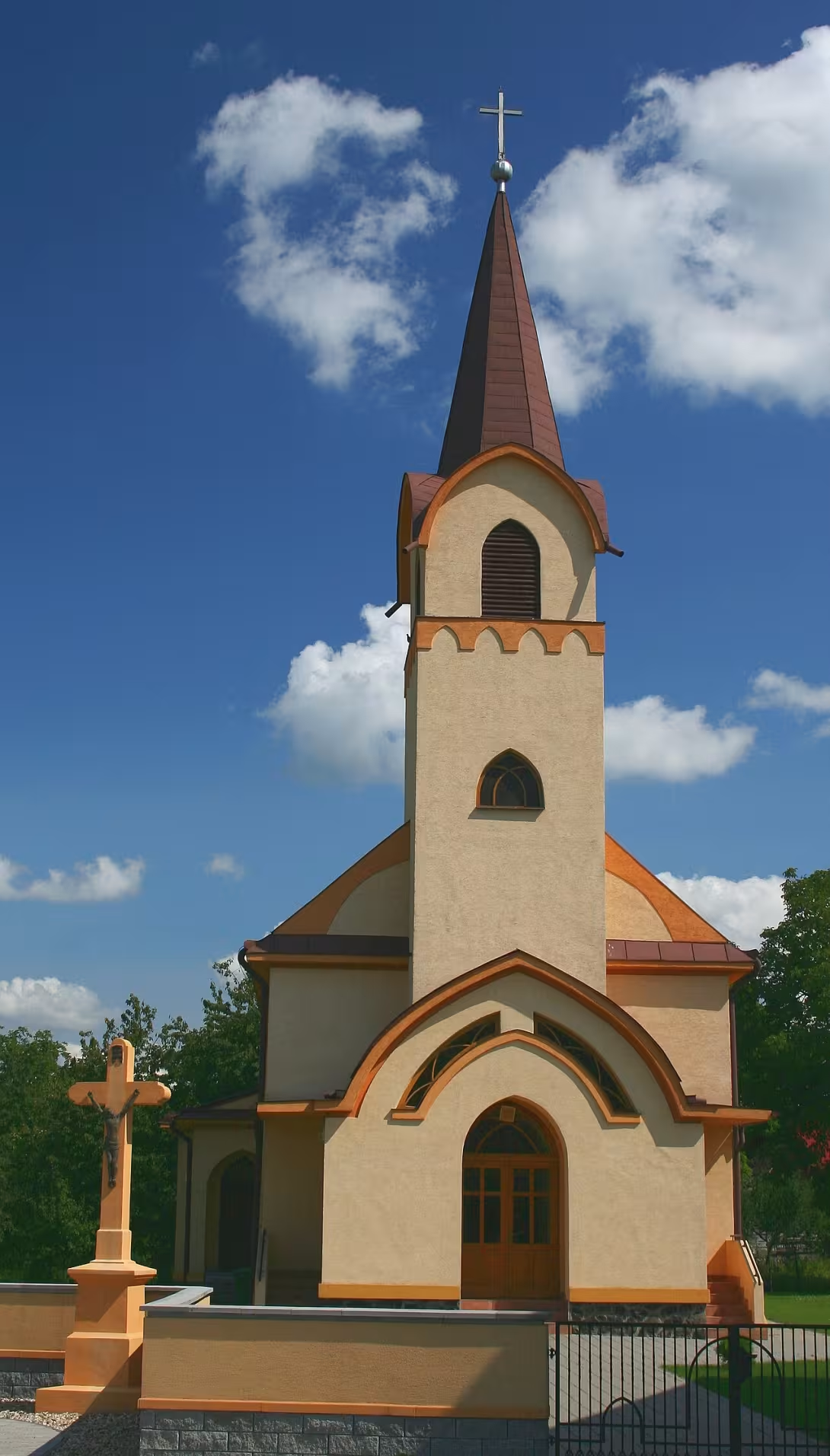
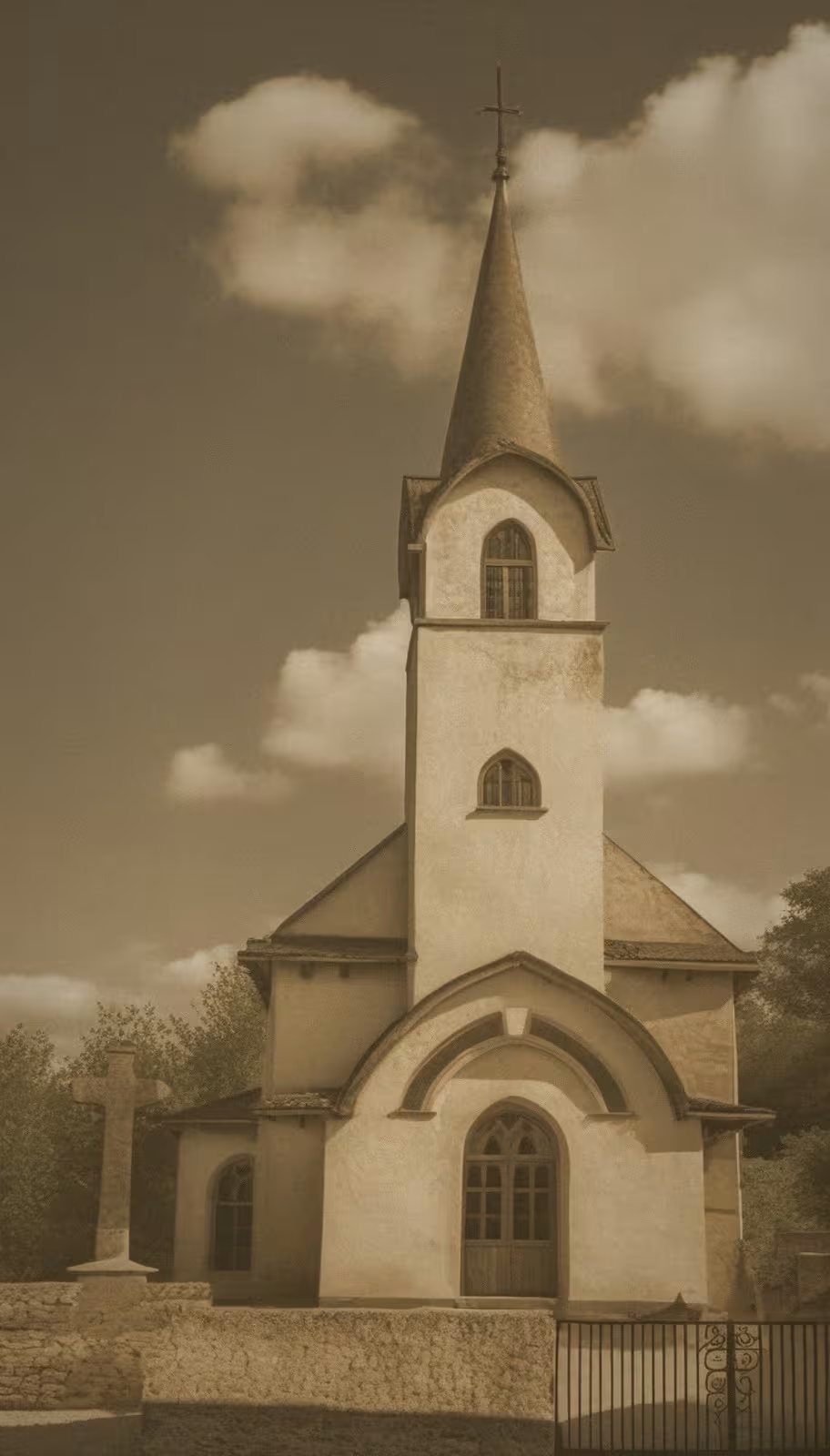
The historical view on the left is a visualisation generated by artificial intelligence and serves as inspiration.
Historical Milestones
- 1618
- A low tower was added to the church.
- 1634-1636
- First bells were suspended on the tower.
- 1827
- The tower was built to its present height.
- 1834
- On the tower was hung a large bell spilled from a bell from 1634; the shrine was encircled by a surface of a Prussian vault and a cross vault was formed in the hallway.
- 1928
- Electric lighting and lightning rod were introduced into the church.
- 1932
- Wooden beams above the temple boat were replaced and the interior decorated Mikuláš Štalmach with wall and cei
Interesting facts
- Gothic building from the 14th to 15th century is a national cultural monument and consists of a church and a brick wall. - The low tower was built in 1618 and was built in 1827 to its current height. - The first bells were hung on the tower between 1634 and 1636. - The interior is decorated with a set of 45 oil paintings of academic painter Fero Kráľ, and the ceiling contains the likeness of saints from thirteen Liptov villages. - In 2002, four stained stains were planted in the windows of Fer King and Peter Krivda.
Guide
The guide was voiced by a synthetic voice created by artificial intelligence.
Show guide text
The text was prepared by artificial intelligence and has not been editorially reviewed. It may contain inaccuracies.
You can see in the picturesque village of East, where time seems to be slower than in other parts of Žilina region. You stand in front of one of the most valuable historical monuments of this region, in front of the Gothic church of St. Stephen's first-classer. Let's stop for a moment and see the atmosphere of this place. In front of you, the building, which preserved its original fragility and dignity, surrounded by a brick wall of wall, which together with the church forms a single architectural unit. This combination of sacral construction and protective wall creates a space that immediately separates you from the busy world outside and touches you into silence and contemplation. Since it is a national cultural monument, you can be sure that each stone and each line of this building has its own story that stretches over the centuries.
When you look at the facade, notice its simplicity and strength. It is a Gothic building, which was created during the 14th to 15th centuries. This means that this church has been built for more than six centuries and has survived countless historical events, wars, plagues and changes in society. Gothic, although often associated with high towers and window fillings, was in this case more manifested in robust masonry and functional access to space. The church was built as a spiritual center of the village, a place where generations of believers met to pray, condone and part with loved ones. Its location in East is not accidental; sacral buildings in this part of Slovakia have always been important points of orientation in the country.
Nyni pay attention to the tower, which dominates the overall appearance of the building. This tower has its own, very interesting history, which differs from the rest of the church. Originally, it did not exist in its present form. Only in 1618 was a low tower added to the church. Imagine what this place looked like at the time - probably a simpler, lower structure, which gradually shattered. The tower served not only as a landmark for citizens, but also as a place where bells, calling people to prayers and announcing important events came from. Between 1634 and 1636 the first bells were suspended on this low tower. The sound of these bells probably resonated around the East and became part of the daily rhythm of the inhabitants' lives.
Time, however, brought about changes and a need for greater height. In 1827 there were interventions that set the tower to its current height. This adjustment changed the ratio of construction and the tower gained its impressive appearance today. When you look up, you can imagine how this building changed from a functional port to the dominant of the village. The tower is not only a decorative element but a symbol of the connections between the earth and heaven, between the community and its spiritual leader.
The interior furnishings and technical adjustments of the church have also undergone significant changes, which testify to the efforts to keep this shrine in good condition and adapt it to the needs of the times. In 1834 a large bell was hung on the tower, spilled from an older bell from 1634. This procedure, when the old bell melted and formed a new, larger piece, was a common practice that preserved some continuity and memory after previous generations. In the same year there were also important building modifications inside the church. The shrine, or altar area, was encircled by a spring vault. Prussian vault is typical for its simple, sedentary shape, which is stable and practical. In the hall, that is, in the space before entering the main ship, a cross vault was formed. These arches are not only technical solutions but also aesthetic elements that affect acoustics and lighting conditions inside the church.
Modern era brought to the church also technologies that would seem magical centuries ago. In 1928 the church introduced electric lighting and installed lightning rod. Previously, lighting relied on candles and lamps, creating an intimate but often dark atmosphere. The electricity brought clarity and safety, while the lightning rod protected the ancient building from lightning damage, which was dangerous in open spaces and high towers. These modifications indicate that the church was still a living organism adapted to new possibilities and threats.
One of the most beautiful aspects of this place is its artistic equipment that gives the interior life and color. In 1932 there was an exchange of wooden beams above the temple boat, which was necessary to preserve the static of the building. But the most important event this year was the decoration of the interior by Mikuláš Štalmach. This artist has created a set of wall and ceiling paintings, which continue to beautify the premises of the church. Although there is a set of 45 oil paintings that make up a rich visual program, it is important to realize that these works are not merely an ornament. They are visual stories that tell about holy, Bible scenes, and spiritual values. Mikuláš Štalmach, as one of the great artists of his time, brought to Eastern artistic quality, which crossed the boundaries of the local community. His paintings testify that a high artistic level could also be achieved in the countryside.
When you look at the wall that surrounds the church, notice that it is brick and creates a unit with the church. This wall is not only a border but also a symbol of protection. In the past, he served to separate holy space from the profane world. Today it is part of the landscape of the East and gives the entire site a historical depth. The brick wall together with the church form a national cultural monument, which means that their protection and preservation is in the national interest.
An interesting thing that may surprise the visitor is the very age and permanence of this Gothic building. Many churches from the same period were rebuilt, rebuilt, expanded, or even destroyed over the centuries so that only debris remained. St. Stephen's church in the first disciple in the East, however, preserved its essence. Gothic architecture from the 14th and 15th centuries is visible here in the basic concept of construction, although later added elements, such as the 17th century tower and the 19th century performance, changed its overall appearance. That
Tips for visitors
We recommend a visit in spring and summer, when the architecture of St. Stephen's church stands out in the natural light. A good time is the morning dawn or shortly before sundown, when the shadows are more pronounced at the wall.
Since it is a sacral structure, we recommend decent clothing and comfortable shoes for the field.
For photography are suitable views of the church with a wall. Details of the facade are best captured in the late afternoons.
For families with children we recommend walks around the monuments to get to know the local history and architecture.
Frequently asked questions
Can the monument be visited?
Religious buildings are usually open mainly during services; at other times a visit is normally arranged with the parish or the operator. We have not verified specific times.
Where is the monument?
Location: Východná, Žilinský kraj. The map on this page shows the exact spot.
Why is the monument protected?
It is listed in the Central List of the Monuments Fund of the Slovak Republic as a national cultural monument (ÚZPF no. 315-2580).
For children
Close your eyes and imagine moving back hundreds of years in time. The air is clear, the noise of the local creeks interrupts, and your world doesn't know electricity or mobile phones. You're standing in the middle of the village of East and something fascinating grows up in front of you. It is not a castle with knights, but a mysterious Gothic building that has been standing here since the Middle Ages.
Nearby
🏰 Historic sites (89)
- Stanica svet Martina Sabaku 1.1 km
- Zámčisko 2.9 km
- Obetiam 1. a 2. svetovej vojny 4.5 km
- Pacho 4.6 km
- Stanislav Lučanský 5.2 km
- Považská lesná železnica 6.2 km
- Hora ich zabila 6.3 km
- Pamätník palatína Jozefa 6.3 km
- múzeum J. Hálu 6.7 km
- múzeum ľudových tradícií 7.1 km
- Kúria 7.9 km
- Kúria 7.9 km
- Vrtárová 8.0 km
- Kúria 8.0 km
- Kúria 8.0 km
- Kúria 8.0 km
- Kúria 8.0 km
- Kúria 8.0 km
- Pamätník padlých v 1. a 2. svetovej vojne 8.0 km
- Kúria 8.0 km
🍽️ Restaurants and dining (94)
- HybajHo 0.9 km
- Pizzeria K 4.6 km +421 903 994 250 web
- Hostinec u Pacha 4.9 km web
- Važecká chata - bistro 6.0 km
- Liptovská izba 6.2 km web
- Pizzeria Garcia 6.6 km +421 907 118 410 web
- Pizzeria 6.6 km
- Mrnais 6.6 km
- Reštaurácia Izabela 7.1 km web
- Reštaurácia Šimčo 7.8 km
- U Libika 8.0 km
- Pohostinstvo u ČIMA 8.0 km
- Humno 8.1 km
- Červený kút 8.3 km
- Espresso Lemit 8.3 km
- Rezort pri jazere 8.8 km
- Krčma u Paja 9.2 km
- Šport bar 9.2 km
- Koliba Permoník 9.4 km web
- Mini-Restaurácia 9.5 km
🏨 Accommodation (138)
- Chalupa pod lipou 0.4 km
- Stanové mestečko 0.8 km
- Karavany 0.9 km
- Gregová 2.5 km web
- Chata u Jastraba 2.6 km web
- Chata Lucka 4.8 km web
- Ranč Kráľova Lehota 5.9 km +421 44 522 14 70 web
- Važecká chata 6.0 km
- Minicamp Jana 6.3 km +421 44 529 74 95 web
- Chata pod kostolom 6.4 km +421 918 335 275 web
- Chalupa Važec 6.4 km Pod vŕškami 920 web
- Apartmán Katarína 6.5 km web
- Chata Medovka 6.9 km +420 734 275 923 web
- Chata Bystrinka 6.9 km
- Vila Rhea 7.2 km +421 903 138 361 web
- u Boba 7.2 km web
- Chata Pod Dlhou - Veľká 7.3 km
- Penzión Family resort 7.3 km
- Chata Limba pod Kriváňom 7.3 km web
- Chata Srdiečko 7.3 km
🚲 Rentals and sport (15)
- Cycling-Sport Milan Jurčo 11.7 km web
- GIVsport 12.5 km Pod lipami 96/34
- Mestská plaváreň Liptovský Hrádok 12.5 km Športová web
- VITALIT sport 12.7 km Moyzesova 187/26
- Požičovňa ebajkov ABL.sk Tatranská Štrba 13.3 km +421911576667;+421915813552 web
- odloshop 14.4 km web
- Zajo 14.4 km web
- Veveričí park 14.4 km web
- INTERSPORT Rent 14.4 km
- Sport JS 14.4 km
- Mostíky 14.5 km
- Outlet spyder 14.5 km K vodopádom 4081/2
- Poniklec shop 14.6 km
- Požičovňa ebajkov ABL.sk Štrbské Pleso 14.7 km +421911576667;+421915813552 web
- INTERSPORT Rent 14.7 km
🥾 Hiking and nature (258)
- Za cintorínom 0.6 km
- Za Martinom 0.8 km
- Rozhľadňa Májka 0.8 km
- Gliaň 1.8 km
- Ziert 2.1 km
- Nad Valaskou 2.8 km
- Jánošíkova studnička 2.9 km
- Zámčisko 3.1 km
- Klobušov 3.3 km
- Sírny prameň 3.4 km
- Petráňová 3.6 km
- Priehradová 3.6 km
- Na Východnú 3.7 km
- Hošková 3.8 km
- Hybská jaskyňa 3.9 km
- u Studníc 4.2 km
- Hybský orloj 4.5 km
- Vodojem 4.6 km
- Turková 4.6 km
- Nad Michalcovou 4.7 km
Thematic route
The proposed thematic route within the monument area:
1. St. Štefana first class teacher - tour of architecture and interior of sacral object. 2. Garden wall - historical church fortification with defensive function. 3. Courtyard and immediate area - walk around the building and its fortification.
Seasonal recommendations
In spring, the church of St. Stephen's first disciple in the village of Eastern awakens into life. The environment includes greenery and flowering trees that contrast with the stone wall. In the morning is a suitable light for photography. Due to the spring rains, waterproof shoes and light windsurf are recommended.
Summer season brings sunlight to the region. Church and fortification are suitable for observing architectural details. For high temperatures it is recommended to visit early in the morning or late in the evening. Light clothing and sun protection are suitable.
Autumn in East brings a change in the colors of leaves and morning misty weather. Light highlights the texture of the stone masonry. During the visit, layered clothing and comfortable shoes are recommended for wet terrain.
In winter months the surroundings of the church will be covered with snow. The contrast of white landscape and dark masonry is significant. For short days it is advisable to plan a visit until noon. Warm clothes, solid winter shoes, and hats are essential.
Visualisations and artistic views


The visualisations are generated by artificial intelligence and serve as inspiration.
Photographs from the area
Real photos taken near the monument


Source and licence are given for each image.
Visitor Tips
No tips yet. Be the first!
Log in and add your tip.
Location on Map
More monuments – Východná
Show all in the town


Visitor photos
No photos yet. Be the first to add a photo from your visit!
Log in and add your photo or leave a rating.
You get more points for a visit verified in the app — we can tell from the GPS that you are there.
Reviews and comments