








st.Martin church with the area Church with grounds
St Martin's church with the area is a baroque national cultural monument from the first half of the 18th century in the village Jarok in the Nitra region. The area consists of a church, a chapel of St. Anna and a wall.
The first mention of the church in this place, which forms an old cemetery, comes from 1601. In the Esztergom bowl is described as small, abandoned and in poor condition. For a long time he served as a branch of the swamp parish and a Nitra district, with priests from Mochenko taking care of the course. In 1708 Jarok became a separate parish with the assigned branch Csápor. The first wooden parish was built.
The present church was built between 1718 and 1723. The construction was supported by priest Karol Orlay and Nitra Bishop Ladislav Erdődy. The construction was consecrated in 1789 by the Nitra bishop František Xaver Fuchs. The original configuration of the object included a sacristy and presented tower with three smaller bells.
The equipment consists of the main altar of St. Martin and two side altars dedicated to St. Charles Boromejski and St. John Nepomuck. They were created during the first renovation between 1784 and 1789 under the direction of parish priest Dr. Anton Šafarivić. At the end of the 18th century, a pulpit and a classicistic marble shrine were added. The cross from 1783 stands in front of the church.
The area, registered by the Monument Office of the Slovak Republic under number ÚZPF 1438, contains in addition to the church a brick Renaissance wall from 1601 and Baroque Chapel of St. Anna from 1740.
In the church he worked between 1709 and 1712 Ján Baltazár Magin, author of the first political defense of the Slovak nation in Hungary. In the interior is still its memorial tablet. The first priest after the creation of a separate parish in 1708 was Paul Fererváry.
The largest bell in 1916 was melted for armaments during World War I.
Tehdy a dnes
Drag the slider and compare how the monument might have looked when it was built with the view today.
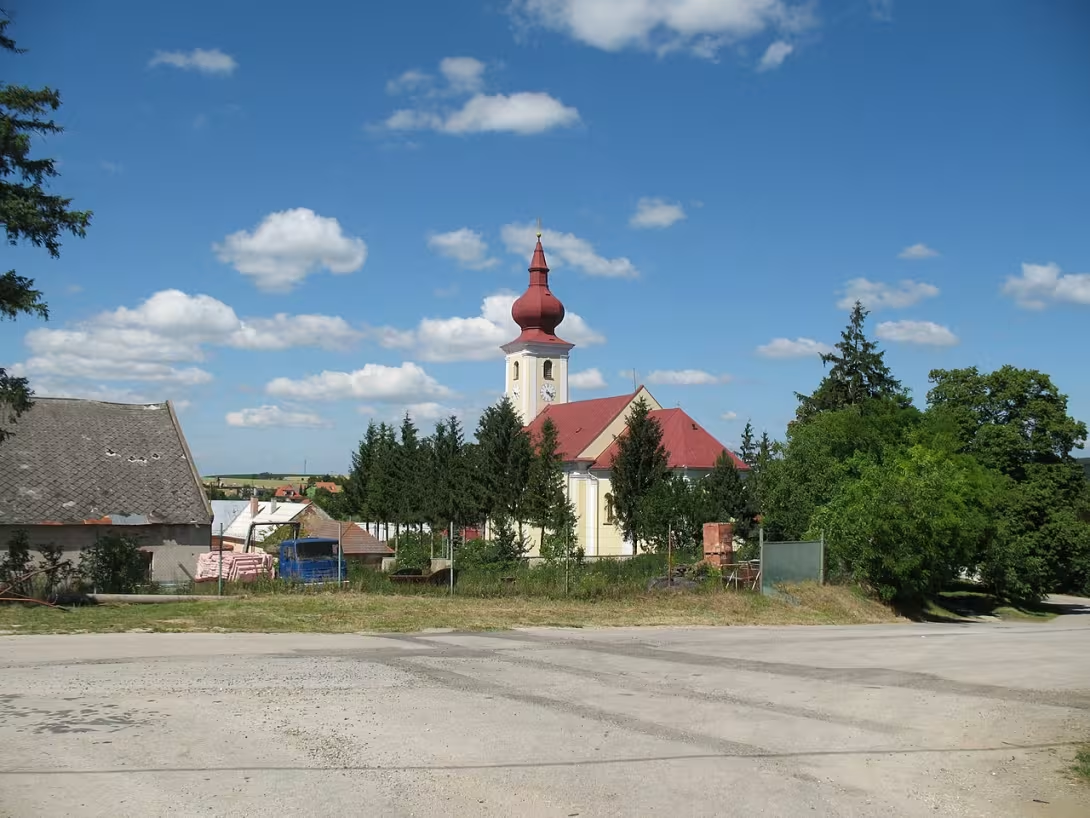

The historical view on the left is a visualisation generated by artificial intelligence and serves as inspiration.
Historical Milestones
- 1601
- The first mention of a church standing in an old cemetery.
- 1708
- Jarok became an independent parish.
- 1718-1723
- Construction of a new church for the merit of priest Charles Orlay and the help of Bishop Ladislav Erdődy.
- 1784-1789
- The first renovation of the church and the construction of the main altar of St Martin and the side altars.
- 1789
- Consecration of the church by the Nitra bishop Francis Xaver Fuchs.
Interesting facts
- The first mention of the church from 1601 describes it as small, abandoned and in bad condition. - The current baroque church was built between 1718 and 1723 with the support of priest Charles Orlay and Bishop Ladislav Erdődy. - The area contains a brick Renaissance wall from 1601 and Baroque Chapel of St. Anna from 1740. - Ján Baltazár Magin, author of the first political defense of the Slovak nation in Hungary, worked in the church, which reminds the memorial board. - The largest bell in 1916 was melted for armaments during World War I.
Guide
Show guide text
The text was prepared by artificial intelligence and has not been editorially reviewed. It may contain inaccuracies.
Welcome to the village of Jarok, Nitra region. Right now you are facing an important historical monument, which is St. Martin's Church with its surrounding area. When you look at it, you may perceive the peaceful atmosphere of this place, which has served as a spiritual center for centuries for the local inhabitants. In front of you there is an area that combines different layers of history and architecture, from Renaissance to Baroque. Look carefully at the overall effect of this construction's resistance and the way it fits into the surrounding country.
To understand exactly what you are seeing, we have to rush deep into the past. The first written mention of the church on this place comes from 1601. At the time, however, it was a completely different construction. Imagine that at that time a small, abandoned church in bad condition, located in the old cemetery, stood there. It was a time of great change and uncertainty when many buildings suffered from a lack of care. However, this primitive, modest temple laid the foundation for everything you see today.
Over time, however, the needs of the community have changed. In 1708 Jarok became an independent parish, which naturally led to the need to build a more dignified and larger temple that would correspond to the new status of the village. It was during this period, namely between 1718 and 1723, that major changes were made. Thanks to the great merit and efforts of priest Charles Orlay, who had a strong vision for his community, and with the invaluable help of Bishop Ladislav Erdődy, a new building was built. This new church that stands before you is a typical representative of the Baroque period.
Now that you take a closer look at the architecture and details surrounding you, note first of all the area. It's not just a space around the building, it's part of a historical whole. Particularly interesting detail is the brick wall. This wall comes from 1601, which means it is older than the actual church. It is a renaissance element which shows how in the past it was approached to securing and separating sacral space from the surroundings. It is fascinating to think that this wall survived centuries and saw the transition from the old, destroyed buildings to the present Baroque beauty.
In addition to the main building, see the Baroque Chapel of St. Anna. Together with the church they form a harmonious whole, which complements the spiritual map of this place. Now if you look at the church itself, see its Baroque face. Although the names of architects are unknown, the result of their work is clearly visible in the overall arrangement. Other important adjustments were made between 1784 and 1789, when the first major renovation was carried out. It was at this time that the main altar dedicated to St. Martin was created and a side oltäre was built, which adds depth and meaning to the interior. The whole process of construction and reconstruction culminated in 1789, when the church of the year consecrated Nitra bishop František Xaver Fuchs.
The story of this place is a story of perseverance. From a small, almost congregationed building from 1601 we reached the magnificent Baroque building. The key figures that enabled this process were named priest Charles Orlay and bishop Ladislav Erdődy. Their cooperation shows how important it was at the time to support the church hierarchy for the development of local communities. Without their intervention, perhaps today this architecture that is now surrounding us would not be preserved.
Perhaps you are interested in one interesting thing that gives this place a sense of mystery. When we recall the first mention of 1601, it is interesting that the church was then described as abandoned. It is fascinating to think about why such an object was neglected at that time and what had to be changed in the village of Jarok, so that more than a hundred years later they decided to build something so significant. This contrast between the decline and the subsequent bloom is hidden within each stone of this area.
Now that you have learned about history from the Renaissance wall to the Baroque oltäre, let us invite you to the final part of our short tour. We recommend that you go through the entire area in peace now, touch the old brick wall and perceive the silence that prevails in this space. Let your senses guide you and try to introduce yourself to the people who prayed here hundreds of years ago.
We hope this short trip to history has helped you to better understand the value of St. Martin's church in Jarok. Thank you for your attention and we wish you a pleasant continuation in discovering the beauty of the Nitra region. Have a good time and enjoy your time in this historical environment.
Tips for visitors
The best time to visit is the spring or autumn period, when the light is soft and the landscape around Jaroka bright. Since it is a sacral building, it is recommended to come at a time when there are no actual religious services, so that you can admire the architecture from outside in peace. When shooting, focus on the details of the facade and surrounding nature, which creates a beautiful contrast with the historical building. In the vicinity of Jarok there is a quiet environment suitable for walks, which will be appreciated by families with children who can enjoy contact with nature without disturbing urban atmosphere.
Frequently asked questions
Can the monument be visited?
Religious buildings are usually open mainly during services; at other times a visit is normally arranged with the parish or the operator. We have not verified specific times.
Where is the monument?
Location: Pod kostolom 742, Jarok, Nitriansky kraj. The map on this page shows the exact spot.
Why is the monument protected?
It is listed in the Central List of the Monuments Fund of the Slovak Republic as a national cultural monument (ÚZPF no. 233-1438).
For children
Close your eyes and imagine pressing a secret button on a time machine. The air around you is going to vibrate, and suddenly you're going to get back exactly 308 years. You're no longer in today's world with cell phones and Internet, but in 1718. Welcome to Jarok village! There are only fields around you, dense forests and silence that only interrupts horse roaring and the sound of the corset from local workshops.
Nearby
🏰 Historic sites (149)
- Múzeum tradičnej ľudovej kultúry 0.1 km Pod kostolom 57
- sv. Vendelín 0.5 km
- Kaštieľ Veľké Zálužie 3.1 km web
- Na pamiatku Turkami zavraždených detí v roku 1530 4.0 km
- Nemecká radarová základňa v Lehote 4.6 km
- Kaštieľ Močenok 5.4 km Sv. Gorazda 553/28 web
- Kaštieľ Báb 5.5 km
- sv. Florián 6.1 km
- Najsvätejšia Trojica 6.1 km
- Padlým v boji 6.2 km
- Kaštieľ Wagnerovcov 6.2 km Wágnerova 224/27 web
- sv. Šebastián 6.7 km
- Kalvária 6.9 km
- Kaštieľ Párovské Háje 6.9 km Lukov dvor 81/2
- sv. Róchus 7.0 km
- sv. Ján Nepomucký 7.1 km
- Kaštieľ Kynek 7.3 km Pri kaštieli 102/1 web
- Kaštieľ Pereš 7.5 km Šalianska 840/48
- sv. Pavol 7.5 km
- Mgr. Jozef Bábik 7.5 km
🍽️ Restaurants and dining (352)
- Borka 0.2 km
- Vendelín 3.7 km
- Rapan 5.0 km
- Sýpka u Ludvíka 5.3 km +421 918 399 575 web
- Kaviareň na Fraštáckej 5.5 km
- Natália 5.9 km
- U Dávida 5.9 km
- Abar – Cabaj-Čápor 6.0 km +421948896482 web
- Reštaurácia Salaš Cabaj 6.1 km
- Pod Lipami 6.1 km
- U Ozifkov 7.0 km
- Prima Pizza 7.2 km +421 902 902 802 web
- Šúdolská viecha 7.3 km web
- Hugo bar 7.3 km
- Pizza Laurizzia 7.5 km +421905992833 web
- Sushi Nitra 7.7 km +421 903 412 131 web
- Bistro Šelma 7.7 km Murániho 131/27
- Ranč Nové Sedlo 7.8 km +421 903 493 551 web
- Pifa Cafe 7.8 km
- Bistro Maurus 7.8 km Beethovenova 655/20
🏨 Accommodation (73)
- Sýpka u Ludvíka 5.3 km +421 918 399 575 web
- U Čmaráka 5.5 km
- Hotel Elsa 6.0 km Sv. Gorazda 653/86
- Penzión Salaš Cabaj 6.1 km
- Penzión Hoffer 7.4 km web
- Manor Boutique Hotel 7.5 km
- Ranč Nové Sedlo 7.8 km +421 903 493 551 web
- Prima 8.2 km
- Hotel Xawax 8.2 km +421376526520 web
- AUTO JAS 8.8 km web
- Glycerin Hostel Nitra 9.0 km
- Ubytovňa Tofi 9.4 km
- Penzión Premona 9.4 km
- Hotel Mikado 9.6 km +421901707011 web
- Viliam Fraňo 9.6 km
- Hotel Comfort 10.3 km web
- Mladosť 10.4 km
- Grand Hotel Sole 10.4 km web
- Hotel 11 10.4 km +421911909111 web
- PKO Nitra 10.4 km web
🚲 Rentals and sport (58)
- Bowling Club 7.9 km
- Tréningová hokejová hala 8.4 km Škultétyho 990/1A
- Sportisimo 8.5 km
- Kellys Bike Centrum 8.5 km
- Klondikebike 8.5 km +421949541752 web
- Dolomitybike 8.6 km +421 37 38 11 584 web
- Mestská hala 8.6 km Dolnočermánska 1651/105
- Rempo 8.9 km
- Hoplaland 9.3 km
- M-Šport 9.3 km
- EXIsport 9.3 km
- Diamond gym 9.6 km
- VELOsprint Nitra 9.7 km +421372211734
- Aquasport 9.8 km web
- Fit Plus 10.1 km
- Outdoor Experience 10.2 km
- Decathlon 10.2 km +421372211680 web
- AN Sport 10.2 km
- Intersport 10.3 km
- Športová hala SPU 10.3 km
🥾 Hiking and nature (50)
- Nad Vinohradmi 3.0 km
- Park mládeže 4.6 km Ulica mládeže
- Močenský park 5.3 km
- Čerešniská 6.1 km
- Síky 6.2 km
- Plešiny 6.6 km
- Tizardov vrch 7.1 km
- Klokočina 7.2 km
- Rumanovský park 8.5 km
- Šibeničný vrch 8.9 km
- Lavička obrov 8.9 km
- Katruša 9.1 km
- Jaskyňa Dezidera Horváta 10.1 km
- Jaskyňa v drevenom lome 10.1 km
- Kalvária 10.1 km
- Kultúrna pamiatka meštiansky dom 10.4 km
- Mestský park Nitra 10.4 km
- Vieroslavín 10.5 km
- Prameň čírej vody 10.5 km
- Jaskyňa pod nitrianskym hradom 10.7 km
Thematic route
St. Martin's Church with the premises This historic church in the village Jarok represents the key point of the entire trip. Its architecture and spiritual atmosphere offer visitors a view of the past of the site. The area around the church is an ideal place to relax and lock, where sacral value is associated with a peaceful environment. Nádvorí church complex The immediate surroundings of the church form a separate point of interest. Walking along the courtyard allows you to explore the details of the facade and perceive the historical context of the building. This place serves as a natural passage between the parts of the monument and offers a peaceful atmosphere for photography and relaxation. Church Tower If accessible, the view from the tower or its interior (if open to the public) is another important aspect of the visit. The tower dominates the horizon of the village Jarok and its history is an integral part of the local identity. A visit to this element complements the overall picture of the sacral monument and its function in the history of the community. The surrounding area Spaces around the church complex itself, including possible older trees or historical elements in the immediate vicinity, illustrate the overall impression from the place. These elements are an integral part of the monument and their examination will further reveal the aesthetic and historical values of the site. The route is thus closed within the area itself, which guarantees the focus on the main goal without the need to travel to more distant points. This compact route is suitable for visitors who want to explore the historical and spiritual wealth of the village Jarok in the climate and without spěch. The entire trip will take place near the main destination, which ensures the fluidity and depth of the experience.
Seasonal recommendations
In spring, St. Martin's Church in Jarok will be surrounded by green vegetation. The sun during this period provides fine lighting suitable for photographing the exterior of the building. It is recommended to visit the place in the morning and wear layered clothes due to variable temperatures. Summer months bring intense light and rich colors of the earth. Due to the high temperatures is the best early morning or late evening time, when it is more peaceful around the church. Easy clothes, a hat, and plenty of drinking water are practical. Autumn in Nitra region lights up the area with golden and red tones of leaves. In this period contrasts between the colors of nature and the materials of the building arise. When visiting, it is advisable to choose waterproof shoes and a warmer sweater, especially in October or November. Winter brings freezing air and possible snow cover to Jarok, which highlights the silhouette of St. Martin's church. There is silence on the premises in Advent time. Due to low temperatures and humidity, warm clothes, gloves and cap are needed. The best light for capturing architecture is around noon.
Visualisations and artistic views


The visualisations are generated by artificial intelligence and serve as inspiration.
Photographs from the area
Real photos taken near the monument


Source and licence are given for each image.
Visitor Tips
No tips yet. Be the first!
Log in and add your tip.
Zdroje a literatura
The factual basis for this text was the article na Wikipedii, whose authors are Wikipedia contributors. The article is available under the licence CC BY-SA 4.0.
Location on Map
More monuments – Jarok
Show all in the town



Visitor photos
No photos yet. Be the first to add a photo from your visit!
Log in and add your photo or leave a rating.
You get more points for a visit verified in the app — we can tell from the GPS that you are there.
Reviews and comments