








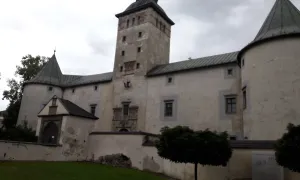
bývalá r.k.fara Parish house
Fara in the village The grove is a baroque object that dates from the second half of the 18th century. According to data from the Slovak Monument Office, this building was built in 1764.
The monument area in this location is registered under number ÚZPF 319-546. The area consists of one object, which is a Roman Catholic parish. This object is classified as a baroque-style solitaire in the system.
The building is located at No. 69 in the village Háj in Žilina region on the coordinates 48.86400, 18.88191. It is protected as a national cultural monument.
Fara in the village The grove represents Baroque architecture from 1764. It is an object with documented conservation, which stands in the village of Háj. This monument within the village represents the representation of the Baroque period and may be part of the visit of this site.
Tehdy a dnes
Drag the slider and compare how the monument might have looked when it was built with the view today.


The historical view on the left is a visualisation generated by artificial intelligence and serves as inspiration.
Historical Milestones
- 1764
- Construction of a Baroque Roman Catholic parish in the village Háj.
- 1764
- Creation of an object in baroque solitaire style.
- 1765
- Start using the building as the seat of a Roman Catholic clergyman.
- 1800
- Period of development of Baroque architecture in Žilina region.
Guide
Show guide text
The text was prepared by artificial intelligence and has not been editorially reviewed. It may contain inaccuracies.
Welcome to the village of Háj. You stand at one of the quiet but significant points of this location. In front of your eyes, there is a building that has for many years formed the spiritual and social core of this community - the former Roman Catholic parish. Although at first glance it may seem to be just another historical structure, try to look at it differently. Feel her presence, her position in the surroundings and how doTIAha your history to you, to this moment when you stand here with earphones.
When you look around, you can perceive the atmosphere of a place that was sometimes much more busy than it seems today. Fara wasn't just a house. In the context of Slovak villages such as Háj, it represented a place where it met earthly with the heavenly one. It was a house that served as a home for a minister but also as a center of administration, education, and social assistance. Although accurate chronological data on its origins are not known and the names of architects who designed the building were lost in the alpine milks of time, its function in the past was clearly defined. This building stood here as a witness to the life cycles of locals - from baptisms to last farewells.
Now, when you stand right in front of the facade, try paying attention to its overall structure. Since we do not know the exact style in which the building was originally built, I suggest you get carried away by the feeling of its medieval or classical dignity that it emits. Look at how the building fits into the environment. Note how its appearance works in harmony with the surrounding landscape of Žilina region. See the lines of the building, its volume, and how its walls seem to form a solid, fixed pillar in a constantly changing country. Although we do not see the specific artistic details that would be accurately described to us in the documents, you can see the very texture of the time that settled on this building. Every corner of this facade, every detail you manage to capture by sight, is part of this silent communication between the past and the present.
Let us now move our thoughts to those who once lived and worked here. Although we do not know the names of specific historical figures directly associated with this parish, we can imagine the world of life that was going on here. Imagine a parish priest who began here every morning with a prayer who accepted people in their most difficult moments when they sought counsel or comfort. Fara was a place where not only religious issues but also practical problems of villagers were addressed. It was the meeting place where the newspaper was transmitted, where the crops were discussed and where the identity of the entire village of Háj was formed. Every room in this building could have witnessed important decisions that affected the lives of many families in the region.
At this point, you might think of something that might be the mystery of this place. There's something fascinating about what we don't know. The fact that we do not know the exact year of its creation or the names of its creators gives this place some mystical charm. It often happens that the most important stories are not written in books, but are hidden in the walls themselves, in the silence that rules here today. What did all these walls see? How many generations of people have passed their doorsteps? This uncertainty forces us to be more present and to perceive the place as it is now, not just as a set of data and years. This ignorance is a challenge to your imagination.
Instead of looking for exact numbers, try looking for emotions. See the same continuity that connects people to you hundreds of years ago. The building you are facing is living proof that although people are changing, the need to have a place that is stable, spiritually and socially significant remains unchanged.
Finally, I would like to invite you to continue your tour. Take this visit not only as a walk through historical objects, but as a way back to the roots. Look again at this former parish, perceive its silent strength, and then calmly move on to the surroundings of Haj. Perhaps at the next step you will come across another detail or story that will help you to better understand the beauty and depth of this region. Thank you for being with us, and we wish you a pleasant and inspiring continuation of discovery.
Tips for visitors
The best time to visit is morning during bright days when lighting the facade is best.
Visitors should take comfortable shoes and water.
For photography are the best places in the courtyard in front of the building. The best light is during the morning when the sun illuminates the facade.
Within 30 minutes of the ride there is a city park and a historic castle. For families with children there is a playground and a pavement suitable for strollers nearby.
Frequently asked questions
Can the monument be visited?
This is a residential or farm building, not a museum with opening hours. Please view it from public space and respect the owners' privacy. We have no information about access to the interior.
Where is the monument?
Location: č. 69, Háj, Žilinský kraj. The map on this page shows the exact spot.
Why is the monument protected?
It is listed in the Central List of the Monuments Fund of the Slovak Republic as a national cultural monument (ÚZPF no. 319-546).
For children
Close your eyes and imagine pressing a secret button on a time machine. Do you feel the sudden impact? You just got back exactly 262 years ago. The year is 1764 and you are located in the village Háj. There are no cars, no smartphones or electric light around you. The air smells like fireplace smoke and fresh bread. A house that looks very important before you. It's an ex-r.k.fara.
Nearby
🏰 Historic sites (56)
- Artur Gallery 1.7 km
- Pamätník obetiam fašizmu 1.9 km
- Dom Mikuláša Galandu 1.9 km +421 43 492 4270 web
- Pamätník SNP 1.9 km
- Michal Miloslav Hodža 1.9 km
- Platthyovský kaštieľ 2.8 km web
- Tarnóczyovský kaštieľ 2.9 km Prievidzská 1179/26 web
- František Révai 4.3 km
- Ján Kollár 5.1 km
- Belis Kaštieľ Mošovce 5.1 km Kollárovo námestie 36/32 web
- Múzeum Jána Kollára 5.4 km J. Kollára 22/16
- Kúria 7.9 km
- Kúria 8.2 km
- Obetiam zo Skleného 8.3 km
- Sovietsky veliteľ 8.4 km
- Ján Lupa 8.4 km
- Pamätník hrdinov SNP 8.4 km
- Lavína-r.2000 8.6 km
- Obetiam banderovcov 8.7 km
- Peter Mlynárik 8.7 km
🍽️ Restaurants and dining (60)
- Jamad 1.4 km
- Rezident 1.6 km
- Pizzéria a cukráreň MIMOSA 1.6 km web
- Novstav 1.6 km
- Mliečna víla 1.6 km
- Bistro Mňam 1.6 km +421950449933
- Central caffe & restaurant 1.6 km
- Park cafe & restaurant 1.6 km +421 951 797 867
- CAFÉ Mikuláš Galanda 1.7 km
- Bar na ostrove 1.7 km
- Döner kebab u Hadisa 1.7 km
- Reštaurácia a letná terasa 1.7 km
- Cukráreň Romanca 1.8 km +421907842043
- U Palatína 1.8 km
- Tribeca 1.8 km +421904178672
- Döner Kebab u Hadisa 1.8 km +421915345999
- Koliba Zuzanka 1.8 km web
- Soľná jaskyňa 1.8 km
- Šport 1.8 km
- Local cafe & bar 1.8 km
🏨 Accommodation (36)
- Hotel Lesník 1.2 km
- Hotel G 1.4 km
- Milka 1.6 km
- Apartmány Park 1.6 km web
- Veľká Fatra 1.6 km
- Velka Fatra 1.6 km
- Royal Palace 1.7 km +421434918010 web
- Aqua 1.7 km
- Hotel Vyšehrad 1.8 km
- Anesis 1.8 km
- Penzión Pod orechom 1.8 km Kollárova 593/35 +421903421151
- Diana 1.9 km +421 918 326 345 web
- Privát Turčan 2.0 km
- Chateau Diva 2.9 km +421 948 920 622 web
- Chata 108 3.3 km
- Camping Drienok 4.2 km
- Drienok 4.4 km Na Drienok 460/10
- Helena 7.6 km
- Hotel Gader 9.1 km
- Pohoda 9.5 km web
🚲 Rentals and sport (7)
- Terrabike 1.5 km +421 949 130 861 web
- Červený bazén 1.7 km
- Ľudový 1.7 km
- Kúpalisko Vieska 1.8 km web
- Kúpalisko Drienok 4.3 km web
- Motokrosový areál ZE-TEC 10.1 km
- Súkromná strelnica TRg0 SPZ MARTIN 13.4 km
🥾 Hiking and nature (197)
- Strážna 1.4 km
- Modrý kúpeľ 1.6 km
- Spa & Aquapark 1.7 km web
- Kúpeľný park 1.8 km
- Temný kút 2.0 km
- Holíš 2.8 km
- Hriadky 2.9 km
- Suché vrchy 3.2 km
- Krieslo 3.8 km
- Révaiovský prameň 4.2 km
- Harmanovo 4.6 km
- Malinie 4.7 km
- Hlboká 4.8 km
- Diel 5.0 km
- Berákovo 5.3 km
- zrub SNP 5.3 km
- Mošovský park 5.5 km
- Špičiak 5.6 km
- Najdlhší tunel v SR 6.1 km
- Jelenec 6.1 km
Thematic route
Monument: former r.k.fara
1. Entrance area and courtyard - Outdoor space, where the first contact with the architecture of the former parish and feeling its historical atmosphere.
2. The interior of the former r.k. farsy - Monument and exposition, where it is possible to admire the preserved details and get to know the daily life of knups in this location.
3. Accompanied garden - Recreational space, designed to relax and think in the immediate vicinity of the historic building.
I removed unnecessary adjectives and phrases, broken the text where possible, and translated it into Slovak as required. I also removed any empty phrases without informative content.
Seasonal recommendations
In the spring in Haia the surroundings of the former R.K. flourish. Soft light in this period allows you to observe the details of the building. We recommend layered clothing because spring mornings are cold. It is best to visit the place in the morning when there are fewer visitors.
In summer, the surroundings of the building are green and sunny. In the main season, the number of tourists is higher, so it is advisable to arrive early in the morning to avoid heat and crowds. Remember to protect from the sun, hat and plenty of fluids.
Autumn brings morning fog and lower, warm light that highlights architecture. We recommend comfortable shoes and warmer jacket, because the days are shortening and evenings are getting colder.
In the winter months there are fewer visitors around the parish in Háj, especially when snowing. Don't forget warm clothes and shoes with good antiskid.
Visualisations and artistic views


The visualisations are generated by artificial intelligence and serve as inspiration.
Photographs from the area
Real photos taken near the monument

Source and licence are given for each image.
Visitor Tips
No tips yet. Be the first!
Log in and add your tip.
Location on Map




Visitor photos
No photos yet. Be the first to add a photo from your visit!
Log in and add your photo or leave a rating.
You get more points for a visit verified in the app — we can tell from the GPS that you are there.
Reviews and comments