

church of the Visit of the Virgin Mary Church
Church Visiting the Virgin Mary is a national cultural monument located in the village of Rabča in the Žilina region. The building comes from 1768 and represents architecture from the second half of the 18th century. According to the monument register, the object is affected by the style of traditional modernity and its construction took place between 1768 and 1772.
The area of the monument is registered by the Monument Office of the Slovak Republic under number ÚZPF 249. It consists of one object, which is the church itself Visiting the Virgin Mary.
The monument is located at Kostolná 853/8 in the village of Rabča. The building is included in the list of national cultural monuments of the Slovak Republic.
The Church of the Visitors of the Virgin Mary is a documented example of sacral architecture from the second half of the 18th century. Its historical value and the status of the national cultural monument is a suitable goal for visitors of the dream regions of the Žilina region.
Tehdy a dnes
Drag the slider and compare how the monument might have looked when it was built with the view today.
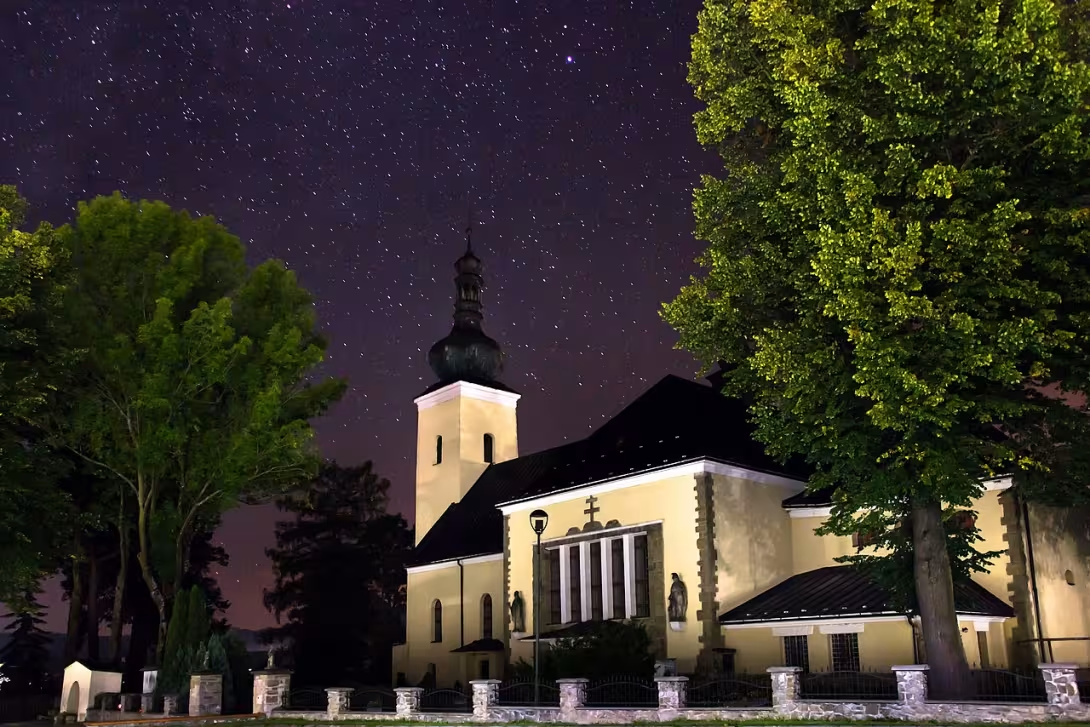
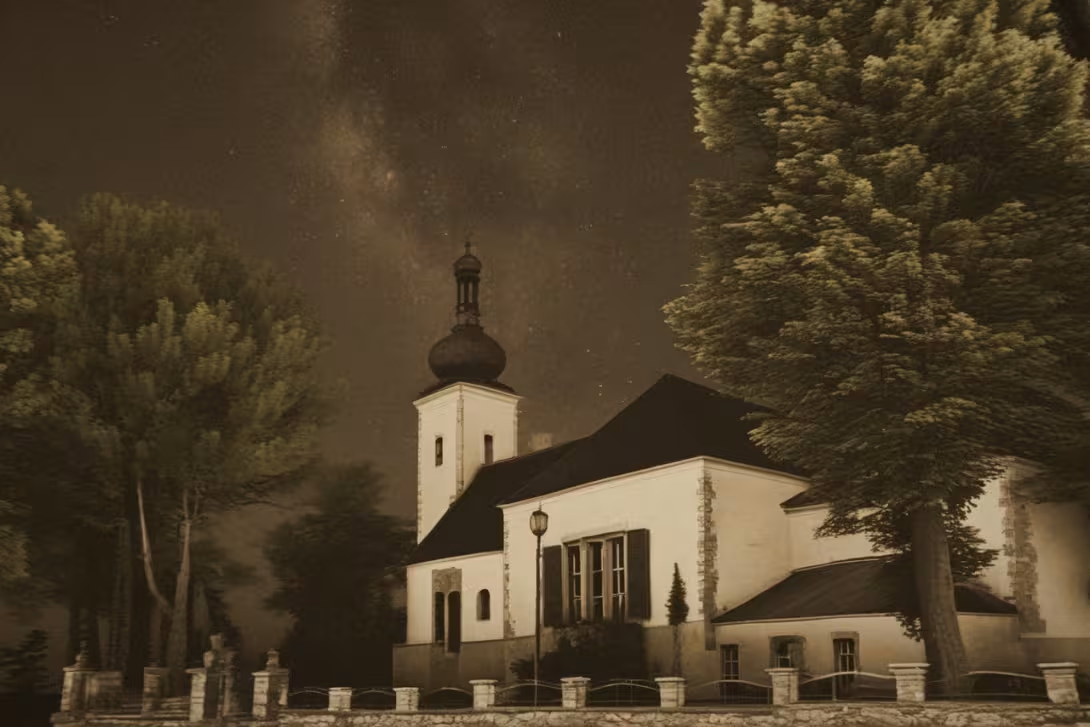
The historical view on the left is a visualisation generated by artificial intelligence and serves as inspiration.
Historical Milestones
- 1768
- Beginning of the construction of the church Visiting the Virgin Mary in Rabča
- 1772
- Completion of the construction and dedication of the Church of the Visits of the Virgin Mary
Artistic features
-
mozaika figurálna — Pieta,sv.Ján Evanjelista,sv.Mária Magdaléna
keramika, vkladanie do omietky · moderna · 1951-1960 -
mozaika figurálna — Anjeli s Arma Christi
keramika, vkladanie do omietky · moderna · 1951-1960
Source: Monuments Board of the Slovak Republic — open data, licence CC BY 4.0
Interesting facts
- Church Visiting the Virgin Mary is a national cultural monument in the village of Rabča. - Construction took place between 1768 and 1772. - The building is affected by the style of traditional modernity. The area of the monument consists of one object, which is the church itself. - The monument is a documented example of sacral architecture from the second half of the 18th century.
Guide
The guide was voiced by a synthetic voice created by artificial intelligence.
Show guide text
The text was prepared by artificial intelligence and has not been editorially reviewed. It may contain inaccuracies.
Welcome to Rabča. Right now, when you're standing in this space, you have something more than a building ahead of you. In front of your eyes the Church of the Visits of the Virgin Mary, which dominates this neighborhood and acts as a quiet guardian of local history. Let's try to stop the time for a moment and just, without a cold, see the atmosphere waiting for you. Do you feel the seriousness of the presence of such a place? Look at the overall silhouette of this building, how it fits into the country of Žilina region and how its presence defines the character of the entire site. When we ask how this church originated, we encounter one of the most fascinating features of historical monuments - their silent legacy. Although accurate chronological data, the exact year of stone laying, or the names of the people who planned it, remained lost in the darkness of time, the very existence of this church speaks with a clear voice. This church stands here because in the past there was a strong need to have a spiritual center in this area, a place that would connect the community. The names we seek in the archives may not be known, but the reason why this church was built is clear - it was a symbol of the faith and association of local people with what they considered holy. Visiting the Virgin Mary is not just a name, it is a concept of presence, a meeting that has been repeated in this place for many generations. Now pay attention to the very architecture you have in front of you. Since we do not know a particular architect, we cannot look for names in textbooks, but we can look at what you see with our own eyes. Look at the facade, at how the surface of the walls shines with the light that hits this object. See the proportions of this building, its stability and how it works in contrast with surrounding nature and urban buildings. Look up on the lines that form the contours of the church against the sky. Every detail, from the way the shapes of the building are drawn up to the overall impression of its massiveness, tells us something about the artistic ideas of the people who used to work here. Even if we do not know whether it was a particular style, we can perceive the pursuit of creating an area that generates respect and peace. Feel the texture of the materials that make up this object, and how time has entered their surface. You might be asking who made all this. Although the history of specific individuals who built or changed history in this church cannot be accurately identified, there is a hidden story of thousands of anonymous people in every stone and every part of this building. These are the stories of the craftsmen who worked here, the people who sought comfort here, and the families who experienced the most difficult and happiest moments of their lives. This church is not just the result of the work of one architect, it is the result of collective efforts of entire generations of Rabče inhabitants. Everyone who has ever entered here has left behind some of their existence, even though no one has long known his name. That is where one of the greatest mysteries of this place lies. We often search history for clear numbers, exact dates, and names that we can remember. But this church offers us something else - it offers us beauty unknown. It is fascinating that we stand before a monument whose exact beginning of the centuries is unknown to us. This uncertainty makes us feel deeper. If we don't know exactly when this church was built, we'll start to see its presence as something timeless. It is no longer just an object from a certain period, but it becomes part of the time itself. This ignorance is a challenge to our imagination. Let us try to imagine those times when the first time we started building here, what was not the weather, what were the faces of the people who were looking at this building with a view over Þ. This riddle about unknown architects and unknown personalities gives the place a depth that no textbook can replace. Now I'm raising you to another discovery. Let yourself be carried away by the feelings raised by this visit. You can slowly walk around the church, observe how the perspective of its appearance changes at every next step, or just relax in the silence it offers. Any angle you see now can reveal a new detail that you have previously missed. Keep this moment to yourself, feel the peace that works here, and enjoy the beauty of this historical monument in Rabča. Thank you for being with us on this short journey in time. We wish you a pleasant rest of your day and other beautiful discoveries of this country.
Tips for visitors
A visit in spring or autumn is recommended. Soft light and the colors of the landscape around Rabče will then highlight the architectural details of the church. Wrap up comfortable shoes and layered clothing for variable mountain weather. The Facade of the Church Visiting the Virgin Maria is recommended to photograph in the morning or before sunset, when light creates significant shadow effects. In the surroundings there are possibilities for short walks. Families with children can connect the visit with the movement in nature.
Frequently asked questions
Can the monument be visited?
Religious buildings are usually open mainly during services; at other times a visit is normally arranged with the parish or the operator. We have not verified specific times.
Where is the monument?
Location: Kostolná 853/8, Rabča, Žilinský kraj. The map on this page shows the exact spot.
Why is the monument protected?
It is listed in the Central List of the Monuments Fund of the Slovak Republic as a national cultural monument (ÚZPF no. 317-249).
For children
Imagine you have a secret button in front of you on the time machine. You press it, and the world around you starts spinning until everything changes. You don't want to be in the present, but you want to see how it was long ago. We're flying backwards until 1768. That was exactly 258 years ago! Then the world looked completely different than you know it today.
Nearby
🏰 Historic sites (36)
- Európske centrum gajdošskej kultúry 2.8 km Hlavná 451/489
- Ježiš Kristus 5.1 km
- Ján Pavol II. 5.1 km
- Expozícia Hviezdoslavovej Hájnikovej Ženy 5.5 km +421 43 586 4780 web
- Expozícia Mila Urbana 5.5 km +421 43 586 4780 web
- grób nieznanego żołnierza 9.5 km
- Ruiny schroniska Beskidenverein 1905-1949 9.6 km
- Ján Pavol II. 9.7 km
- Józef Antoni Habsburg 9.7 km
- Kongres Eucharystyczny 1987 9.7 km
- Ježiš v Getsemanskej záhrade 9.7 km
- grób turystów 1935 r. 9.7 km
- Judášova zrada | Božie milosrdenstvo 9.7 km
- Anton Bernolák 10.0 km
- Červenej armáde 10.0 km
- Pavol Országh Hviezdoslav 10.3 km
- Ján Vojtaššák, spišský viskup 10.4 km
- Ruiny "Fickowej Budy" 10.5 km
- Slanický ostrov umenia – Oravská galéria 10.7 km web
- Anton Bernolák 10.7 km
🍽️ Restaurants and dining (71)
- Pizza a cukráreň 0.8 km
- Hostinec Babia hora 1.0 km +421 904 112 925 web
- Pizza LaGrande 2.0 km
- Pizza Rabča 2.1 km +421435594123 web
- Bar Laverna 2.1 km
- Pizza Mavo 2.6 km +421 902 171 869 web
- Pulz 3.6 km
- Koliba Poľana 6.1 km Hlavná 886/818 +421 905 972 792 web
- Pohostinstvo Romanka 6.5 km
- Bar Kultúra 6.5 km
- Koliba Klin 6.7 km Hlavná 235/137
- Colnica 8.7 km +421949729678 web
- Reštaurácia Gurmán 9.6 km
- Šport Club 9.7 km
- Špuľka 9.9 km
- Hotel Studnička 9.9 km Vojenské 2072 +421 43 552 21 11; +421 911 511 111 web
- Pascucci Caffe 10.2 km Hviezdoslavovo námestie 213 +421 910 450 820
- Colour Coffee 10.2 km Hviezdoslavovo námestie 213 +421 907 348 200
- Papuča 10.2 km
- Bar 74 10.2 km Štefaniková 1110
🏨 Accommodation (71)
- Penzión Amito 2.7 km web
- Turistická ubytovňa 3.6 km
- Hrubjak 3.7 km
- Penzión Beskydy 4.8 km +421 43 370 9047 web
- Poľana 6.1 km Hlavná 886/818
- U deda 6.2 km
- Chata Pilsko 7.1 km
- Chata pod Repiskom 7.4 km
- Bunny Glamp 8.8 km Graniczna 45 web
- Penzión Korytnačka 9.4 km Vojtaššákova 1041 web
- Trzy jaskółki na Siarce 9.6 km
- Ranč u Edyho 9.8 km +421 4355 21 840 web
- Autocamp JAMI 10.0 km
- Oravia 10.1 km
- Hájovňa Vajdovky 10.1 km
- Penzión Modul 10.3 km Nábrežie 1161/25
- Turistická ubytovňa Magura 10.3 km
- PORT CLUB pension 10.4 km Nábrežie 1164/13
- Penzión Kriš 10.4 km
- Kompleks Pilsko Jontek 10.9 km Sitki 8 +48 604 144 823 web
🚲 Rentals and sport (11)
- OŠK Sihelné 3.0 km
- TJ Sokol Zubrohlava 6.1 km
- Bicykle X Sport 10.2 km Hviezdoslavovo námestie 213 +421 948 038 414
- HEIKO šport 10.2 km Hviezdoslavovo námestie 213 +421 903 5405 05
- Kappa šport 10.3 km Štefaniková
- Prístav č. 2 11.4 km
- Ebike Korbielów.pl 12.3 km +48 533 789 532
- Prístav č. 1 13.6 km
- Wyciągi Wojtek 13.7 km web
- Wyciągi Baca 13.8 km web
- Mosorny Groń 15.0 km web
🥾 Hiking and nature (211)
- Rozhľadňa Trchovnica 1.7 km
- Črchľa 2.6 km
- Taľagova grapa 2.8 km
- Minerálny prameň Slaná voda 3.1 km
- Bučinka 3.1 km
- Grúň 3.6 km
- Vahanov 3.6 km
- Kopanica 3.9 km
- Alexovka 3.9 km
- Poľana 3.9 km
- Turňa 3.9 km
- Gluchová 4.0 km
- Bandíkovka 4.3 km
- Mišovka 4.4 km
- Magura 4.5 km
- Skalka 5.0 km
- Grapa 5.0 km
- Jurčovka 5.0 km
- Sihelniansky hrádok 5.0 km
- Úpladisko 5.2 km
Thematic route
As there are no other objects in the area of the area, I propose a thematic route within the area of the main monument:
1. Church of the Visit of the Virgin Mary - The main monument with its characteristic architecture. 2. Interior of the church - Space with artistic design of the altar and interior equipment. 3. Church area - Outdoor space around the building, which allows view of the exterior of the building.
Seasonal recommendations
In spring, the surroundings of the church Visits the Virgin Mary in the village of Rabča will be covered in green vegetation. Gentle natural lighting during this period makes it easier to photograph the exterior of the building. It is recommended that footwear with a firm sole as the surfaces may be wet after rain. A visit in the morning is appropriate.
Summer months bring intense sunlight to the Žilina region. Due to high temperatures it is advisable to visit the place early in the morning or late in the evening. In practical terms, breathable clothing and sun protection are provided as there is little shadow around the building.
Podzim in Rabč brings color change of leaves. The low sun creates long shadows and highlights the details of the facade. Due to fluctuating temperatures and breeze is appropriate layered clothing.
Winter changes the atmosphere of the area, especially if the landscape covers the snow. The lighting is clearer in this period, but the days are short, so it is necessary to plan a visit by noon. Warm, leaky clothing and insulated footwear are essential to ensure stability on frozen or snowy soil.
Visualisations and artistic views


The visualisations are generated by artificial intelligence and serve as inspiration.
Visitor Tips
No tips yet. Be the first!
Log in and add your tip.
Location on Map



Visitor photos
No photos yet. Be the first to add a photo from your visit!
Log in and add your photo or leave a rating.
You get more points for a visit verified in the app — we can tell from the GPS that you are there.
Reviews and comments