








former church of the cleansing of the Virgin Mary Church
The former Church of Purification of the Virgin Mary in the village of Liptovské Revúce in the Žilina region is a baroque-classicist building from the first half of the 19th century. It has classicistic equipment and wall paintings from painter Joseph Hanula.
Church independence of Liptovské Revúc and Lužná from Liptovská Osada occurred on 7 August 1787. The first administrator of the newly formed parish was probably P. Anton Janík from Okoličná. In 1789, Anton Tobiah Nedeczey, the first priest, also initiated the opening of the school. Until 1819, believers used the wooden church (oratorium) from 1694. The foundation stone of the new brick church was laid on May 26, 1802. The construction lasted 17 years and was completed in 1819, when it was dedicated on August 1st to the purification of the Virgin Mary (Sacrifice of the Lord). The original wooden church was demolished in October 1819. During the construction, Jozef Dvorčák, who initiated the construction, Ján Lazar, Štefan Tóth, Matej Nemessányi and Jozef Mojš, was replaced by a priest.
It is a single-boat building with a flat cap Presbytery, built-in sacristy, built-in tower and small entrance hall. The tower is finished with a bell helmet and the facades are smooth. The triaxial main facade retains the original classicistic breakdown. A covered staircase leads to the church. Above the entrance there is a recess with a statue of the Virgin Mary and a inscription dating back to the construction of a wooden church for 1694 and brick for 1819.
The interior is equipped with a classicistic main altar from around 1820. He bears a picture of the sacrifice of Jesus in a temple from 1913 by Spiš painter Joseph Hanula. Hanula also painted wall paintings on Prussian vaults between 1912 and 1913. Classical equipment is complemented by benches, baptistery and pulpit. In the interior there is also krucifix under the chorus from the 19th century, which represents folk woodcut. There is a statue of St. Andrew from 1854 by J. Angyal.
In 1821 believers and priest Joseph the Greater One began to build a brick parish, since it had previously served as a parish wooden cottage of Ondrej Močilán. In 1823 a school was built near the church. In 1829 a picture of the Crucified by Maximilian Racskaya for Advent and Lent Times was set on the main altar. In 1829 Leopold was founded to support missions in America and in 1884 the priest Ján Vlošák founded the Society of Sobriety and Total Reticence. The parish was administered by Jozef Tomík, who had the church painted by Joseph Hanul. Joseph Tomík died on May 7, 1916 and is buried at the church.
Between 1952 and 1957, the church was repaired and paintings were renovated. Between 1957 and 1972, the administrator of the parish Jozef Debnár ensured the construction of the water supply and extension of the corridor with bathroom and toilet. In 1967 he started building a new floor on the parish building, which he completed by winter of the same year. The church is registered in the Central List of Monument Fund of Slovakia under number ÚZPF 12051/1.
The state of the church is good and the object serves its purpose. It is located in the center of Liptovské Revúce.
Tehdy a dnes
Drag the slider and compare how the monument might have looked when it was built with the view today.
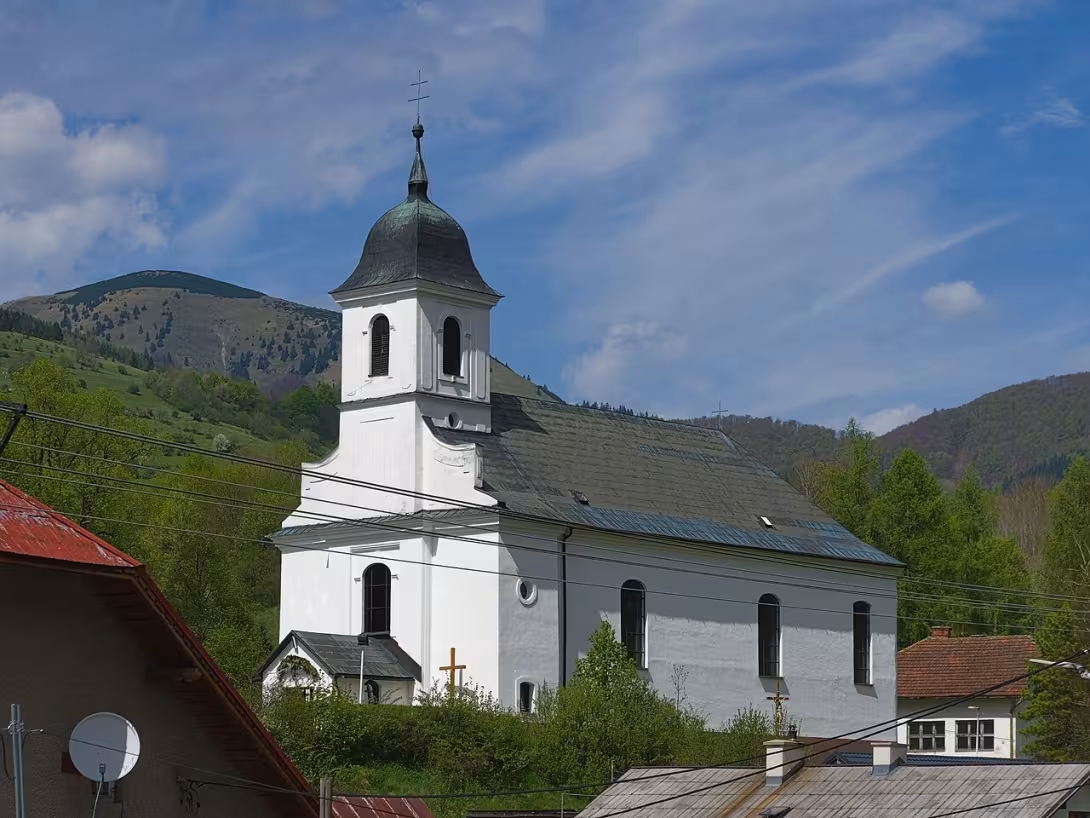
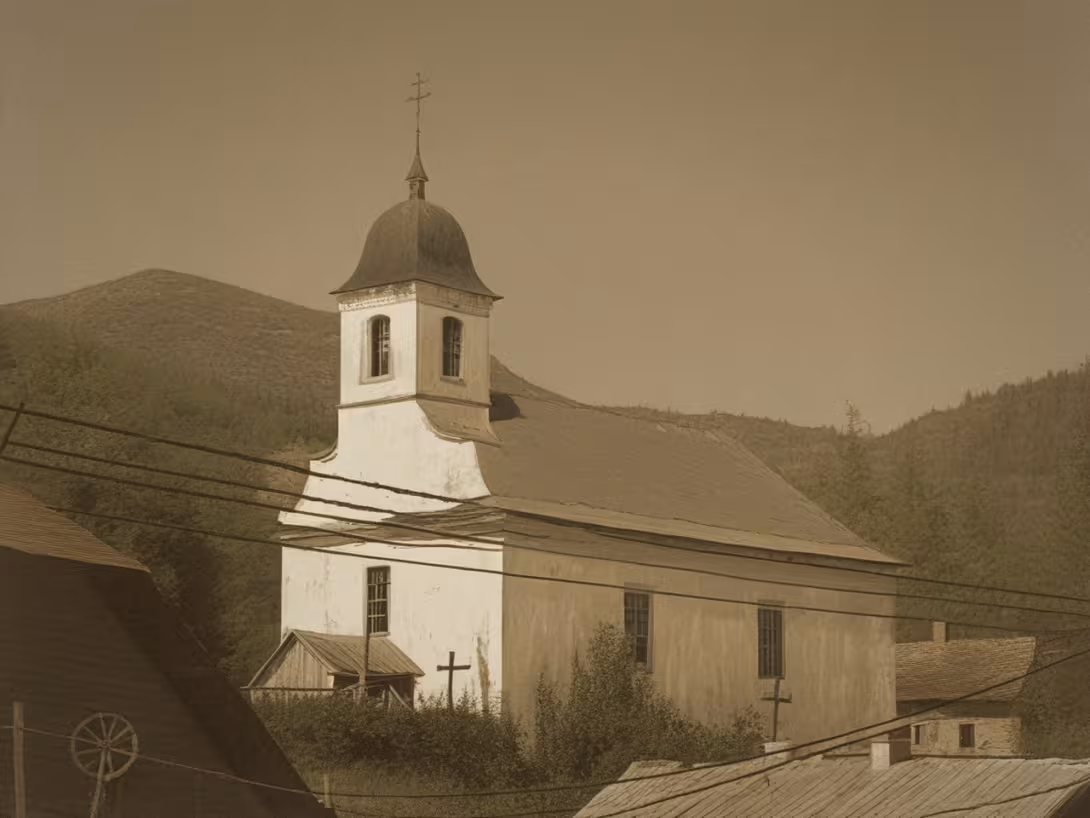
The historical view on the left is a visualisation generated by artificial intelligence and serves as inspiration.
Historical Milestones
- 1694
- the origin of the original wooden church
- 1802
- sanctification and laying of the foundation stone of the new brick church
- 1819
- completion of the building of the brick church and its dedication to the purification of the Virgin Mary
- 1912
- realization of wall painting on Prussian vaults by Jozef Hanul
Artistic features
-
maľba dekoratívna — Dekoratívna výmaľba
omietka, secco - maľba na suchú omietku · historizmus · 1911-1920 -
maľba figurálna — Kristus žehná revúckemu ľudu
omietka, secco - maľba na suchú omietku · historizmus · 1911-1920 -
maľba figurálna — Klaňanie troch kráľov
omietka, secco - maľba na suchú omietku · historizmus · 1911-1920 -
maľba figurálna — sv.Metod
omietka, secco - maľba na suchú omietku · historizmus · 1911-1920 -
maľba figurálna — Klaňanie pastierov
omietka, secco - maľba na suchú omietku · historizmus · 1911-1920 -
maľba figurálna — sv.Cyril
omietka, secco - maľba na suchú omietku · historizmus · 1911-1920 -
maľba figurálna s dekorom — Dekoratívna výmaľba s figurálnymi scénami
omietka, secco - maľba na suchú omietku · historizmus · 1911-1920 -
maľba figurálna — Svätica s horiacim srdcom
omietka, secco - maľba na suchú omietku · historizmus · 1911-1920 -
maľba figurálna — Adorácia Sviatosti oltárnej
omietka, secco - maľba na suchú omietku · historizmus · 1911-1920 -
maľba figurálna — Svätica s horiacim srdcom
omietka, secco - maľba na suchú omietku · historizmus · 1911-1920
Source: Monuments Board of the Slovak Republic — open data, licence CC BY 4.0
Interesting facts
- It is a Baroque-Classicist building from the first half of the 19th century with murals from the painter Joseph Hanula. - The building of the brick church lasted 17 years, while the foundation stone was laid on May 26, 1802, and the dedication took place on August 1, 1819. - Before the construction of the new church, believers used a wooden church from 1694. - In the interior there is a crucifix from the 19th century, which represents folk woodcut. - There is a statue of St. Andrew from 1854, the author of J. Angyal.
Guide
Show guide text
The text was prepared by artificial intelligence and has not been editorially reviewed. It may contain inaccuracies.
Welcome to the village of Liptovské Revúce. Right now you are facing a historical monument, which is the former Church of Purification of the Virgin Mary. Looking at this building, you perceive the peaceful atmosphere of a place that has served as a spiritual center for centuries. Look carefully at the overall shape of the building that stands before you, and note its balanced composition and features, which testify to the period in which it originated.
In order to understand the importance of this place, we must invade deeply into the past. The story of this building did not start with the brick walls you see today. Already in 1694 there was an original wooden church that met the needs of the local community. However, time went by and the need for more sustainable and more representative construction became inevitable. That is why, at the beginning of the 19th century, the municipalities and local believers decided to build a new temple.
Stop for a moment and think about the patience and endurance that people had then. The building you are standing before has not been built quickly. The whole process of building a brick church lasted up to 17 years. Everything began on May 26, 1802, when the foundation stone was laid and the building was sanctified. Imagine this moment full of hope, when the first stones began to layer together to form the basis for a building that would survive generations. Construction gradually grew and found its final ending only in 1819. Just then, in August 1, 1819, the dedication of the temple took place in honor of the Purification of the Virgin Mary.
Now, when you look at the architecture of this building, look at its distinctive features. It is a building from the first half of the 19th century, which combines elements of baroque and classicism. This temporary style brings to the appearance of the building certain nobles and stability. Although we do not know exactly who the architect of the work was, the result is evidence of high craft skills. Feel the cleanliness of the lines and harmony of the whole, which is typical of classical elements, combined with the Baroque tradition, which at that time still influenced the Central European architecture.
If you have the opportunity to take a look inside or remember the interior, you will see the ceiling in particular. Especially interesting details are Prussian vaults. It is on them that you can find wall paintings that are an integral part of the artistic value of this church. However, these paintings are not from the period of the construction itself, but were carried out later, namely in 1912. The artist Joseph Hanul is the author of these works of art. His work added a new dynamic and spiritual dimension, linking architecture from the early 19th century with artistic expression from the turn of the century.
It is fascinating to think about how this place has changed. Before these solid brick walls were built, the believers met in that wooden church. The transition from wooden building to stone was not only a technical change, but symbolized the stability and development of the village Liptovské Revúce. Seventeen years of construction have been a huge effort for local residents, but the result is a monument that fascinates us to this day.
The interesting thing you might be interested in is this very long construction period. Nowadays, we are used to quick projects, but at that time every layer of stone and every detail of the vault was the result of precise work and often of the financial victims of the community. The fact that the building lasted so long only undermines the meaning this temple had and should have for the local people.
Now that you know the basic historical lines and artistic details, let us invite you to go over the construction in peace and to see its majesty. Take a look at the details of the facade and imagine how the chariots were found here over two hundred years ago and people were walking in period clothes. Feel the silence that surrounds this former church and think about all the stories that took place in its walls.
Thank you for your attention and for discovering with us the history of Liptovské Revúc. We hope this short trip to the past has helped you to better understand the value of the former Church of Purification of the Virgin Mary. We wish you a pleasant continuation in your journey and plenty of new experiences in exploring the beauty of our country. Goodbye.
Tips for visitors
Autumn (September and October) and Spring (April to May)
During these periods, the surroundings of the church are covered with green vegetation that contrasts with historical architecture.
In the summer months (June - August) can be around hot and in winter (December - February) can snow.
The church is located in the village of Liptovské Revúce. It is available by car through the road III/1841 from Liptovský Mikuláš or from Ružomberok.
In the summer season we recommend to come by car earlier due to higher frequency visitors.
Clothes - the church is exposed to weather conditions, so dress up according to current weather (we recommend hat and protective cream in summer).
For detailed images we recommend lenses with appropriate focal length.
Small backpack - to store small items such as maps, money or protective gloves (if you choose to touch stone details).
Water and refreshments - there are no shops or stalls around the church, so take plenty of fluids and bacon.
The southwestern facade of the church - from there are the best visible baroque elements and the main entrance with wooden portal.
Surroundings of the church - stone steps and the path to the church are suitable for overall images with the village in the background.
For stable images we recommend using a tripod.
Surroundings of graves - some tombstones and stone crosses come from the previous centuries.
The appropriate light for photography is morning (until 10:00) or evening (from 16:00) when the sun is world from side angles and creates fine seams.
In the western sun, the facade of the church is stained with gold and orange tones.
In the clouded sky, the details of the church are taken equally, without sharp shadows.
Liptovský Mikuláš (about 15 minutes by car)
The historical centre of the town with a town hall, St. Nicholas church and a Renaissance castle (today's hotel).
The city offers walks along the streets and a visit to the Liptov Museum.
Ružomberok (about 20 minutes by car)
City with church of St. John the Baptist, Renaissance castle and museum.
You can visit the Liptov Museum or SNP Square, where the statue of Andrej Hlinka is located.
Pribylina (about 10 min by car)
The village with the church of St. George and the memorial house of the Chrobákov family.
Suitable for those interested in folk architecture and nature around Váh.
Searching for Details
Children may be interested in looking for symbols on the church facade (e.g. statues of saints, coats of arms, stone details).
You can organize the competition to find the greatest detail.
Snake and legends
Tell your children about church history or local legends.
If you have time, visit Liptovský Mikuláš and the Liptov Museum with exhibitions for children.
Mobile game
Organize a small quest - for example, from the church to the nearest stone cross.
There is plenty of space to play around.
Drawings and journals
You can offer children paper and crayons to draw a church or detail.
If you have a workbook with you, you can write down what you saw in the village.
Frequently asked questions
Can the monument be visited?
Religious buildings are usually open mainly during services; at other times a visit is normally arranged with the parish or the operator. We have not verified specific times.
Where is the monument?
Location: Stredná Revúca, Liptovské Revúce, Žilinský kraj. The map on this page shows the exact spot.
Why is the monument protected?
It is listed in the Central List of the Monuments Fund of the Slovak Republic as a national cultural monument (ÚZPF no. 318-12051).
For children
A mysterious church that was built like an argument
Nearby
🏰 Historic sites (89)
- SNP 1944 3.5 km
- SNP 1944 4.8 km
- Podhorec-Ágh 1984 5.3 km
- Památník Slovenského národního povstání 5.8 km
- sv. Anton Paduánsky 5.9 km
- Milan 6.0 km
- Tragicky zahynula r.Bertotová 6.3 km
- Tragédia 4.7.2024 6.5 km
- Pomník neznámych partizánov 1945 6.7 km
- Ing. Daniel Leitman 6.7 km
- Padlým občanom Liptovskej Osady 6.8 km
- SNP 6.8 km
- Tragicky zahynul 26 r. 6.8 km
- sv. Ján Nepomucký 6.9 km
- KSČ 7.0 km
- Martinák 2012 7.1 km
- Karolína Bullová 7.1 km
- ...to bola naša Korytnička... 7.2 km
- SNP 1944 7.2 km
- 21.2.2001 7.4 km
🍽️ Restaurants and dining (50)
- U Nája 0.1 km
- Poľovnícka krčma 0.2 km
- Chata Horec 1.9 km +421 907 239 377 web
- Pohostinstvo Vyšná 2.0 km
- Pohostinstvo Nižná 2.5 km
- Bistro u Mateja 2.6 km
- Koliba Goral 6.0 km +421905522668 web
- Bistro Donly 6.0 km +421 48 429 90 39
- Rekreačné stredisko Smrekovec 6.0 km +421 48 419 98 60 web
- Stodola 6.0 km +421 905 884 896 web
- Donovalský pivovar 6.0 km +421 918 666 016 web
- Dami Sport 6.1 km
- U paroma 6.1 km
- Yeti 6.2 km
- Jánošíkova koliba 6.3 km
- Husky Bar 6.4 km
- Reštaurácia pod Čepeľkou 6.4 km
- Chata pod Magurou 6.4 km
- Riders bar 6.4 km
- Patty Bistro 6.5 km
🏨 Accommodation (66)
- Chata Relax 2.1 km Nižná Revúca 161 web
- Chata u Baníkov 2.2 km
- Enjoy Wellness & Fun 2.2 km
- Wellness privát Štyri Lipy 2.4 km +421908704491 web
- v sedle Kýšky 5.6 km
- Aurelia 5.7 km web
- Šport Hotel 5.9 km
- Penzión Limba 6.0 km
- Anička 6.0 km
- Rekreačné stredisko Smrekovec 6.0 km +421 48 419 98 60 web
- Hotel Encián 6.0 km +421 903 297 111 web
- Chata Lesy 6.0 km +421 918 334 562 web
- Hotel Galileo 6.0 km web
- Stredisko akadémie finančnej správy Donovaly - Stred 6.2 km web
- Residence 6.2 km web
- Triangel Donovaly 6.2 km
- Chata pod Magurou 6.4 km web
- PattySki 6.5 km
- Penzión HALUŠKA 6.5 km
- Chata U Kmotra 6.5 km Poľná 605 web
🚲 Rentals and sport (5)
- Šport 2000 SKI-TI 6.1 km
- Almet Bowling 6.1 km
- Bowling 7.5 km
- Gothal e-bike 7.7 km +421 948 7212 12 web
- #Ride 13.3 km
🥾 Hiking and nature (789)
- pri táborisku Malá Turecká 0.4 km
- Nad Strednou Revúcou 0.9 km
- v Marčekove 1.2 km
- Biela jaskyňa 1.2 km
- Luštavá 1.2 km
- Stráž 1.2 km
- Malá Turecká 1.3 km
- Koleso 1.4 km
- Luštavá 1.4 km
- Pod Marčekovom 1.4 km
- Vtáčí Raj Miroslava Sanigu 1.4 km
- Ihla PRAČLOVEK 1.4 km
- Mlynová 1.6 km
- Pod Grúňom 1.6 km
- Jergeľka 1.6 km
- Koleso 1.8 km
- Sekanica 1.8 km
- Kaňon Veľká Rakytová 1.9 km
- Haláš - hitorický hostinec 2.0 km
- Malá Sútecká 2.0 km
Thematic route
1. A former church Purification of the Virgin Mary (Church) Type: Sacral monument Why it is worth visiting: The building in the village Liptovské Revúce is a regional monument. In the area you can observe the architecture of the building.
2. Church area Liptovské Revúce Type: The immediate surroundings of the monument Why it is worth visiting: The route continues in the historical area, where you can explore the exterior and details of the building.
Seasonal recommendations
In spring, the surroundings of the former Church of Purification of the Virgin Mary in Liptovské Revúch will wake up to life. The first green and flowering trees complement the architecture of the building. A visit in the morning light is recommended. Due to variable spring weather, it is advisable to coat with layers and put on waterproof footwear.
Summer season brings strong sunlight, which highlights the details of the facade. Nature around is in bloom. Early morning or late evening hours are suitable for visiting to avoid high temperatures. It is practical to take a hat and enough drinking water.
Autumn in Žilina region is characterized by a color change of leaves, creating a background for this sacral building. The light is softer and more golden in this period, which is suitable for outdoor photography. Due to colder temperatures, it is advisable to carry a lightweight sweater or jacket.
Winter brings different dynamics to Liptovské Revúč, especially if the construction covers snow. Short days and low temperatures should be taken into account when planning visits in Advent Time. It is important to wear warm winter clothes and wear stable, insulated shoes.
Visualisations and artistic views


The visualisations are generated by artificial intelligence and serve as inspiration.
Photographs from the area
Real photos taken near the monument


Source and licence are given for each image.
Visitor Tips
No tips yet. Be the first!
Log in and add your tip.
Location on Map
More monuments – Liptovské Revúce
Show all in the town


Visitor photos
No photos yet. Be the first to add a photo from your visit!
Log in and add your photo or leave a rating.
You get more points for a visit verified in the app — we can tell from the GPS that you are there.
Reviews and comments