








ľudový dom Vernacular house
The folk house in the village of Povina, Žilina Region, is a national cultural monument of Slovakia. This object is located at no. 225 and is registered under the number ÚZPF 314-2961. Built in 1900, it represents 19th-century architecture, specifically folk construction with a log structure.
The monument site consists of only one object: a folk house (log construction, folk architecture, 19th century). According to the Monuments Board of the Slovak Republic, this is the only primary object on the site.
The folk house is located in the cadastral area of the village of Povina, at latitude 49.30229 and longitude 18.86583. Its protection is confirmed by its status as national cultural heritage.
The folk house in Povina is located in the Žilina Region and is an important part of the local heritage. Its presence in the village enhances its historical value and contributes to the development of local tourism. This folk house is an example of traditional Slovak architecture, making it a significant monument for anyone interested in the cultural heritage of Slovakia. A visit offers an opportunity to better understand and appreciate the historical context of the area.
This folk house is an example of the heritage we preserve for future generations. Visiting it contributes to the sustainable development of the local community. This object is a significant part of the heritage of the village of Povina, which takes pride in its history and tradition.
Tehdy a dnes
Drag the slider and compare how the monument might have looked when it was built with the view today.
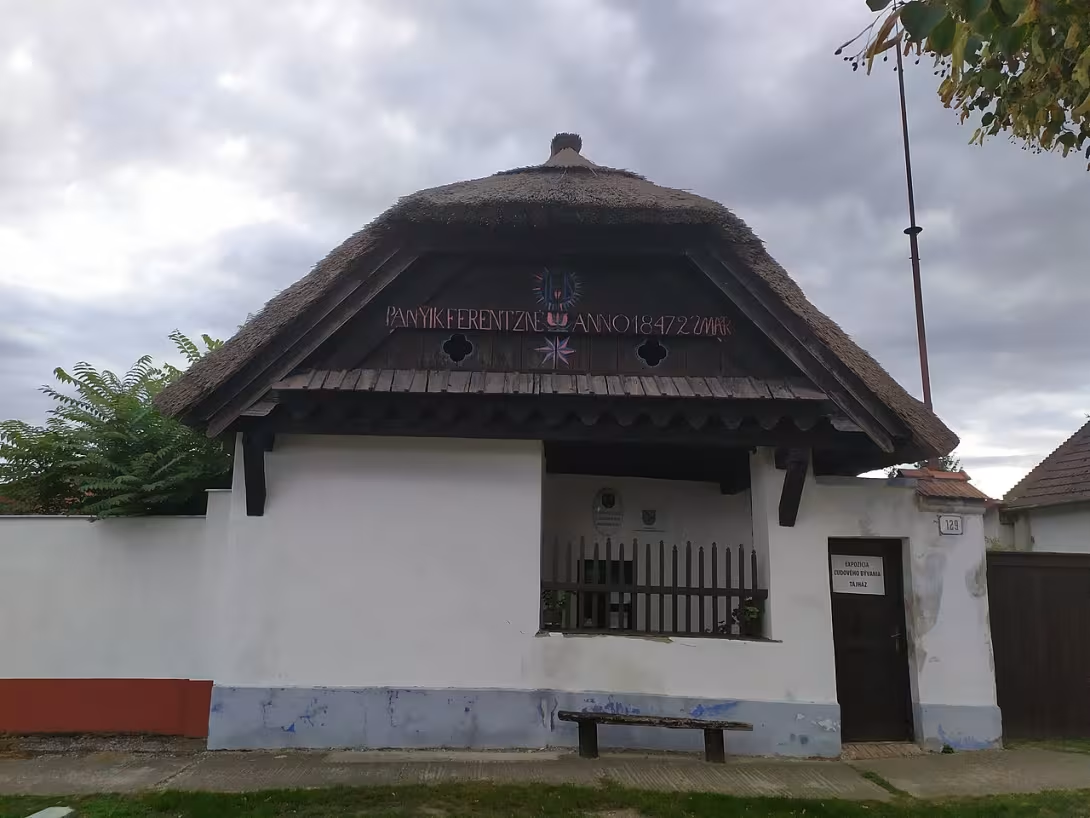

The historical view on the left is a visualisation generated by artificial intelligence and serves as inspiration.
Historical Milestones
- 1900
- Construction of the Folk House in the village of Povina
- around the 19th century
- The house exemplifies vernacular architecture with log construction
Interesting facts
- The Folk House in Povina is a national cultural monument of Slovakia. - It was established in 1900 and represents the style of the 19th century, specifically folk architecture with log construction. - The site consists solely of one object: The Folk House (log construction, folk architecture, 19th century). - Its presence in the village enhances its historical value and contributes to the development of local tourism. - This folk house is an example of traditional Slovak architecture, making it a significant monument for anyone interested in Slovakia's cultural heritage.
Guide
Show guide text
The text was prepared by artificial intelligence and has not been editorially reviewed. It may contain inaccuracies.
Welcome to the village of Povina. Right now, as you stand in front of this Folk House, you find yourself at a moment when time stands still and you can immerse yourself in an atmosphere typical of this corner of Žilina Region. Look around you. Feel the silence that envelops this building and try to imagine the lives that unfolded here, the voices that resonated, and the stories hidden within these walls. The Folk House before you is not just an ordinary structure. It is a living witness to the past, a fragment of our shared memory that helps us understand the roots of the people who lived here before us. Although it may seem at first glance like just an old house, in reality, it symbolizes stability, tradition, and the enduring connection between humans and their environment. When you look at the overall appearance of this building, its naturalness might surprise you. The house sometimes seems as if it has always been here, as though growing directly from the earth, a part of the landscape rather than something imposed upon it. While history hasn't told us the exact year this house was built or the name of the architect who designed its shape, its presence here is undeniable. In folk architecture, individual names often play a lesser role than the collective measure of skill, tradition, and knowledge passed down from generation to generation in villages. This house is the result of many hands that worked with respect for materials and the needs of the family that lived here. Now I will tell you what to look at more closely when observing it. Notice how this structure blends into its environment. Look at its lines and how it relates to the surrounding landscape. Feel the texture of the materials that make up its face. Even if we don't know the precise technical details, your eyes will tell you more than any written documents. Watch how light falls on the surface of the "folk house," how it changes with the time of day, and how it creates shadows that give the building depth and character. Look at its appearance, its balance, and the strength it exudes. Every detail you now perceive, from the shape of openings to how the structure meets the ground, is the result of a certain logic and artistic sense that was an integral part of everyday life in those days. You might wonder who chose this exact spot or who was the master builder with such care? Although the names of historical figures associated with this house are not preserved in archives, their legacy stands before you. Every folk house once served as the center of joyful gatherings and also as a place for quiet, sad moments, where children were born and elders peacefully passed away into eternity. These unknown personalities, these ordinary yet important human destinies, give this place its true value. They are not kings or great dukes but ordinary people whose struggle for life and aspiration for a better future are expressed in every centimeter of this structure. This place also holds a certain mystery. It is the mystery of anonymity. In today's world where everything about everyone is known, this Folk House has one advantage—its anonymity. It is precisely this uncertainty, this unknowability of its exact origins and creators that creates a special tension and fascination. It is a challenge to your imagination. When you look at this object, you are not just a passive observer but become a fellow traveler in the search for truth. What would happen if we knew every date and name? Perhaps this magic would disappear. This very ambiguity allows us to perceive this house not as a lifeless object but as an ever-changing enigma that we can interpret according to our own feelings. Feel this atmosphere. Feel how your inner self calms down in this moment. You stand before something that has transcended time, survived many changes in the world, and still stands here to remind us of our place in time. The Folk House in Povina is not just a monument; it is a bridge between what was and what is today. As you continue on your journey, try to take this feeling with you. Let yourself be inspired by how a simple structure can express so much emotion and remain a steadfast pillar in an ever-changing world. I invite you to continue exploring this location. Rich history and beautiful nature surround us, creating one great, uninterrupted story. Spread your eyes across the surroundings, feel the scent of the air, and seek other traces of the past hidden in this landscape. Thank you for spending this brief time with us and for stopping to pay attention to this quiet witness of our past. I wish you an enjoyable further walk, and may curiosity guide you toward what you have yet to discover. Goodbye.
Frequently asked questions
Can the monument be visited?
This is a residential or farm building, not a museum with opening hours. Please view it from public space and respect the owners' privacy. We have no information about access to the interior.
Where is the monument?
Location: č. 225, Povina, Žilinský kraj. The map on this page shows the exact spot.
Why is the monument protected?
It is listed in the Central List of the Monuments Fund of the Slovak Republic as a national cultural monument (ÚZPF no. 314-2961).
For children
Lift your spirits back into the past, exactly 126 years ago! The folk house in Povina emerged almost like a miracle—a monument to our ancestors. How did it all begin? Imagine that windows and doors were closed so we could see what was happening here around the year 1900.
Nearby
🏰 Historic sites (156)
- sv. Mikuláš 4.4 km
- Pamätník vyhorenia mesta 5.4 km Nábrežná
- sv. Ján Nepomucký 5.7 km
- Kaštieľ Radoľa 5.7 km +421 41 4212 505 web
- Kaštieľ Radoľa 5.7 km web
- Pamätník starého mosta 5.7 km
- Dlhomír Poľský 5.8 km
- Koscelisko 5.8 km
- Panna Mária 5.9 km
- Panna Mária 6.0 km
- sv. Anton Paduánsky 6.0 km
- Pamätník Starý cintorín 6.0 km
- Panna Mária 6.1 km
- Pamätník na Skačkove 6.7 km
- Desatoro 6.9 km
- Strojovňa orloja 7.1 km
- Slovenský orloj 7.1 km
- sv. Michal archanjel 7.1 km
- Obetiam 1. svetovej vojny 7.1 km
- sv. Ján Nepomucký 7.2 km
🍽️ Restaurants and dining (445)
- Cafe Bar X 3.2 km
- Hostinec u Jana 3.6 km
- Hostinec u Jana 3.8 km
- Hostinec u Borovice 3.9 km
- Pod lipou 4.3 km
- Bar Alfa 4.4 km
- Espresso u dvoch levov 4.5 km
- Nad Barom H.V. 4.6 km
- Krčma pod Zlieňom 4.8 km
- Pohostinstvo Jana Čížová 5.1 km
- Rebeka 5.2 km Sládkovičova 2747/67
- Caffe Bar Marína 5.2 km Jána Lottnera 3178/1
- Zastávka pod Lipkou 5.3 km
- M Caffé 5.3 km Benkova 2833/10
- Hostinec 5.5 km
- Gastro pod Gaštanom 5.6 km
- Piváreň Rajtek 5.6 km
- U Kultána 5.6 km +421 905 232 694 web
- Stary pivovar u bociana 5.6 km Kysucká 174/2 +421 917 645 495 web
- Caffe Bar Life 5.6 km +421 905 849 056
🏨 Accommodation (145)
- Horský hotel Hájnice 2.6 km +421 41 420 77 00 web
- Hotel KNM 5.6 km
- Hotel Kriváň 5.6 km Námestie slobody 104/34
- Chalupa Mariana 6.1 km web
- Chalupa Višňa 6.4 km
- Turistická ubytovňa Kysucké Nové Mesto 6.9 km Dubská cesta 2648 +421 908 940 250 web
- Hotel Bystričan 7.4 km
- Penzión v Starom mlyne 9.1 km SNP 283/41 +421 907 294 724 web
- Diana 9.3 km
- Hotel Brainy 9.6 km Vlčovská cesta 751 +421 915 793 931 web
- Château Gbeľany 9.9 km +421 41 420 41 41 web
- Penzión Anton 10.0 km web
- Bukovina 10.3 km web
- Hotel Bránica 10.5 km +421 41 5693035 web
- Autocamping Varín 10.5 km +421 911 49 42 42 web
- Penzión u Adama 10.6 km +421 905 471 361 web
- Camping Belá Nižné Kamence 10.7 km +421 905 742 514 web
- Penzión Anita 10.7 km +421 910 323 203 web
- Penzión Martinov dvor 10.7 km
- Chalupa U Toma 11.3 km +421 915 063 910;+420 725 586 699 web
🚲 Rentals and sport (92)
- Nedostavaná plaváreň 5.4 km
- Šport-Market 5.5 km Jesenského 1347 +421414216416 web
- Mestská športová hala 6.5 km Športová 1338/1
- Bike centrum 7.1 km
- ANTIK SmartWay Bikesharing 8.8 km
- Lezecká stena Village resort Hanuliak 9.2 km +421 41 707 89 06 web
- ANTIK SmartWay Bikesharing 9.9 km
- Rekreačno-oddychový areál 10.2 km
- Detský vodný park 10.4 km web
- ANTIK SmartWay Bikesharing 10.6 km
- ANTIK SmartWay Bikesharing 10.7 km
- ANTIK SmartWay Bikesharing 10.8 km
- Cyklošport 10.8 km Struhy +421 903 669 436
- Športový areál Juraja Sobolu 11.7 km Športová
- Vodné dielo 11.8 km web
- Kubicasport 11.9 km +421 41 565 13 49 web
- Budatín - Dolná 11.9 km web
- 2J Sport 12.0 km
- Nika Sport 12.0 km
- Košická - Tesco 12.1 km web
🥾 Hiking and nature (279)
- Senkov 0.7 km
- Holý vrch 1.8 km
- Priehyb 2.3 km
- Steny 2.4 km
- Obelec 2.4 km
- Ľadonhora 2.5 km
- Skáčkova hora 2.7 km
- Kykula 3.2 km
- Pod Uhliskami 3.2 km
- Prašivá 3.4 km
- Bizov vrch 3.4 km
- Diely 3.6 km
- Černatín 3.7 km
- Pleš 3.7 km
- Žiare 3.9 km
- Včelnica Kašička 4.0 km
- Malé Ostré 4.1 km
- Poľana 4.4 km
- Bartkov kopec 4.6 km
- Veľké Ostré 4.6 km
Thematic route
Folk House – a cultural heritage site. The main building represents the typical architectural style of the region and serves as an exhibition space for the folklore traditions of the Žilina Region.
Courtyard – outdoor area. In the courtyard, you will find traditional wooden stalls and seating, where you can soak up the atmosphere of old folk festivals and relax while enjoying views of the surrounding nature.
Exhibition Hall – interior. The hall displays authentic folk costumes, musical instruments, and handicrafts that illustrate the richness of local crafts and culture.
Tower – architectural feature. From the top of the tower, a panoramic view opens up over the village of Povina and the surrounding hills, making it an ideal spot for photography and reflecting on the historical context of the site.
Park near the house – green space. The surrounding park offers manicured paths, benches, and plantings typical of the region, where you can stroll among old trees and find peace after touring the exhibits.
Seasonal recommendations
Jaro: In the spring season, the folk house in Povina is adorned with blooming shrubs and trees. Under sunlight, lighting effects can emerge that enhance the historical character of the monument. Rapid weather changes are common, so wearing layered clothing is recommended. It's best to visit during early spring. Léto: In summer, the folk house becomes a center of activity. With warm sunshine, nature around the monument is at its liveliest, allowing comfortable strolling or relaxation on the lawns. Due to high visitor numbers, it's advisable to arrive earlier in the morning or later in the afternoon. Warm clothing and sun protection are essential. Podzim: In autumn, the surroundings of the folk house in Povina are covered with golden and orange hues of falling leaves. Sunny days remain suitable for walks, but rapid weather changes can be common during this period. It's recommended to wear warm clothing and prepare for possible rain or snow. Zima: In winter, the folk house is adorned by a frosty and snow-covered landscape. Warm clothing and protection against the cold are essential. This time is ideal for those seeking a peaceful visit.
Visualisations and artistic views


The visualisations are generated by artificial intelligence and serve as inspiration.
Photographs from the area
Real photos taken near the monument

Source and licence are given for each image.
Visitor Tips
No tips yet. Be the first!
Log in and add your tip.
Location on Map
More monuments – Povina
Show all in the town




Visitor photos
No photos yet. Be the first to add a photo from your visit!
Log in and add your photo or leave a rating.
You get more points for a visit verified in the app — we can tell from the GPS that you are there.
Reviews and comments