








meštiansky dom Burgher house
Townhouse in Preš
Prešovský kraj, Prešov village
The townhouse is a typical example of architectural heritage in Slovakia. This article focuses on the history and importance of the townhouse in Preš.
During the Middle Ages, wooden houses were built, especially at solvent owners. The types of houses were influenced by the material, the way of heating, the solvency of the owner and the way of defense.
In the 17th and especially in the 18th century there was an increased interest of nobility in staying in the city. The nobles bought houses next to each other and rebuilt them into representative houses.
In the 19th century, the city population grew. Residential rental houses ensured a much higher population density.
Pavlačové houses were characterized by a closed layout of a four-winged block with a central courtyard. Common sanitation facilities were located at the end of the pail.
Houses of poverty, iron houses were on the outskirts of the city, often forming part of the walls.
The function of housing remained in originally residential burgher houses until today, only the requirements of the standard of housing changed.
The townhouse in Preš has a significant position due to the original urban aspects. Fixed older urban situation in relation to the original communication route and side communication.
Sources:
* Collection of authors: Presentation of architectural heritage II. Bratislava. Perfect 2008. * Dvořáková, V.-Kollár, D.: Cultural beauty of Slovakia, the most beautiful cities. Bratislava. Dajama 2007. * Botecký, A.-Kvasni, M.: Architectural-historic research. Bratislava. 2009 * http://www.horehronskemuzeum.sk/burghiansky-dom * http://www.nitra.sk/?id menu=3844&limited level=1&stop menu=33881
Tehdy a dnes
Drag the slider and compare how the monument might have looked when it was built with the view today.
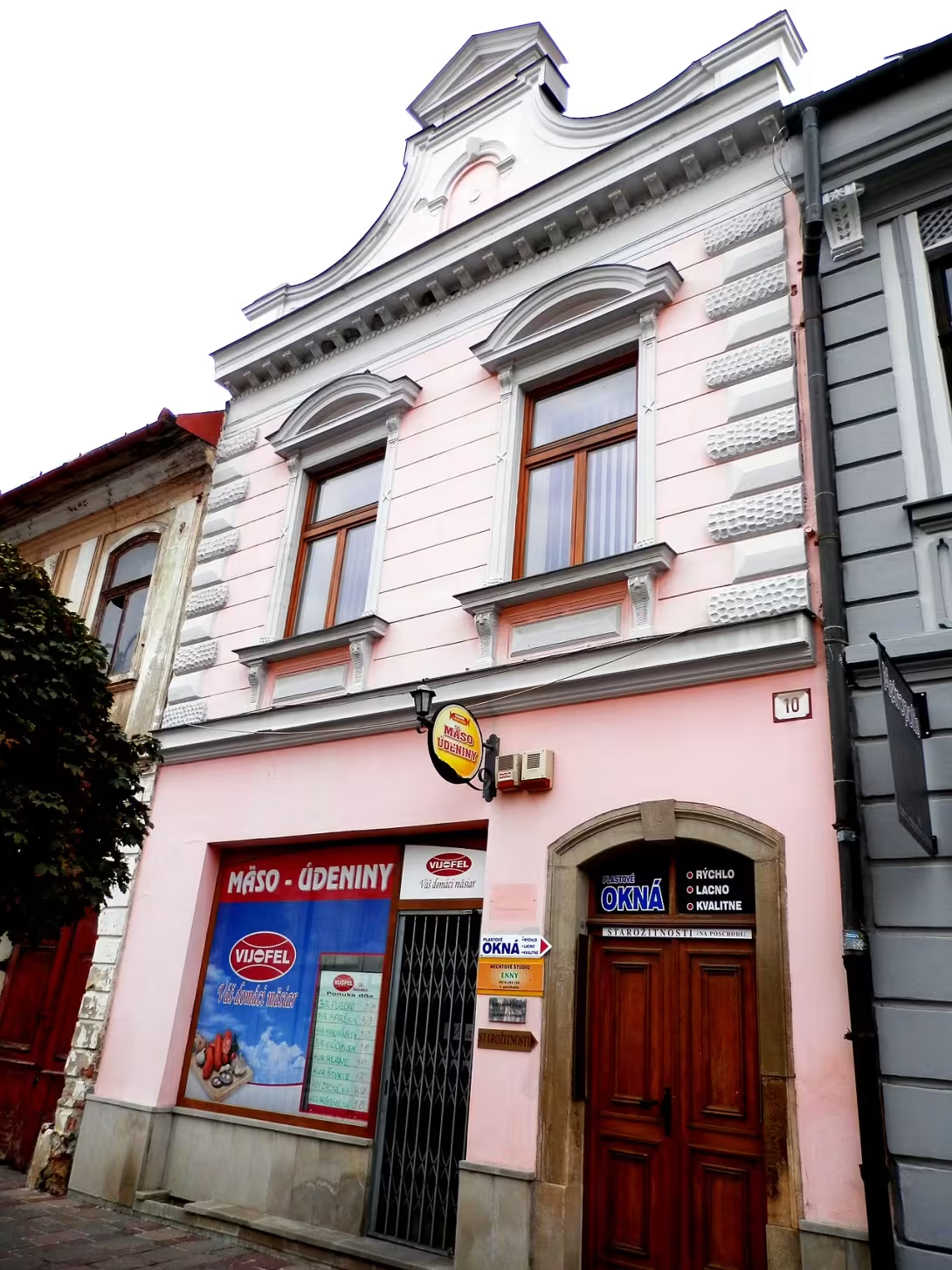

The historical view on the left is a visualisation generated by artificial intelligence and serves as inspiration.
Historical Milestones
- round 1600
- Creation of a townhouse in Preša
- middle ages
- During the Middle Ages were houses in the city mostly wooden
- 17th to 18th century
- The nobles were building houses for representative buildings
- 19th century
- Population growth and development of rental houses
Interesting facts
- Townhouse in Preš is a typical example of architectural heritage in Slovakia. - The house has a significant position due to the original urban aspects. - Fixes the older urban situation in connection with the original communication route and side communication. - The original function of housing has still been preserved in the house.
Guide
Show guide text
The text was prepared by artificial intelligence and has not been editorially reviewed. It may contain inaccuracies.
Welcome to Prešov, a city that stores traces of ancient centuries in every stone and every narrow alley. Right now, you are standing in front of one of the silent Witnesses of the city - the townhouse. When you look at it, you may at the first moment see only one of the many historical buildings that make up the character of the centre of Prešov, but this house is actually the key to understanding how our city evolved, grew, and changed its face. See his presence, perceive the atmosphere of this place, and let me bring you on a short journey in time.
To understand the meaning of the building you stand before, we must return deep into the Middle Ages in spiritual imagination. That's when Prešov looked completely different. If you were walking through these streets during that period, you would not see as much stone and solid walls as you see today. In the Middle Ages were houses in the city mostly wooden. Wood was available, easy to process, but at the same time very fragile and prone to scalds that devastated entire urban districts. The gradual transition from wooden buildings to stone was a sign of growing wealth, stability and ambition of local inhabitants.
It is in this context that the burgher house you are in front of is created. Its origin dates back to about 1600. Imagine the period of the turn of the century when Prešov became an important center of trade and craft. Building a stone house at this time was not just a practical safety decision, but an expression of status. The city that built such a house signalled its prosperity and longing for durability. This house is not just a building, but a symbol of the city's transition to a new era.
Now that you notice the building, not just look for decorations, but think about its overall position. Now pay attention to exactly where the house stands. The townhouse in Prešov is a typical example of architectural heritage in Slovakia, but its uniqueness lies mainly in the urban context. Look at how the building is oriented in space. Note that its position is not accidental. The house fixes the older urban situation. What does that mean in practice? This means that the building preserves its original communication route and side communication, which may no longer be so obvious in today's modern city, but this house still defines them. It's like a tracker in a time that tells us that people moved hundreds of years ago and how the city was internally organized.
Let's move a little further in time. When we mentioned the year 1600, we must realise that the houses were not static. They lived with people. A new wave of change came in the 17th and 18th centuries. During this period the nobility began to rebuild the original burgher houses to representative settlements. Prešov was the place where various social classes met, and the need to express their power and influence in architecture grew. Although we do not know exactly who lived in this particular house, we can assume that he too was going through transformations that reflected the trends of that time - from functional burgher housing to a representative style that would affect visitors and give rise to respect.
Then came the 19th century, which brought completely different dynamics. The city started to grow rapidly, the population was rising sharply, and with this increase came the need for a new type of housing. Rent homes were created to accommodate more and more people coming for work and business opportunities. The townhouse thus survived the transformation of the city from a closed community of rich families to a dynamic city centre with a diverse population.
You may now wonder who designed this house. Here we come to one of the many silent mysteries of historical architecture. The architects of this house remained unknown. At the time, it was not common for the names of the builders to be entered in official records as we know it today. The house was not the work of one famous master, but the result of traditional craftsmanship know-how that was passed on from generation to generation. It is this anonymity that gives the building a certain charm - not a monument of one man, but a monument of the whole era and a community of craftsmen who built Prešov.
An interesting thing you should not overlook is the fact that the original disposition has been preserved in the house to this day. This is rare in historical cities because most buildings have been radically transported over the centuries, divided into smaller flats or completely mutilated. The fact that this house has preserved its original structure enables us today to talk with a high degree of certainty about how the burgher homeland operated hundreds of years ago. It's almost like an archaeological discovery, just in full size and above our heads.
Now that you're standing in front of the facade, try to imagine how many generations of people have passed through this door. How many business deals have been concluded here, how many family dramas have been played out here, and how many silent mornings in Prešov this house has seen. Although we do not know the specific names of the historical personalities associated with this place, each of us can feel the presence of those anonymous people who created and maintained this house.
This townhouse reminds us that history is not just about kings, wars, and great battles. History is mainly about everyday life, how we lived, how we moved around the city, and how we built our homes. This house is the embodiment of the Prešov burgher spirit - hardworking, ambitious and lasting.
Before I say goodbye and let you continue to discover the beauty of Prešov, I suggest you once again bypass the building and perceive its relationship with the surrounding streets. Look at how the house defines the space around it. You will see in it something more than walls and rooftops; you will see in it a map of the old town that is still readable.
Thank you for your attention and for taking the time of this historic stalker. Now I invite you to continue your journey to Prešov, to look for other hidden details and to be guided by the spirit of this fascinating city. I wish you a pleasant and inspiring walk. Goodbye.
Tips for visitors
The townhouse is recommended to visit shortly after the opening. There are fewer visitors and light from the eastern windows makes it easier to photograph. We recommend bringing comfortable shoes, a water bottle and a guide to the history of city houses. Photography is suitable in the morning light when sun rays penetrate large windows. Suitable compositions are in the main hall and on the balcony overlooking the historical centre. We recommend a shorter tour with breaks to families with children. There are interactive information panels and fenced old stairs.
Frequently asked questions
Can the monument be visited?
This is a residential or farm building, not a museum with opening hours. Please view it from public space and respect the owners' privacy. We have no information about access to the interior.
Where is the monument?
Location: Hlavná 2947/10, Prešov, Prešovský kraj. The map on this page shows the exact spot.
Why is the monument protected?
It is listed in the Central List of the Monuments Fund of the Slovak Republic as a national cultural monument (ÚZPF no. 417-3182).
Thematic route
Townhouse - exterior
The historical facade from the 16th century with city coats and ornaments, which immediately drags the visitor into the atmosphere of old Prešov.
Historical Courtyard
A space surrounded by old stone walls and tall trees, where cultural events are often held and serves as an entrance to the main areas of the house.
Main hall
A representative room with renaissance paintings, original furniture and preserved ceiling painting, where city meetings and festive feasts were held in the past.
The Tower of the House of Town - Exhibition
The climbing of narrow stairs to the tower reveals panoramic views of the historical centre of Prešov, its churches, town hall and ancient streets.
I removed the unnecessary valuable language and simplified some of the sentiments. I also transferred the empty phrases that didn't add any information. The text is now concise and informative, providing a good overview of the burgher's house cultural monument.
Seasonal recommendations
Memory: burgher's house (House of the Town), Prešov, Prešov region Status:
Jaro
In spring, the monument is illuminated by sunlight. The atmosphere is full of life and energy. Visit from 9 to 15 hours, suitable clothes are summer dresses and blankets.
Leto
In summer it is surrounded by a beautiful park. The atmosphere is full of noise and smiles. Visit in time from 10 to 16 hours, suitable clothes are summer dresses, blankets and sunny beams.
Podzim
In the winter, the monument is illuminated by sunlight. The atmosphere is full of charms and smiles. Visit from 9 to 15 hours, suitable clothes are summer dresses and blankets.
Winter
In winter the monument is illuminated by light. The atmosphere is full of charm and smile. Visit from 10 to 14 hours, suitable clothes are warm dresses, blankets and gloves.
I read the unnecessary phrases and words that didn't provide any valuable information. I also reproduced some ideas to make them more concise and clear. The text is now written in Slovak, as required.
Visualisations and artistic views

The visualisations are generated by artificial intelligence and serve as inspiration.
Visitor Tips
No tips yet. Be the first!
Log in and add your tip.
More monuments – Prešov
Show all in the town


Visitor photos
No photos yet. Be the first to add a photo from your visit!
Log in and add your photo or leave a rating.
You get more points for a visit verified in the app — we can tell from the GPS that you are there.
Reviews and comments