

parish church of St Church
The parish church of St. Trinity in the village of Lokca in Žilina region is a Renaissance church from 1665, which was later baroqueized. The building together with the church cemetery forms a monument area listed in the Central List of Monument Fund of Slovakia under number 229/1.
The church was founded in 1665 as a Protestant Emporic Temple. In the 18th century it was extended and adapted to a three-ship church with a polygonal ending of the presbytery.
The exterior of the building is characterized by a smooth facade and a pictured tower with a high baroque mine and lateral. Renaissance stucco vaults are preserved in the interior. Under the church there is a crypt with a signboard from 1665.
Art equipment includes the Baroque side altar of St. John Nepomuk from the 18th century. In the menze there is a baptismal drawer with doors decorated with folk painting from the middle of the 17th century. The second baptistery is stone and dates back to the early 18th century. The ensemble of interior paintings consists of three works from the 18th century with motifs of Preaching, St. Colorful windows were made in 1952 E. A sweeper.
The church stands in the central part of the village, behind it is a cemetery. The building has undergone reconstruction and is in good condition.
Tehdy a dnes
Drag the slider and compare how the monument might have looked when it was built with the view today.
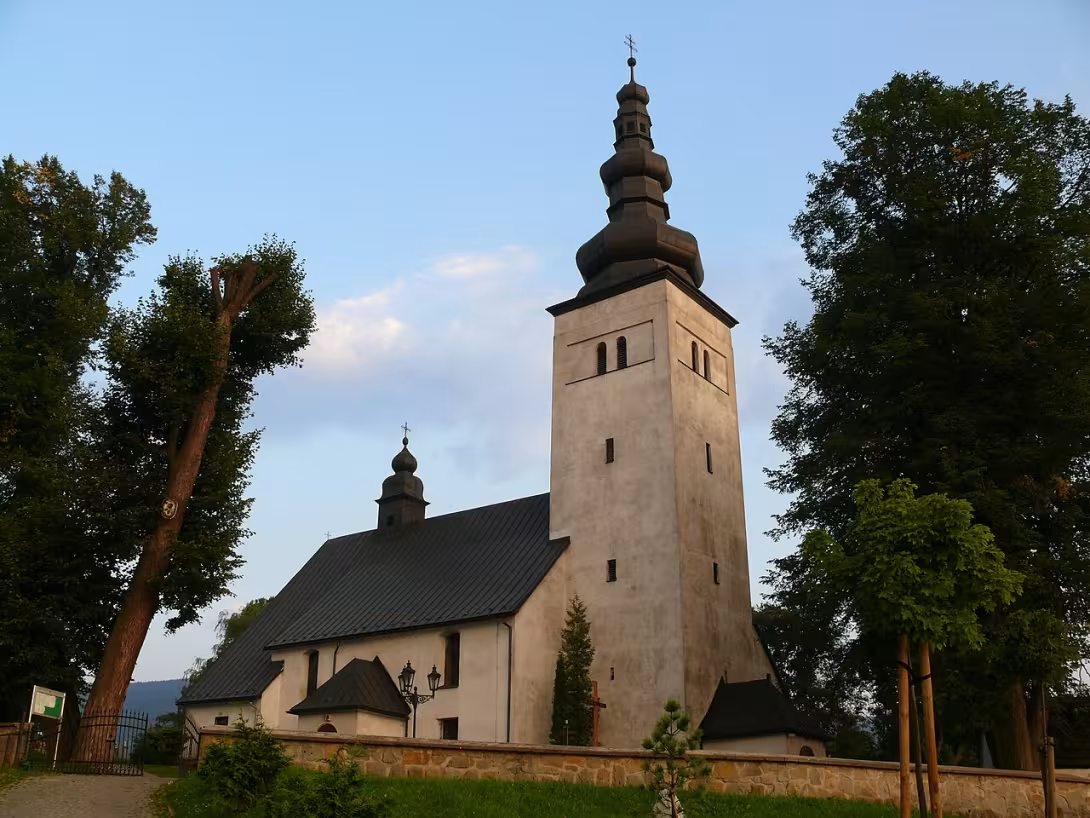
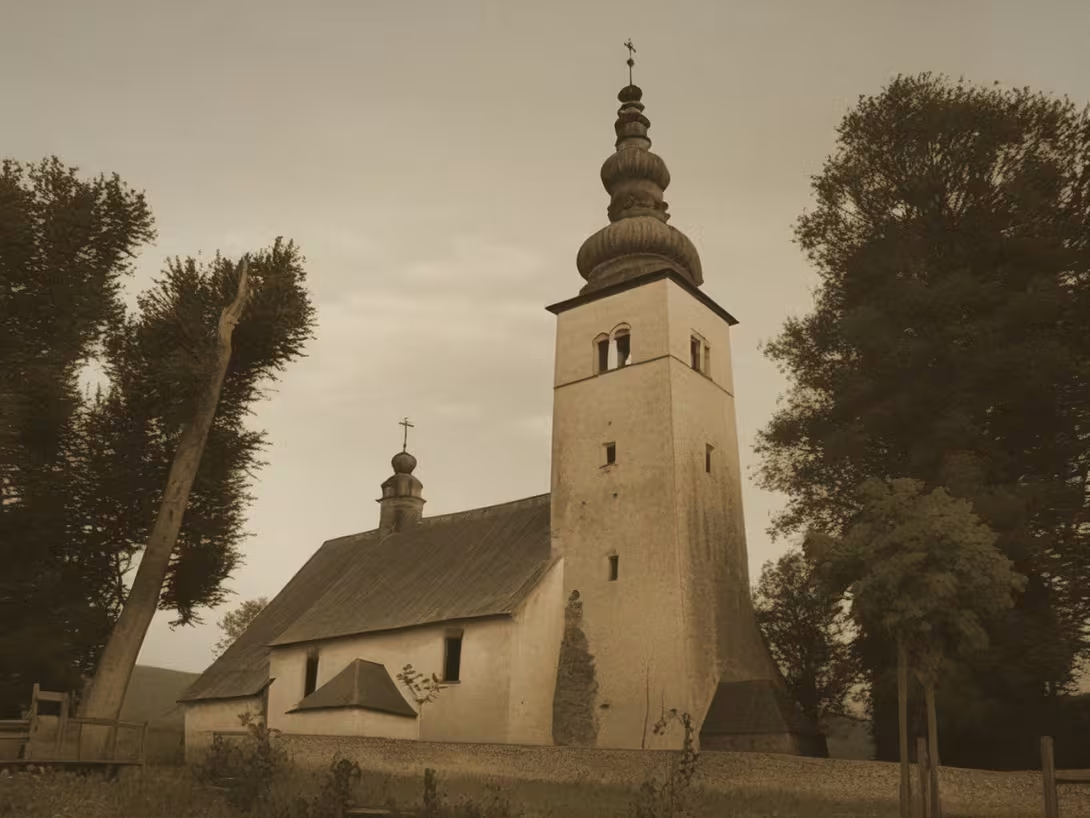
The historical view on the left is a visualisation generated by artificial intelligence and serves as inspiration.
Historical Milestones
- 1665
- construction of the originally renaissance protestant emporic church
- 18th century
- extension, modification and baroqueization of the three-ship church
- 1952
- design of color windows from E. Battery
Artistic features
-
vitráž figurálna — Panna Mária Lurdská
sklo, vkladanie do siete · moderna · 1951-1960 -
vitráž figurálna — sv.Trojica
sklo, vkladanie do siete · moderna · 1951-1960 -
vitráž figurálna — sv.Rodina v tesárskej dielni
sklo, vkladanie do siete · moderna · 1951-1960
Source: Monuments Board of the Slovak Republic — open data, licence CC BY 4.0
Interesting facts
- It is a Renaissance temple from 1665, which was later baroqueized. - Originally it was built as a Protestant Emporic Temple, later it was converted into a three-ship church. - In the interior there are preserved Renaissance stucco vaults and under the building there is a crypt with inscription board from 1665. - In the menze there is a baptismal drawer with doors decorated with folk painting from the middle of the 17th century. - Art equipment includes the Baroque side altar of St. John Nepomuk from the 18th century.
Guide
The guide was voiced by a synthetic voice created by artificial intelligence.
Show guide text
The text was prepared by artificial intelligence and has not been editorially reviewed. It may contain inaccuracies.
Welcome to the village of Lokca, in the heart of Žilina region, where one of the local spiritual and historical pillars lies before you right now. You are standing in front of the parish church of St. Trinity, which together with the promised church cemetery forms a peaceful and formidable whole. When you look at the building, you may only perceive the peaceful atmosphere of the local temple, but the walls of this church testify to the many changes that have been made with the flow of time and the shift of religious currents in our region.
Now let's rush into the past together to understand how this temple was created. The story of this place begins in 1665. At this time it was originally built as a Renaissance Protestant Emporic Church. Imagine, then, a building that served another religious community in its original focus and had a different inner disposition, typical of Protestant temples of the time, where the empors, or galleries, served to expand the seating capacity for believers. It was a time to seek stability and spiritual refuge, as reflected in the construction itself.
However, the history leaves few in their original condition. If you are now aware of the overall form of the building, you can see the result of the changes that occurred later, namely during the 18th century. During this period the church has undergone a significant modification and extension. There has been a process of baroqueisation, which means that Renaissance strenght was replaced by Baroque dynamics and a new arrangement of space. The original Emporic Temple was rebuilt into a three-ship church, which gave it a larger size and new identity, which you still perceive today.
If you now move to the details that may be subtle at first glance, I suggest you focus your attention on what is hidden under the surface and in the interior. Although the exterior bears traces of the baroque, rare traces of its origin have been preserved inside the temple. They are Renaissance stucco vaults, which are silent witnesses in 1665. These vaults are a fascinating detail, as they connect two large epochs of architecture in one building.
Even deeper, right below the building, there is a place that gives the church a fascinating and mysterious dimension. It's a crypt. It is there that you can find a signboard that dates exactly to the construction until 1665. It's almost like touching the very foundation stone of this monument. It is fascinating to think that while the upper parts of the building changed and adapted to the new trends of the 18th century, the crypt in the lower part remained as a stationary archive of history.
When you move inside and perceive the light penetrating into the space, note the colorful windows. They're not from the Renaissance or the Baroque, but they're much newer. They were made in 1952 by artists, namely E. Butter. These windows give the interior a colorful dimension and connect the historical substance of the church with the artistic expression from the 20th century's polina. There is also artistic equipment in the mension, which complements the overall impression of the room.
The whole complex, including the church cemetery, bears the story of adaptation. From the Protestant temple to the three-nave Catholic church, from Renaissance vaults to Baroque form and modern color glass. It's a place where the old meets the new.
Now I invite you to go around the whole object in peace, to perceive the silence of the church cemetery and slowly absorb the atmosphere of this historic place. Let your curiosity guide you and try to imagine what this temple looked like on the day of its dedication more than three centuries ago.
Thank you for your attention and we wish you a pleasant further survey of the beautiful village of Lokca and its historical monuments.
Tips for visitors
Visit the church late in spring or summer, when the flower surroundings and the church cemetery acts atmosphericly. We recommend coming at dawn or before sundown when light highlights the details of the facade and architecture of the Trinity.
Since it is a sacral structure, cover appropriate clothing and choose clean shoes.
When photographing are suitable views from the church cemetery, which captures the church along with historical tombstones. Watch the impact of natural light on the walls of the building to pick up the texture of the material.
Families with children can use the visit for a short lesson from history and architecture. Children can be involved in searching for details on the facade or in the perception of the silence of the church space.
Frequently asked questions
Can the monument be visited?
Religious buildings are usually open mainly during services; at other times a visit is normally arranged with the parish or the operator. We have not verified specific times.
Where is the monument?
Location: Trojičné námestie 518/7, Lokca, Žilinský kraj. The map on this page shows the exact spot.
Why is the monument protected?
It is listed in the Central List of the Monuments Fund of the Slovak Republic as a national cultural monument (ÚZPF no. 317-229).
For children
Close your eyes and imagine pressing the invisible time button. Boom! You fly deep into the past, exactly 361 years back. Cars, cell phones and asphalt roads will disappear around you. Súmeš in 1665 in the village Lokca. The air smells like fireplace smoke, and that's when something extraordinary starts building. Imagine hundreds of people carrying heavy stones in linen baskets and hats. There were no Eating Machines, they had to lift everything with their own hands. The parish church of St. Trinity was established here.
Nearby
🏰 Historic sites (72)
- Pamätná izba Martina Hamuljaka 3.1 km
- Múzeum kávy 5.5 km +421 948 566 677 web
- Pavol Országh Hviezdoslav 6.5 km
- sv. Florián 6.5 km
- Ján Vojtaššák, spišský viskup 6.5 km
- sv. Ján Nepomucký 6.6 km
- Červenej armáde 6.8 km
- Anton Bernolák 6.8 km
- Najsvätejšia Trojica 8.1 km
- Malé Podbielanské etnografické múzeum 8.2 km +421 903 535 832 web
- Slanický ostrov umenia – Oravská galéria 8.8 km web
- Anton Bernolák 8.8 km
- sv. Ján Evanjelista 9.8 km
- sv. Ján Krstiteľ 9.8 km
- sv. Ján Nepomucký 9.8 km
- Ruiny mostu 10.0 km
- Františkova huta 10.0 km
- pamätník Zdenky Schelingovej 10.4 km
- Madona 10.4 km
- Zápalky 10.5 km
🍽️ Restaurants and dining (114)
- Pohostinstvo Bakala 0.1 km
- Restaurant Pizza Bar u Barťáka 0.3 km web
- Pizza-Bar 0.3 km
- Gassum Club 0.4 km
- Pub Baron 3.0 km
- Pohostinstvo u Pištu 3.0 km
- Bar u Koptu 3.0 km
- Zbojnícka koliba 3.9 km
- U Domina 4.4 km
- Piváreň 4.4 km
- Krčma u Maťa 4.6 km
- Pohostinstvo u Johnyho 4.7 km
- Penzión Pohoda 5.3 km web
- Papuča 6.1 km
- Daria 6.3 km
- Poloma 6.4 km Mláka 5
- Fresh Corner 6.4 km
- Furmanka 6.4 km
- Natali burger 6.4 km
- Bistro Bar Marina 6.5 km web
🏨 Accommodation (50)
- Penzion Bakala 0.1 km +421 949 432 187,+421 944 043 569 web
- Penzion Pohoda 4.5 km
- Penzión Kriš 4.8 km
- Penzión Krušetnica 5.6 km +421 905 852 695 web
- Turistická ubytovňa Magura 6.5 km
- PORT CLUB pension 6.6 km Nábrežie 1164/13
- Penzión Modul 6.8 km Nábrežie 1161/25
- Penzión U Peťa 6.8 km
- Oravia 7.0 km
- Penzión Korytnačka 7.8 km Vojtaššákova 1041 web
- Chata Ester Oravská priehrada 7.8 km Slanická osada 2135 +421911763285 web
- Agrohotel Tri brezy 7.8 km Črchľa 396/145 +421 911 631 992 web
- Penzion Príslop 8.1 km +4210917720004 web
- Autocamp JAMI 8.2 km
- Camp Marina 8.2 km
- Slanica 8.2 km
- U RYBÁRA 8.2 km
- Ranč u Edyho 8.3 km +421 4355 21 840 web
- Chatka Gos 8.3 km +421 908 100 700 web
- Drevenica Podbiel 8.3 km web
🚲 Rentals and sport (9)
- HEIKO šport 6.5 km Hviezdoslavovo námestie 213 +421 903 5405 05
- Bicykle X Sport 6.5 km Hviezdoslavovo námestie 213 +421 948 038 414
- Kappa šport 6.5 km Štefaniková
- Prístav č. 2 8.3 km
- Prístav č. 1 9.2 km
- Cyklošport 10.3 km
- Europa Gym 10.4 km
- Mestská plaváreň Tvrdošín 10.4 km
- TJ Sokol Zubrohlava 11.6 km
🥾 Hiking and nature (192)
- Opálený 1.4 km
- Klinec 2.4 km
- Havraní vrch 2.5 km
- Pekelná 2.9 km
- Uhlisko 2.9 km
- Komanižky 3.0 km
- Za skalou 3.1 km
- Vajcovka 3.1 km
- Vajcovka 3.5 km
- Bučina 3.6 km
- Budín 3.6 km
- Budín II 3.7 km
- Šubovka 4.0 km
- Surov 4.2 km
- Šutkovka 4.7 km
- Rozhľadňa Brabírka 4.7 km
- Hruštín 5.0 km
- Kýčera 5.0 km
- Prípor 5.1 km
- Moldovenín 5.3 km
Thematic route
1. Parish Church of the Trinity - sacral building with rich interior. 2. Church cemetery - Part of the complex with historical tombstones. 3. Church Tower - An elevated point from which to see the architecture of the temple and surroundings. 4. Courtyard of the church - The area near the temple designed to rest.
Seasonal recommendations
In the spring, the surrounding parish church of St. Trinity in Lokec will wake up to life. The sun at this time provides light suitable for outdoor photography and church cemetery. It is recommended that shoes suitable for wet surface and visit in the morning.
Summer season brings intense sunlight, which highlights the details of the architecture and color of the facade. Due to high temperatures it is advisable to choose morning or late afternoon hours and dress light, breathable clothes.
Autumn in Žilina region is characterized by a variety of colors that form the background for historical monuments. The golden and red leaves of trees around the church give the place peace. When visiting, it is advisable to wear layered clothing and non-slip shoes, as the surfaces around the cemetery may be slippery due to fallen leaves.
Winter is turning the landscape around Lokca into snowy space. The contrast of white snow and the walls of the church creates a minimalist picture. Hot and functional clothing, including insulated shoes, is essential for visitors. The ideal time to visit is a bright winter day with natural lighting.
Visualisations and artistic views


The visualisations are generated by artificial intelligence and serve as inspiration.
Photographs from the area
Real photos taken near the monument

Source and licence are given for each image.
Visitor Tips
No tips yet. Be the first!
Log in and add your tip.
Location on Map



Visitor photos
No photos yet. Be the first to add a photo from your visit!
Log in and add your photo or leave a rating.
You get more points for a visit verified in the app — we can tell from the GPS that you are there.
Reviews and comments