








st. Michael's Church Church and belfry
St. Michael's church is located in the village of Liptovský Michal in the Ružomberok district in Slovakia and is a historical monument from the second third of the 13th century. It serves as a Roman Catholic parish church with rich history and architectural features.
The first written mention of the church dates back to 1288, when it was mentioned by Liptov's Vice-archidiacón Mikus. At that time he was part of the Liptov vice-archidiconate.
After the Reformation between 1575 and 1686 the church was used by Protestants who added a western wooden tribune and a brick pulpit. Under the church there is an inaccessible crypt.
In 1694 a bell tower with onions was built on the church, which is a protected element of the monument. In the 19th century, parishioners such as Štefan Nikolai Hyroš and Albin Kontrík worked here.
In the 20th century a brick hall was built before the southern ceiling, the interior was enriched by M. Štalmach (1941) and the church tower was dismantled and moved to the Pribylinské Museum of Liptov village.
The exterior has a rectangular floor plan with a polygonal apsid in the east, a sacristy on the north side and a western wooden bell tower. The interior is single-boated with a arched rib cross vault in the presbytery and portal with a saddle top.
In the church there are Rococo elements, like the altar of St. Michael the Archangel and painted figures of the apostles from the time of Protestantism. Sakristia has Gothic windows and a box with Christ's painting from 1763.
Of the original three bells, only one was preserved, spilled from the old bell in 1725. Two others were used for military purposes during World War I.
The church was first mentioned in writing in 1270 because of the property dispute. The altar has rococo ornaments and rustic statues, which testify to carving work in Liptov.
The Monument Office of the Slovak Republic records the area under the number of ÚZPF 332 and consists of two objects: the church (Gothic, 2nd half of the 13th century) and bell tower (walled, frame construction, folk construction, 17th century).
Tehdy a dnes
Drag the slider and compare how the monument might have looked when it was built with the view today.
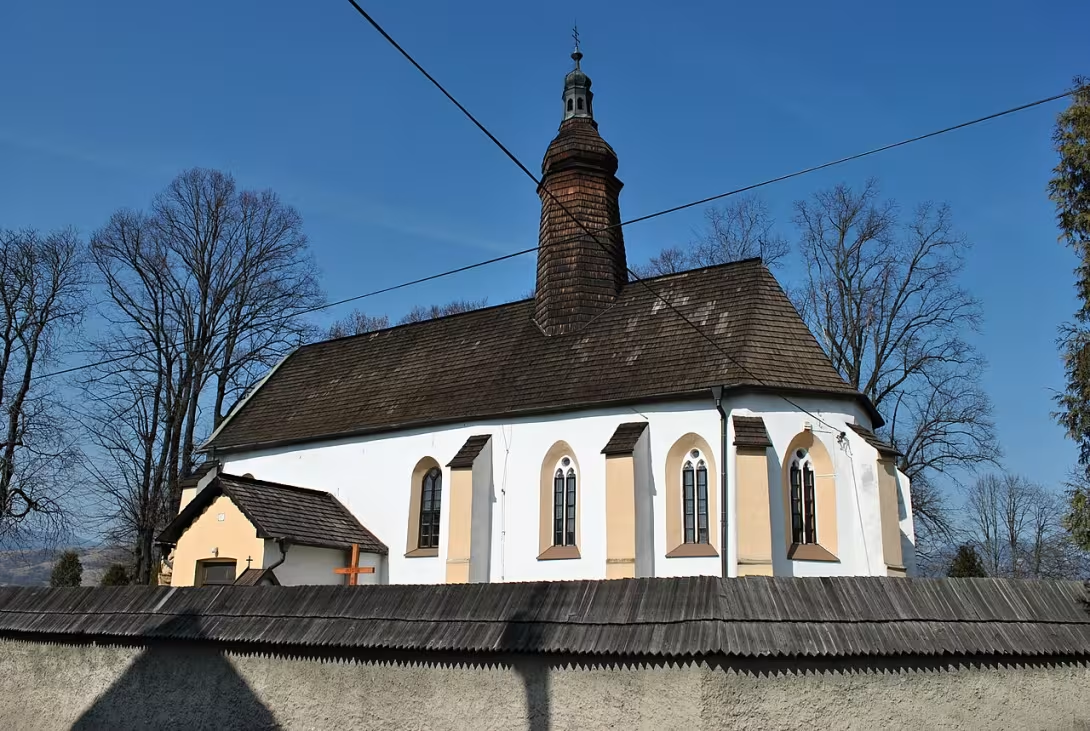

The historical view on the left is a visualisation generated by artificial intelligence and serves as inspiration.
Historical Milestones
- 1270
- First written mention of the church in connection with the property dispute
- 1288
- Written mention of the church by Liptov vice-archidiacon Mikus
- the second third of the 13th century
- Church formation
- The average labour costs of the sampled Union producers developed over the period considered as follows:
- Period of church use by Protestants during the Reformation
- 1694
- Position of bell tower with onion peak
- 1725
- Casting a preserved bell from an old bell
Interesting facts
- The church was first mentioned in writing in 1270 because of the property dispute. - Between 1575 and 1686 the church was used by Protestants who added a western wooden tribune and a brick pulpit. - In 1694 a bell tower with onions was built on the church, which is a protected element of the monument. - Only one of the original bells was preserved, spilled from the old bell in 1725. Two others were used for military purposes during World War I. - The interior is single-boated and contains rococo elements, such as the altar of St.
Guide
Show guide text
The text was prepared by artificial intelligence and has not been editorially reviewed. It may contain inaccuracies.
Welcome to Liptovsky Michal. You stand in front of St. Michael's Church, a place that bears the traces of many centuries of our ancestors. Before us lies this peaceful area, where the dominant is not only the temple itself, but also its accompanying belfry. At this point, when you put your headphones on and close your eyes, try to perceive the silence of this country, which is interrupted only by the sound of the breeze. When you then open them, look at the entire silhouette of this monument. You can see a diet that has long served as the spiritual pillar of this village and which hides stories from the time Liptov changed and evolved.
Let's go in time together now. To understand what lies ahead, we must return deep into the Middle Ages. We date the church itself to the second third of the thirteenth century. Imagine Liptov at that time - wild, full of dense forests and built settlements. It was during this period that this temple began to become here. Interestingly, we only know about many old monuments from random references. In the case of St. Michael's Church, this is exactly the case. The first written mention from 1270 does not refer us to any grand celebration, but to something very human and ground - the dispute over property. It is fascinating to think that it is precisely because of the legal conflict of the 13th century that we know with such precision that the church already existed in this location.
A little later, in 1288, the church is reappearing in historical records, this time in connection with the Liptov vice-archidian named Mikus. These early references help us to understand that this church was not just a local chapel but an important point within the church administration and social organisation of the region. Now look at the walls of the temple, see the stability it carries. He survived periods of prosperity, but also times of great change that will affect Europe as a whole.
Reformation was one such fundamental change. If you stop by now and think about how the beliefs of those who attended church services changed, we will reach the period from 1575 to 1686. The use of the church by Protestants in this long time span left concrete traces in the temple that you can still perceive today. It was at this time that elements were added to the interior which met new liturgical needs. Note that within the interior space, a western wooden stand was built and a brick pulpit was built. These details are not just architectural elements, but evidence of the profound religious changes and social tensions that ruled in Liptov. The pulpit from which the words in the native language of believers sounded symbolized a new approach to faith and education.
Now I would like to ask you to move your view towards the bell tower. This is one of the most significant and most valuable elements of the whole monument. The bell you see was built in 1694. Look up at her peak. You will see a characteristic onion shape that is typical of the architecture of the time. This onion peak is not only an aesthetic addition, but is an officially recognized and protected element of this monument. Imagine how this tower dominated the country in the late seventeenth century and how the bell announced important events, festivals, but also warned against danger to all inhabitants of Liptovsky Michal.
And speaking of the bell tower, we cannot ignore the sound itself that comes out of it. In 1725 there was an interesting process. The old bell, likely to have endured its best years, was spilled. His material produced a new bell, which in many cases preserved the continuity and spiritual value of his predecessor. It is a beautiful metaphor for the church itself - the old one changes, spills and takes on a new form, but the essence and mission remain the same.
Now that you're standing in front of this complex, try to imagine all the generations of people coming here. From the medieval peasants of the thirteenth century, through the 16th century reformers, to craftsmen who completed this belfry in 1694. Although we do not know the names of the specific architects who designed this church, their work is before us. Their anonymity gives the place a kind of humility and mystery. It is not a monument built for the glory of one man, but a space created for the whole community.
An interesting thing that may not be visible at first sight, but is important for understanding the value of this place, is precisely this layeriness. St. Michael's church is not a static building but a living organism. From the first dispute over property in 1270, through the period of Protestantism, to the Baroque elements of the bell tower, all of this together forms one unique story. It's a story about endurance, the vortex, and the ability to adapt to new times, without losing identity.
The last part of our short journey remains ahead. Look again at the entire structure, the connection of the temple and the bell tower to the onion peak. Feel the atmosphere of this place where history meets the present. This church in Liptovský Michale teaches us that even small villages can store great history and that every detail, whether it be a brick pulpit or a spilled bell, has its own, irreplaceable value.
Now I invite you to walk around the church in peace, bypass the bell tower, and perhaps stop quietly to feel the energy of this century-old place. Let yourself be guided by your curiosity and try in the details of the facade or the shape of the roof to find the answer to the question of what the connection to the past means to you.
Thank you for a walk in the history of St. Michael's Church in Liptovsky Michal. I hope this short trip in time has helped you to better understand the beauty and meaning of this monument. I wish you a pleasant rest of the day and a peaceful discovery of other gems of our region. Goodbye.
Frequently asked questions
Can the monument be visited?
Religious buildings are usually open mainly during services; at other times a visit is normally arranged with the parish or the operator. We have not verified specific times.
Where is the monument?
Location: č. 84, Liptovský Michal, Žilinský kraj. The map on this page shows the exact spot.
Why is the monument protected?
It is listed in the Central List of the Monuments Fund of the Slovak Republic as a national cultural monument (ÚZPF no. 318-332).
For children
As we open an adventure storybook, let us move back in time to the mysterious village Liptovský Michal and its oldest church - St. This church stands as a true guardian of the past, and its deep foundations are established in 1270 when it was first mentioned in writing. Imagine this: the church as a witness to the great historical debate about property! Even if we do not have an exact plan where this debate took place, it is fascinating to think of the various loud and decision-making people. At the time, the green valley was full of life.
Nearby
🏰 Historic sites (244)
- Kaštieľ Bešeňová 0.4 km Mitošiny 117/4
- Hradisko sv. Ďur 1.0 km
- Hrádok 1.0 km
- Kaštieľ Ivachnová 1.5 km
- Kaštieľ Liptovská Teplá 2.0 km
- Michal Král 2.3 km
- Kaštieľ Madočany 2.3 km
- SNP 2.8 km
- Kaštel rodiny Kubínyi 2.9 km
- Vodny hrádok 3.0 km
- Stavba Liptovskej Mary 3.3 km
- sv. Peter 3.6 km
- sv. Pavol 3.6 km
- Sv. Peter a Pavol 3.6 km
- Archeologické múzeum v prírode NKP Liptovská Mara-Havránok 3.6 km web
- Cirkevný zbor evanjelickej cirkvi 1525-2010 3.6 km
- Milan Rastislav Štefánik a obetiam 1. svetovej vojny 3.6 km
- Pamätník SNP 3.6 km
- Kaštieľ Partizánska Ľupča 3.6 km web
- Ruiny kostola Panny Márie 4.0 km
🍽️ Restaurants and dining (274)
- Koliba Bešeňovka 0.2 km web
- Dobrota 0.3 km
- Pohoda Pilsner Pub 0.4 km
- Pri kameni 0.6 km
- Bistro Smrek 0.7 km
- Vila 27 0.7 km +421 914 271 271 web
- Cullinaria 0.8 km
- Giovanni 0.9 km
- Cosmopolitan Bar 0.9 km Ľudovíta Bešeňovského 270/124
- Grill House 0.9 km
- Sweet & Coffee 0.9 km
- Bistro 0.9 km
- Relax bar 1.0 km
- Kozí vŕšok 1.1 km web
- Reštaurácia a ubytovanie Zuzana 1.3 km Na Kamenci 31 +421 911 998 722 web
- Na Majeri 1.6 km
- Kúria 1.7 km
- Reštaurácia u Sršňa 1.8 km
- Penzión Motýľ 1.9 km Liptovská Teplá 442 +421 905 833 069 web
- Rybárska krčma 1.9 km
🏨 Accommodation (226)
- Apartmány Best 0.3 km
- Privat4you 0.3 km
- Summit 0.3 km web
- Privát Anna 0.3 km Jánska 9/34
- Privát Mária Zacharova 0.3 km
- Privát Bystrá 0.3 km
- Marka 99 0.4 km
- Miluška 0.4 km web
- Penzión Ivana 0.4 km
- Čabaj 0.4 km
- Zaria 0.5 km
- Pension Agrothermal 0.5 km Bešeňová 137 +421 911 521 636
- Penzión Fontána 0.5 km
- Privát Magdaléna 0.5 km
- Apartmány Butterfly 0.6 km
- Privát Thermal Bešeňová 0.6 km
- Vila Ajka 0.7 km web
- Privát Maja 0.7 km
- River Cottage Bešeňová 0.7 km Ľudovíta Bešeňovského 130/82 web
- Flóra 0.7 km
🚲 Rentals and sport (78)
- Relaxačný sedací bazén 0.8 km
- Relaxačný sedací bazén 0.8 km
- Bazény pre hotelových hostí 0.8 km
- Bazén Termal 0.8 km
- Veľký plavecký bazén 0.9 km
- Relaxačný bazén Čaša 0.9 km
- Relaxačný bazén s vodným barom Cosmopolitan 0.9 km
- Tobogany - dopadový bazén 0.9 km
- Bazénová hala 0.9 km
- Veľký relaxačný bazén Mara 0.9 km
- Detský atrakčný bazén 0.9 km
- Tobogany a šmýkačky - dopadový bazén 0.9 km
- Plavecký bazén Šport 1.0 km
- Divoká rieka 1.0 km
- Bazén s vlnobitím 1.0 km
- Fun bubble pool 1.0 km
- Detský atrakčný bazén 1.0 km
- Diving centrum - potápačský bazén 1.0 km web
- Raft river 1.1 km
- Marina 4.1 km
🥾 Hiking and nature (1093)
- Bešenovský Medokýš 0.8 km
- Bešenovské travertíny a minerálne pramene 0.8 km
- Prť 0.8 km
- Medokýš 1.0 km
- Termálny kráter 1.0 km
- Prameň pri poľnej ceste 1.0 km
- Termálny kráter 1.1 km
- Travertínová veža v Bešeňovej 1.2 km
- Prameň za travertínovým lomom 1.2 km
- Termálny kráter 1.2 km
- Drienok 1.4 km
- Dvoriská 2.2 km
- Vlahora 2.5 km
- Kyseľovec 2.7 km
- Úložisko 2.8 km
- Hôrka 2.9 km
- Ivachnovský potok 2.9 km
- Kalinový jarok 2.9 km
- Madočanská hojdačka 2.9 km
- Madočanská hojdačka 2.9 km
Thematic route
Thematic cruise route from Liptovský Michala
1. St. Michael's Church and the Belfry - Type: Kostel - Proč is worth visiting: This baroque church, built in the 18th century, is the most significant monument of the village Liptovský Michal. Its architecture and interior with rich decoration are true wonders for lovers of history and architecture. 2. Liptovský Michal - center of the village - Type: City Square - Why is it worth visiting: After visiting the church you can walk through the picturesque city square, where there are traditional houses with artistic decorations. Ideal place to relax and get to know the past atmosphere. 3. School building - Type: Historical school - Why it is worth visiting: This object is part of the long-term educational tradition of the village. Its historical significance and architecture are a fascinating element for anyone interested in the history of education. 4. City Library - Type: Library - Why it is worth visiting: The local library offers a variety of resources for reading and research. It is an ideal place to learn about the past culture and literature. 5. Park near the church - Type: Local park - Proč is worth visiting: The park around the church offers a quiet place to relax in nature. Ideal for short walk or view of the picturesque landscape pejzaz. This route will take you through the most notable historical and cultural places of Liptovsky Michal, where you can get to know the locality in its context.
Seasonal recommendations
Jaro: In the spring period, St. Michael's church is adorned with flowering gardens and greenery, which gradually appears in the surrounding mountains. Sunny paprika creates noble lightcuts on the stones of the church, which gives the building a splendor and a pleasant feeling of restoration. When visiting, it is advisable to wear lightweight clothes with hoods or jacket to protect them from the cold winds that can be raised in the mountains. The best time to visit is morning or evening, when the atmosphere is quietest and not so likely crowds of tourists.
Leto: In summer, St. Michael's church appears to be an ideal shelter in a comfortable, warm-loving parasol. The surrounding area is full of flowering grasses and pine trees, which adds landscape beauty. Sunlight illuminates the church from its foundations to peaks of peaks, making the building a significant attraction for visitors. When planning the trip, it is advisable to wear sunglasses and sunglasses to protect you from intense sunshine. The best time to visit is the morning or evening start, when temperatures become quieter and fewer tourists visit the memorial.
Under: In the foothills, St. Michael's church is watered in grey - white and rumen leaves that fall from the surroundings. This time of the year offers a unique view of the building in the air full or lively light, which is promoted in darker barns with the arrival of the evening. During the visit it is recommended to wear warm jacket and headbands for protection against cold winds that can be raised in the mountains. The best time to visit is evening or early dawn, when the atmosphere is quietest and fewer tourists visit the memorial.
Winter: In winter, St.Michael's church appears to be a significant landmark in the snowy mountains. Sunny hills illuminate the walls and shields of the building, thus highlighting its architectural details against the background of white landscape beauty. When planning a visit, it is important to wear warm clothes, protective gloves and high shoemakers for travelling on snow or led soil. The best time to visit is in the morning when the atmosphere is quietest and fewer tourists visit the memorial.
Visualisations and artistic views


The visualisations are generated by artificial intelligence and serve as inspiration.
Photographs from the area
Real photos taken near the monument


Source and licence are given for each image.
Visitor Tips
No tips yet. Be the first!
Log in and add your tip.
Zdroje a literatura
The factual basis for this text was the article na Wikipedii, whose authors are Wikipedia contributors. The article is available under the licence CC BY-SA 4.0.
Location on Map
More monuments – Liptovský Michal
Show all in the town



Visitor photos
No photos yet. Be the first to add a photo from your visit!
Log in and add your photo or leave a rating.
You get more points for a visit verified in the app — we can tell from the GPS that you are there.
Reviews and comments