

st Peter's and Paul's temple Church
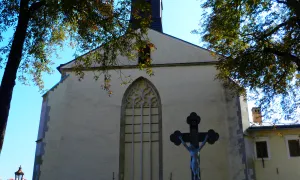
Saint Peter and Paul's Church in the village of Jakubany in Prešov region is a Greek Catholic church with a brick wall of the first half of the 20th century. Construction from 1904 to 1911 combines historical Art Nouveau style with Byzantine and Romanesque influences.
The present temple is probably located on the site of the previous church from 1772, which destroyed the fire. The foundation stone of the new temple was laid on September 4, 1904, for the administration of the parish Alexander Kriška. They completed the construction in 1911 as the administrator of the parish of Michal Michalic and sanctified the temple on 12 July.
The building was built according to the plans of Ján Bobulu Jr. It has a Greek cross plan with a polygonal closure. Above the square crossing there is a large dome on the pendants, which is decorated in the exterior by a wreath of three-pronged attic shields. Facades are divided by decorative support pillars and ended with triangular shields with bosážami. The asymmetrically placed tower is square at the bottom, in the middle transition to the octagonal shape and is finished with a bell-shaped helmet. The tower reaches a height of 50 meters, and 120 steps lead to its top.
The interior of the church is oriented by the altar to the north, which is a departure from the traditional eastern orientation due to the longitudinal character of the village. Three entrances lead to the building: main from the south side, entrance from under the bell tower and side entrance from the southwest. In the southern part there is a chorus for men. There are two altars in the interior: the altar of the holy apostle Peter and the right altar of Jesus ' heart in the left corner. The main altar has four sides, which symbolizes the suffering of Christ for the whole world.
The element of the interior is the iconostasis of Russian style, which separates the temple part from the sanctuary. It was produced by the Budapest company Retay és Benedek and installed in 1934 after train to Podolínec and then wagons to Jakubian. The walls decorate the painting: on the right side is the picture of Jesus entrusting the keys to Saint Peter, and on the left are depicted the saints Cyril and Methodius. The four corners of the walls depict the Gospels Luke (the bull), Matthew (the angel), Mark (the lion) and John (the eagle). In the right part there is a chapel with God's grave and a place for the baptism of children.
The tower contains four bells. The oldest of them, named Eva, dates back to 1758 and was cast in Prešov on the cargo of Bazil Katrenič. The other two bells from 1921 were made in Chomutov from gifts of believers living in America; the largest of them is named after St. Peter and Paul and central to St. Nicholas.
In 1782, the construction of the school began near the church, which served for services during the construction of the new church between 1904 and 1911. It is believed that the plans from Jamesian could later be used to build a similar temple in Debrecen, Hungary.
The building is registered in the Central List of Monument Fund of SR under number 888/1. In 1937 he was renovated. Between 1977 and 1979, the roof was covered with copper metal, and the façade was renovated in 1979. The internal renovation took place between 1982 and 1985 and another exterior repair in 1997, when the object was sanctified by the Prešov governor John Hirk.
The church is located in the centre of the village and is in good condition. Construction is an example of eclectic architecture.
Tehdy a dnes
Drag the slider and compare how the monument might have looked when it was built with the view today.
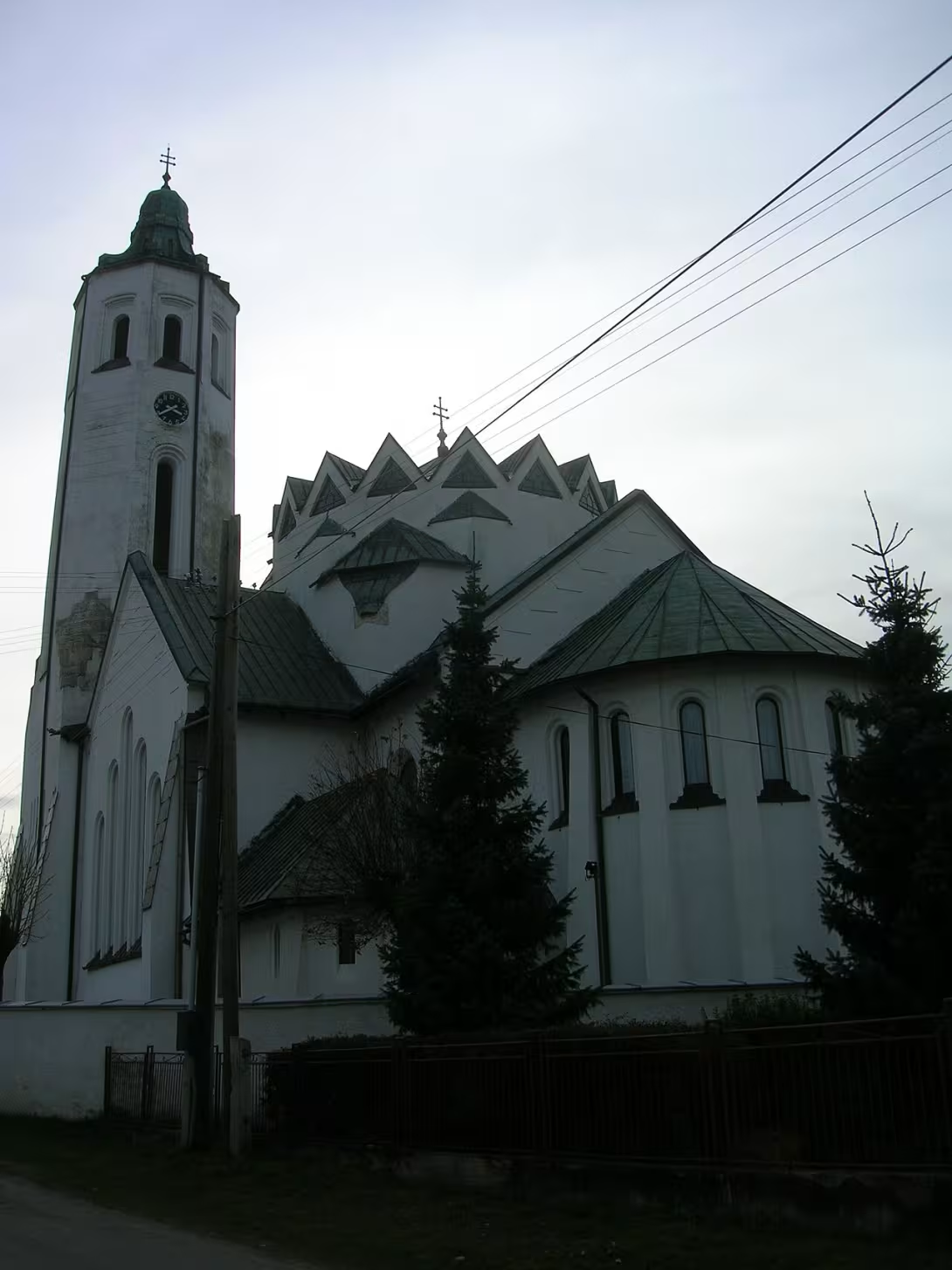
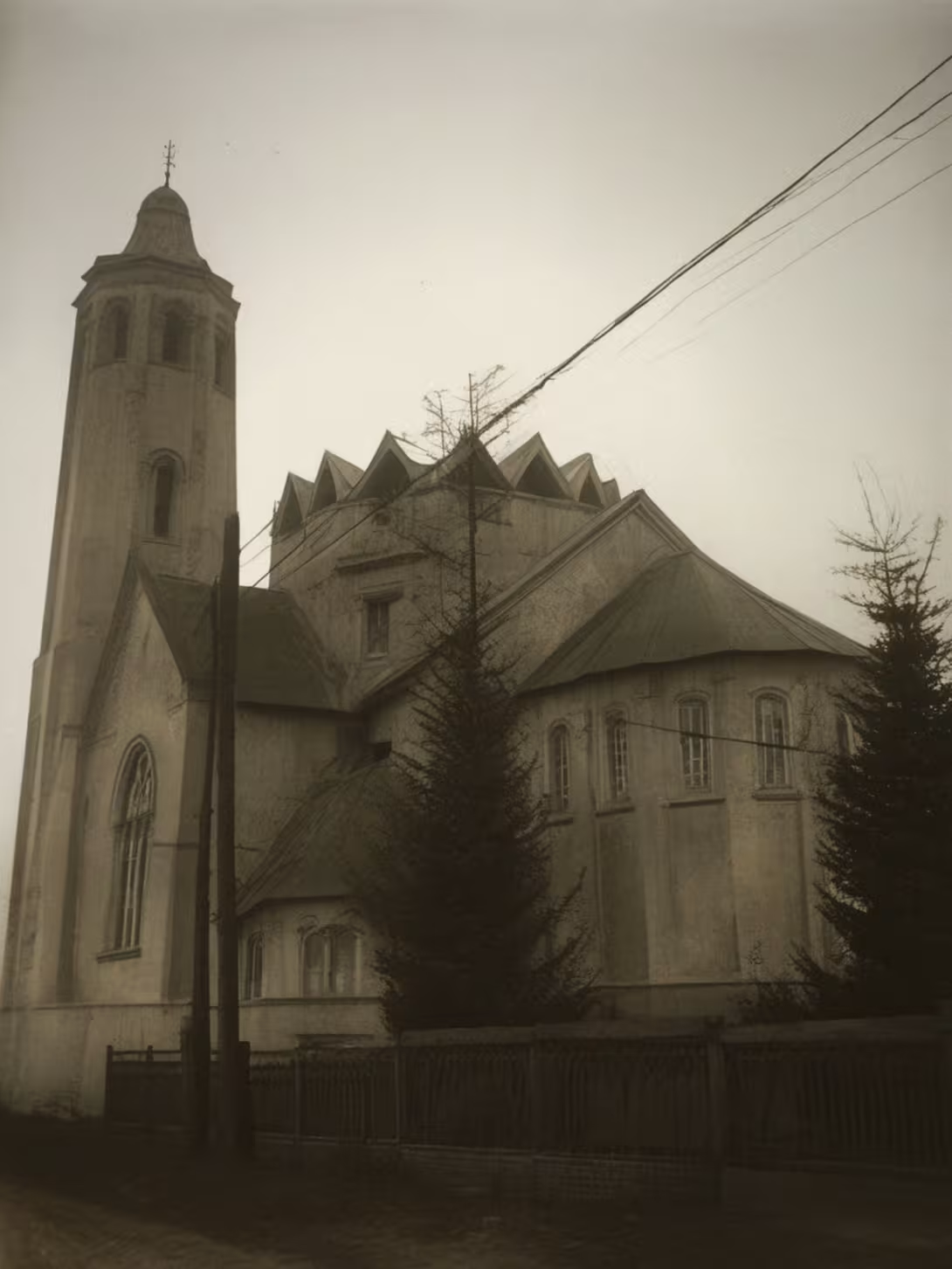
The historical view on the left is a visualisation generated by artificial intelligence and serves as inspiration.
Historical Milestones
- 1772
- the creation of the former temple
- 1904
- laying the foundation stone of the new temple
- 1911
- completion of the construction and sanctification of the temple (12 july)
- 1934
- installation of an iconostasis of Russian style from Budapest
- 1937
- renovation of the temple
Artistic features
-
vitráž dekoratívna — Rozeta
sklo, vkladanie do siete · bez slohových znakov · 1901-1910 -
vitráž dekoratívna — Rozeta
sklo, vkladanie do siete · bez slohových znakov · 1901-1910 -
vitráž dekoratívna — Geometrický dekor
sklo, vkladanie do siete · bez slohových znakov · 1901-1910 -
vitráž s rastrom — Raster obdĺžnikový s lemom
sklo, vkladanie do siete · bez slohových znakov · 1901-1910
Source: Monuments Board of the Slovak Republic — open data, licence CC BY 4.0
Interesting facts
- Construction from 1904 to 1911 combines historic Art Nouveau style with Byzantine and Romanesque influences. - The tower reaches a height of 50 meters, and 120 steps lead to its top. - The interior is oriented by an altar to the north due to the longitudinal character of the village, which is a departure from the traditional eastern orientation. - The Russian-style iconostasis was produced by the Budapest company Retay és Benedek and in 1934 it was transported by train to Podolínec and then the wagons to Jakubian. - The oldest bell named Eva dates back to 1758 and was cast in Prešov.
Guide
Show guide text
The text was prepared by artificial intelligence and has not been editorially reviewed. It may contain inaccuracies.
We welcome you to the village of Jakubana, in the heart of the Prešov region, where the majestic temple of Saint Peter and Paul is now standing before you. When you look at it, you will immediately feel respect for a place dominated by the surrounding area. Together with him you see the presence of a wall that surrounds this holy area and separates it from the daily rush of the village. It is a place where faith, history and architectural ambition meet, and we now invite you to plunge with us into the story of its origin and uniqueness.
To understand why this very building is standing before you, we must return to our minds a few centuries back. This was not the first building in its kind. Already in 1772 a previous temple was established that served the local community for decades. However, time and growing needs of the community led to the need to build something bigger and more representative. That is why the foundation stone of the new temple was laid in 1904. The construction lasted several years, which shows the precision and emphasis on the detail that all involved put into the work. The highlight of this process was July 12, 1911, when the construction was finally completed and the temple was solemnly sanctified.
Now we ask you to take a moment to take a closer look at the architecture itself. Note how a building that connects several different streams of artistic expression lies before you. The construction from 1904 to 1911 is a fascinating example of the combination of historical Art Nouveau styles with Byzantine and Romanesque influences. It is a brave architectural mix that makes this temple a unique object in Jakubany. Follow the lines of the building and see how the stronger romance elements with more elegant secession curves and the monumentality of Byzantine style intersect. Although the names of particular architects remained unknown in time, their work speaks for itself and testifies to the high aesthetic taste of the time.
Now look high up. Your attention will certainly be drawn by a massive tower that reaches a height of 50 metres high above the villages. It is a real beacon of faith and a landmark for anyone who comes to James. Maybe you're wondering what's inside this tower. If you decide to ascend to its top, you will have a path along the tracks of history leading you through exactly one hundred and twenty steps. It is a challenge for every visitor, but the reward of panoramic view of Prešov region is certainly worth the effort.
Let us now move our attention to the inside of the temple and its spiritual heart. If you enter the premises of the building, you perceive the atmosphere of peace and relaxation. The key element you should not miss is the iconostasis. This important element was installed in 1934 and comes from Budapest. It is made in Russian style, which gives the interior a specific character and depth. Note the precise design and symbolism that the iconostasis brings to the space of prayer. The whole temple was renovated in 1937, which helped preserve its beauty and integrity for future generations, so today you see the structure in its full splendoriness.
However, there is one detailed attraction that is surprising to many visitors and that requires a little more attention. Notice the orientation of the temple. Traditionally, temples are oriented to the east, to the sun, which symbolizes the resurrection and a new beginning. In the case of the temple of St. Peter and Paul in James, however, it is different. The altar is oriented north. Why was that? The answer is not found in the theological disputes, but in the geography and urbanism of the village itself. Jakubans have a longitudinal character, which means that the municipality has evolved in a narrow zone. It is precisely because of this specific distribution of the village that architects had to abandon their traditional orientation and adapt the temple to local conditions. This is a fascinating example of how the practical need and terrain are also affected by sacral structures.
So you are facing a memorial that is not just a set of walls and stone, but a living witness to the changes that have gone through this region at the turn of two centuries. From the foundation stone in 1904 through the sanctification in 1911 to the addition of the Budapest iconostasis in 1934. Every detail, from the height of the tower to the unusual direction of the altar, tells its own story about the people who lived and built here.
Now we're watching you go around the whole area in peace, see the texture of the wall, and perhaps try to imagine how people felt over a hundred years ago in these areas. Go through the facade in detail, view the game of light and shadow on the Art Nouveau elements and let yourself be swallowed up by the peace of this place. Thank you for spending with us this short trip to Jakubana's history. We wish you a pleasant further stay and an inspirational journey through beautiful places of Prešov region.
Tips for visitors
Recommended visit time
The appropriate period is spring or summer when light is mild. Ideal are the morning hours or later full - up, when warm light creates the seams on stone details and walls of fenced wonder. Winter months are an interesting atmosphere, although the weather is unpredictable.
At this time it is possible to observe how light falls on the stone reliefs and colors of windows.
What to Take With You
Camera or smartphone with high-quality camera
The temple and its wall have numerous details, stone reliefs and architectural elements that are worth capturing.
Coarse clothing
Jakubans lie in a colder area, so it is advisable to have layered clothing, especially in spring and autumn.
Water and light snacks
There are no shops or stalls around the temple.
Photography - places and light
Main entrance and facade
Interesting are stone statues and reliefs on the facade. The best light is morning or evening.
Garden Wall
The wall around the temple contains architectural details. It is recommended to photograph it from different angles.
Surroundings of the church in the village
The temple is located in Jakubians. Photos from the surroundings can capture surrounding houses and nature.
The best light is in the morning or in the later bedtime. In the interior it is advisable to have the lightning off.
What to visit nearby (up to 30 min)
Prešov
The town of Prešov offers historical attractions such as the Prešov Castle, St. Nicholas Cathedral or historical centre.
Prešov valley
Prešovská Valley offers opportunities for hiking in forests and fields, which is also suitable for families with children.
Tips for families with children
A Walk Around the Temple
Children can observe stone statues and reliefs on the temple facade.
Looking for details on the wall
Children can look for stone ornaments or drawings on walls.
Visit to surrounding fields and forests
Possibility to walk around the surrounding fields or forests, especially in spring.
Frequently asked questions
Can the monument be visited?
Religious buildings are usually open mainly during services; at other times a visit is normally arranged with the parish or the operator. We have not verified specific times.
Where is the monument?
Location: č. 510, Jakubany, Prešovský kraj. The map on this page shows the exact spot.
Why is the monument protected?
It is listed in the Central List of the Monuments Fund of the Slovak Republic as a national cultural monument (ÚZPF no. 41A-888).
For children
A magical church that doesn't want to get in line
Nearby
🏰 Historic sites (43)
- Replika vodného kolesa 4.5 km
- Vysoká pec Jakubany 4.5 km web
- Oslobodenie sovietskou armádou 4.6 km
- Jozef Dragoš Alžbetinčan 5.2 km
- Svojim hrdinom v r. 1914-18 5.2 km
- Metod Dominik Trčka 6.1 km
- Milan Rastislav Štefánik 6.1 km
- Dom Mešťana 6.3 km web
- Ján Kubášek 6.3 km
- Mons. Viktor Trstenský 6.3 km
- sv. Florián 7.0 km
- Panna Mária 7.5 km
- Ľubovniansky hrad 7.7 km +421 52 432 20 30 web
- Vojenská expozícia Michala Strenka 7.8 km web
- Ľubovniansky skanzen 7.9 km +421 52 432 39 82 web
- Galéria Hniezdne 8.0 km
- Trojičný stĺp 8.0 km web
- Bajerovským rodákom 8.2 km
- Hrdinom sovietskej armády 8.2 km
- 60 rokov od vyhorenia obce | 95 rokov založenia DHZ 8.2 km
🍽️ Restaurants and dining (69)
- Ľubovnianka 3.0 km
- Krčma 3.1 km
- Bistro Štelka 3.5 km +421 950 798 796
- kaviareň Glóbus 3.7 km
- Nasa kava 4.9 km Levočská 36 +421 911 917 827 web
- Kamenný dvor 5.1 km
- Modra 5.9 km
- Kultur klub 5.9 km
- Damask 5.9 km
- MP Cafe 5.9 km
- Piváreň Hnedá Kocka 5.9 km
- Pizzéria Palma 6.0 km
- Unico 6.2 km
- Talianska pizzéria 6.2 km
- Caffe Rustical 6.2 km
- Dukla 6.2 km
- Reštaurácia Gurmen 6.3 km
- Kebabing 6.3 km
- Pohostinstvo u Jeleňa 6.3 km
- Reštaurácia u Jeleňa 6.3 km
🏨 Accommodation (31)
- Dinda 2.8 km
- Silvia 2.9 km
- Hotel SOREA Ľubovňa 2.9 km +421524321751 web
- penzion Barbora 4.1 km
- Chata Plavnica 5.4 km +421 52 43 93 807 web
- Penzión Gurmen 6.2 km
- Penzión u Jeleňa 6.2 km
- Hotel Familia 6.8 km
- LIMBA 7.8 km +421 911 656 056 +421 904 113 714 web
- Čierna hora 7.9 km
- Poľana 9.4 km
- Chmeľov 10.2 km
- Privát Tina 10.8 km +421919432222 web
- Peklo 11.1 km
- Grosek 11.4 km +421524398347
- Privat BENE 11.4 km +421911876170
- U Johna 11.4 km
- Villa Thermia 11.5 km
- Mystery 11.5 km
- Privát Panoráma 11.8 km
🚲 Rentals and sport (8)
- Wallhalla 4.6 km web
- PEM aréna 5.4 km Tehelná 10 +421940649641 web
- Mestská športová hala 5.6 km Tehelná 462/1
- Športové a relaxačné centrum 5.8 km
- Plaváreň 6.2 km
- TheGrind.sk 6.3 km Námestie sv. Mikuláša
- Sportisimo 6.7 km
- detský bazén 12.2 km
🥾 Hiking and nature (205)
- Vajcovka za tyšačku 0.7 km
- Zajačia hora 1.1 km
- Modrenina 2.2 km
- Vysoká 2.4 km
- Borsučiny 2.6 km
- Kýčery 2.8 km
- Javorinka 2.8 km
- Martinec 2.9 km
- Prameň Andrej 3.0 km
- Veronika LZ - 6 3.0 km
- Predné hory 3.6 km
- Sihla 3.7 km
- Pustá hora 3.9 km
- Hŕbok 4.0 km
- Rytierska studnička 4.2 km
- Repisko 4.4 km
- Nízka hora 4.7 km
- Nízka hora 4.8 km
- Viktóriine záhrady 4.9 km +421 950 456 630 web
- Grúň 5.1 km
Thematic route
Here is the proposal of the thematic cruise route for the village of Jakubany and its immediate area:
1. Church of St. Peter and Paul (church and wall) Type: Sacral monument Why it is worth visiting: The building is interested in historical architecture and location in the village. The wall complements the sacral complex.
2. Area and Courtyard of the Temple Type: Exterior and surrounding monuments Why it is worth visiting: The space around the temple and the wall of the fence allows you to explore historical building elements and sacral architecture from close proximity.
Seasonal recommendations
In the spring, nature awakens around the village of Jakubany and the meadows get rid of snow. The sun creates suitable lighting conditions for photographing the exteriors of the temple of St. Peter and Paul and its wall. As the weather is variable and the soil can be soaked, it is recommended to wear layers and solid waterproof footwear.
Summer brings rich colors of vegetation and a long daily time. Sun rays illuminate the details of the wall, while the evening is cooler in the foothills. There is no mass tourism in the main season. Pack light clothing, head cover and plenty of fluids because of the lack of commercial services around the monument.
Autumn changes the landscape around Jakubian into yellow, orange and brown shades. The low sun produces long shadows that highlight the structure of the masonry. It is advisable to leave in the morning during the frigid days before the cold sores disappear. In windy and colder weather, we recommend a windproof jacket, warm cap and gloves.
Winter will transform Prešov region on a quiet, white landscape in which the temple of Saint Peter and Paul is peaceful. Winter days are short and quick to darken, so it is advisable to schedule a visit for an early afternoon. In Advent time and during the winter there is peace. Wear quality winter clothes, warm waterproof shoes with non-slip soles and reflex elements, as the trails in the village and surroundings can be icy.
Visualisations and artistic views


The visualisations are generated by artificial intelligence and serve as inspiration.
Visitor Tips
No tips yet. Be the first!
Log in and add your tip.
Location on Map
More monuments – Jakubany
Show all in the town
Visitor photos
No photos yet. Be the first to add a photo from your visit!
Log in and add your photo or leave a rating.
You get more points for a visit verified in the app — we can tell from the GPS that you are there.
Reviews and comments