

st. Stephen's Church Church
St. Stephen's church in the village Trebatice in Trnava region is a classicistic sacral building from 1851. It is a single-boat longitudinal area with segmental closure Presbytery and tower built into the shield facade, which is listed in the Central List of Monument Fund of the Slovak Republic under number 1 040/1. This monument is a typical example of the classical sacral architecture of the 19th century in Slovakia, which reflects the influence of Central European architecture and still serves as an important cultural and religious point in the village.
Building development of the church is connected with the half of the 19th century, when this building was built in 1851. The historical context of this building is indicative of the transition from older building traditions to a new architectural direction, which was then promoted in Central Europe. The church was later, namely in 1928, subject to renovation that helped maintain its original appearance and functionality. Currently, the building is registered by the Monument Office of the Slovak Republic under the number of the ÚZPF 1040 and consists of one object, namely the church of Roman Catholic religion, dedicated to St Stephen the King.
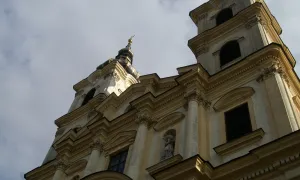
The architectonic form of the church is defined by the classicistic style that manifests itself in its divided exterior. The main façade is decorated with pilasters, which at the bottom characterized the hull of the tower. The tower is built directly into the shield facade, which is a characteristic element of this type of construction. The exterior is further divided by lysenes, which give the building rhythm and visual structure. The Presbytery has a segmented closure, which is typical of classicistic sacral architecture, where it deviated from Gothic pointed arches to simpler geometric shapes.
The interior facilities and layout of the church are also documented and specific. The ship and the presbytery are encircled by Prussian vaults with interlocutors. Prussian vault is a simple construction structure, which was often used in the 19th century for its economic and technical effortlessness compared to more complex vaults. On the western side of the ship there is a brick arcade organ chorus, which serves as a place for a musical group during worship. This element is integrated into the brick device, indicating the emphasis on the acoustic and visual connection of music with the space of the ship.
The interior equipment of the church has various historical layers. The main altar and pulpit come from the time of the original church building in 1851, making them the oldest preserved interior parts. Other interior facilities date back to the end of the 19th century, indicating that the church was then supplemented with other liturgical objects and furniture. The painting of the church is the work of painter J. Jelínek and comes from 1951. This later painting is therefore not part of the original classicistic device, but it represents the 20th century interior adjustment, which probably respected or transformed the original appearance according to the then aesthetic and religious ideas.
The fates of the church and its administration are associated with its constant maintenance and reconstruction. The Monument Office of the Slovak Republic states that the object has undergone reconstruction, which is a common practice in protecting cultural monuments in order to preserve their material integrity and aesthetic value. The specific names of owners or administrators are not mentioned in the available documents, but the fact that the church serves its purpose testifies to its active use within the local community. The church is listed in the Central List of Monument Fund, which means that it is subject to state conservation and any interference with its substance must be coordinated with the Monument Office.
Key events in the history of this monument are mainly associated with its construction development and modifications. The position in 1851 is a fundamental milestone that determines its architectural identity. Renovation in 1928 and removal in 1951 are other important points that influenced the appearance of the church. These events are not linked to dramatic historical events, such as wars or fires, which would be explicitly mentioned in the background, but rather with the normal maintenance and modernization of sacral construction during the 20th century. The church thus represents the continuity of religious life in the village Trebatice, which manifests itself in its constant use and care of its preservation.
Today the state of the church is rated as very good, which is a positive sign for its further use and protection. It serves its purpose, which means that it is actively used for religious services and other religious activities. Access to the church is simple, as it stands in the middle of the village Trebatice. It is easily accessible for visitors and integrated into the city or municipal area. A visit to the church offers the opportunity to admire the classicistic architecture of the 19th century, which is represented in Slovakia by many similar buildings, but each one has its specifics. In the case of the church of St. Stephen it is a combination of Prussian arches, brick organ chorus and classical facade elements.
For tourists and those interested in cultural heritage, this church is an interesting goal because it allows you to know the typical sacral architecture from the period of classicalism. The original main altar and pulpit from 1851 are important historical artifacts that testify to the church's original facilities. Painting from 1951 by J. Jelínek is another element that is worth the attention, as it represents 20th century interior interpretation. The church is registered with the number 1 040/1, which confirms its value as a cultural monument. A visit to this place makes it possible to understand how sacral architecture in Slovakia developed in the 19th century and how these buildings were adapted to the needs of local communities over the next decades.
St. Stephen's Church in Trebatice is not only a religious center but also a historical monument that preserves architectural and artistic values from the period of classicalism. Its very good state and active use is evidence of successful protection and care of this cultural heritage. For visitors it is an opportunity to see what typical classicistic looks like
Tehdy a dnes
Drag the slider and compare how the monument might have looked when it was built with the view today.
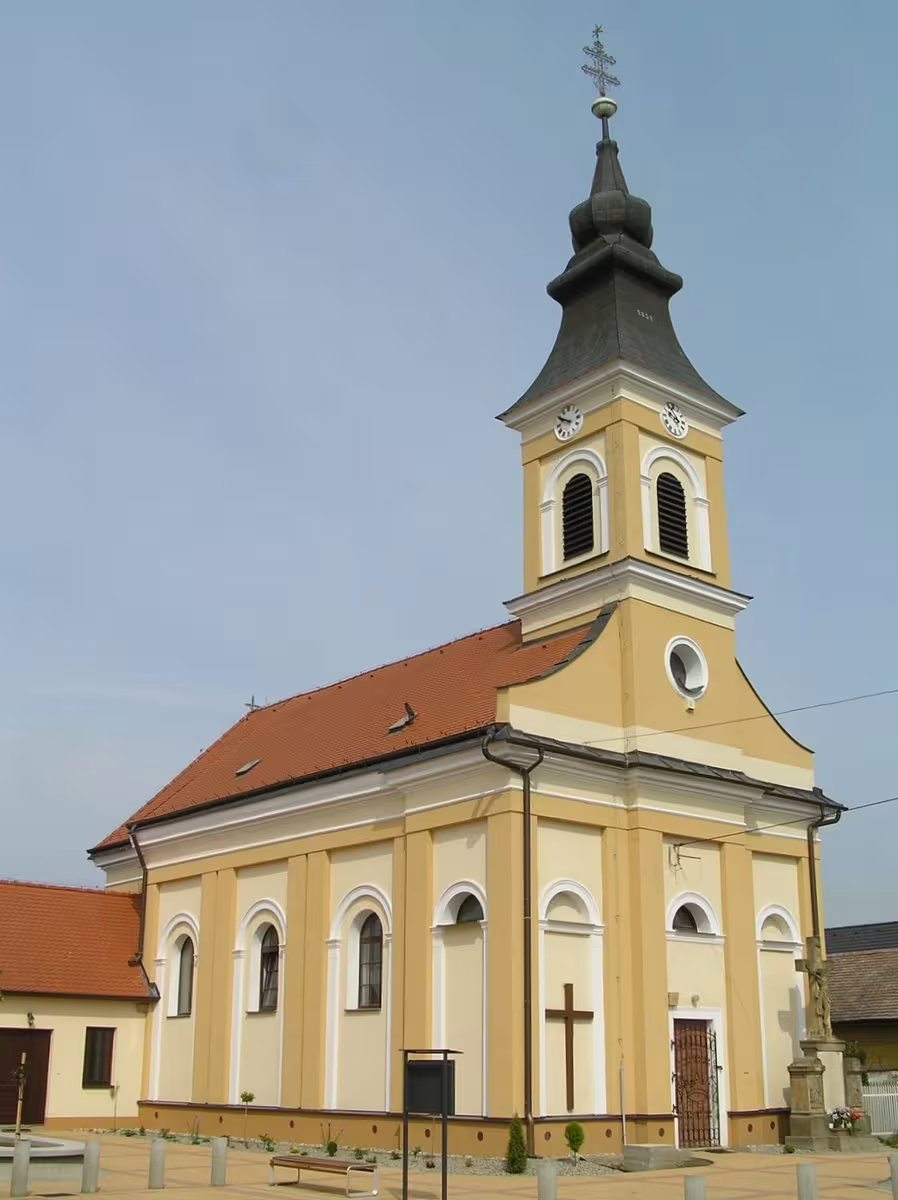
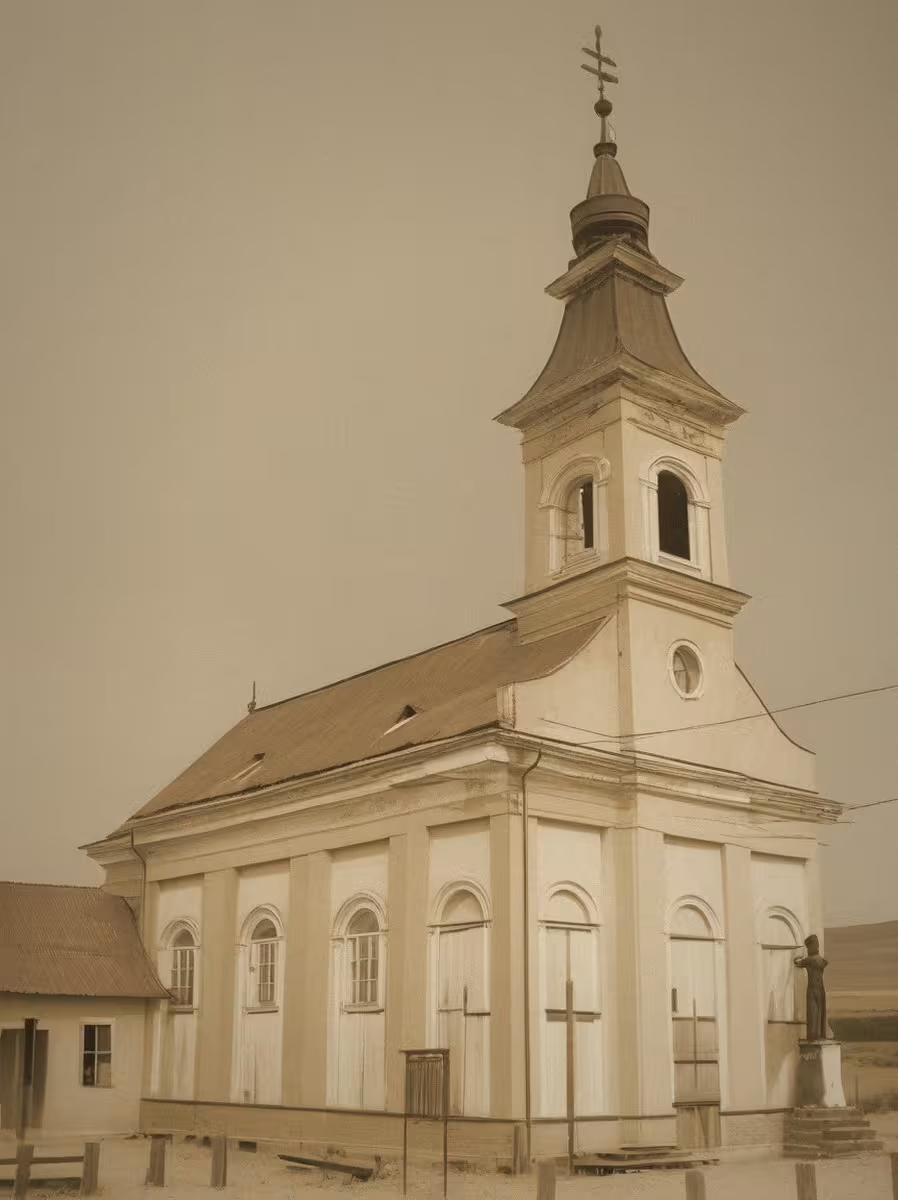
The historical view on the left is a visualisation generated by artificial intelligence and serves as inspiration.
Historical Milestones
- 1851 - construction of the church
- 1928 - renovation
- 1951 - removal by J. Jelink
Artistic features
-
vitráž figurálna s dekorom — Panna Mária Ochrankyňa
sklo, vkladanie do siete · historizmus · zač.20.st. -
vitráž figurálna s dekorom — sv.Rodina
sklo, vkladanie do siete · historizmus · zač.20.st. -
vitráž figurálna s dekorom — sv.Vojtech
sklo, vkladanie do siete · historizmus · zač.20.st.
Source: Monuments Board of the Slovak Republic — open data, licence CC BY 4.0
Interesting facts
- St.
Guide
Show guide text
The text was prepared by artificial intelligence and has not been editorially reviewed. It may contain inaccuracies.
Welcome to Trebatice, the heart of the Trnava region, where time has slowed down for a while so that we can appreciate the beauty and peace of the local country. Right now you are standing in front of one of the most important local monuments in front of St. Stephen's church. Look at the building in front of you. The first impression that you are likely to think of is the feeling of harmony, stability and some moderation that is typical of sacral buildings of this period. Feel the atmosphere of this place where spiritual values are associated with the architectural expression of their time. This church is not only a building made of stone and mortar, but it is the embodiment of faith and joint effort of generations of inhabitants of Trebatice. When we stop at the origin of this building, we move to the middle of the 19th century. St. Stephen's church was built in 1851. Imagine what it was like at the time in this area. The century that we have experienced has brought about many changes, but this building remains a silent witness to everything that has happened in the village. Although the specific names of architects who designed this temple are not exactly documented in historical records, their work speaks for itself. Construction was created during the period when classicalism dominated Europe and our territories. This style tried to return to the purity and simplicity of the Ancient, avoiding excessive decorating and looking for balance and logic in proportions. That is why St. Stephen's church is so balanced and peaceful. Now look at the architecture itself. As I mentioned, it's a classicistic sacral structure. Note how this aesthetic manifests itself in the general design. Classicism is not about pomp and exaggeration, but about elegance that results from simplicity. Look at the main facade of the church. This is where the basic identity of the building is concentrated. Although time has left its tracks, lines and shapes of the facade still express this sought - after harmony. See how the building fits into the surroundings and defines the space around it. It is an architecture that is not designed to stagger its size but to provide refuge and a sense of security. We do not have the names of specific historical figures that would be closely associated with this place in terms of great political or artistic acts, but in fact, every person who has sought peace in this church is part of its history. Every resident of Trebatatí, who crossed his doorstep during baptisms, weddings, or funerals, wrote a small chapter in the invisible book of the temple's history. It is this anonymous, folk history that is often more precious than the names of known personalities, because it represents the lives of ordinary people, their hopes and their judgment. One of the key moments in the modern church act was 1928. This year the building has undergone significant renovation. It is important to realise that interwar renovations often aimed not only at repairing what was destroyed but also, in many cases, at preserving the original character of the building. It was thanks to the interventions from 1928 that the original appearance and functionality of the church, which you see today, was preserved. Imagine this work, those hands that cleaned the walls and fixed the details so that the building could serve the next generations. It is evidence that the local community was aware of the value of its cultural heritage almost a hundred years ago. An interesting fact that you should not overlook is the fact that the church of St. Stephen is not only a local symbol, but is written in the Central List of Monument Fund of the Slovak Republic. What does that mean in practice? This means that the state has officially recognised the architectural and historical value of this building. This entry makes the building a protected element of our national culture. It is not only formalities, but a commitment that this classicistic jewel will be protected from arbitrary changes and that its authenticity will be preserved for the future. When you look at the church, you can see not only a building but a protected monument that represents a particular epoch in the history of Slovak architecture. You might wonder if there are any mysteries associated with the church. Although there are no stories of secret corridors or hidden treasures in the backgrounds, time itself is the real mystery. Think about how many thousand people over the centuries have become exactly the same place where you are standing. What ideas accompanied them? What did they see when they looked at the facade in 1860 or 1910? This continuity, the connection of the past with the present, is the most fascinating element of every historical object. St. Stephen's Church is like a bridge that connects us to our ancestors. Now that you know the basic facts about this place, I invite you to move slowly around the building. See how the perspective changes when you bypass the church. Look at how the shadows hit the walls and how the building interacts with the light. Note the silence surrounding this place and give yourself a moment to think about the importance of protecting such monuments. Because they're the only physical clue left to us by those who lived here before us. Before I say goodbye and leave you in the silence of your own impressions, I recommend paying attention to the overall context of Trebatice. This church is her heart and its presence in the country gives the place an identity. The classicism you see here is a symbol of order and reason, which is perhaps what we are all looking for in today's rushed world. Thank you for a walk in the history and architecture of St. Stephen's Church. I believe you have gained a new perspective on this moderate but noble construction. Now you can continue to explore Trebaticia and discover other hidden beauties of this region. May this day bring you peace and inspiration. Have a good and pleasant sequel to your journey.
Tips for visitors
St. Stephen's Church in Trebatice is an impressive sacral monument that is worth visiting during peaceful sunny days in spring or autumn, when surrounding nature offers ideal conditions for walks and admiration of architecture. Do not forget to pack comfortable shoes for walking, plenty of drinking water and camera or mobile phone to document interesting details of the exterior of the building. For photo lovers is the best time during the early morning or before sunset, when soft side light beautifully highlights architectural lines and details of this historical monument. Since there are only standard municipal areas in the immediate vicinity of the monument, families with children will find a peaceful environment suitable for a quiet walk connected with the knowledge of the local history and cultural heritage of the region.
Frequently asked questions
Can the monument be visited?
Religious buildings are usually open mainly during services; at other times a visit is normally arranged with the parish or the operator. We have not verified specific times.
Where is the monument?
Location: Hlavná ulica 245/64, Trebatice, Trnavský kraj. The map on this page shows the exact spot.
Why is the monument protected?
It is listed in the Central List of the Monuments Fund of the Slovak Republic as a national cultural monument (ÚZPF no. 214-1040).
For children
Imagine that you are in time some 150 years ago. It's eight hundred and fifty-one and you smell the smell of old in the air. No cars, no phones, no tablets. Something spectacular is growing in the village of Trebatice. It's right at the time when the story of a beautiful church dedicated to St. Stephen begins to be written. Hold your breath for a second. Imagine the heartbeat of the builders who make up this extraordinary building by stone. Like when you build the most complicated lego cubes, but these last for centuries.
Nearby
🏰 Historic sites (221)
- Najsvätejšia Trojica 1.5 km
- Najsvätejšia Trojica 1.5 km
- sv. Ján Nepomucký 1.6 km
- sv. Florián 1.6 km
- Trojičný stĺp 1.6 km
- Obetiam 1. a 2. svetovej vojny 2.0 km
- Najsvätejšia Trojica 2.1 km
- Kúria 2.7 km
- Martinka Bosáková 2.8 km
- Kúria M. A. Beňovského 3.4 km M. A. Beňovského 495/2 web
- Najsvätejšie Srdce Ježišovo 3.5 km
- Beňovského svet 3.5 km
- Pieta 3.5 km
- Obetiam 1. a 2. svetovej vojny 3.5 km
- sv. Florián 3.6 km
- sv. Ján Nepomucký 3.6 km
- Svätá rodina 3.7 km web
- Trojičný stĺp 3.7 km
- Trojičný stĺp 3.7 km web
- Jozef Pánik - SNP 3.9 km
🍽️ Restaurants and dining (254)
- Saloon 0.2 km
- Infuzia koktejlbar a kávabar 0.5 km web
- Na lúke 0.8 km
- Slavic Trak 1.4 km
- Starý šenk 1.5 km web
- Cyklobufet Pauzička 1.5 km
- U Notára 1.7 km
- Fresh Corner 2.2 km
- Cyklobufet Stanica 2.4 km
- Hostinec Ferkus 2.9 km
- Fuelka 3.2 km
- Pizza 3.2 km
- Madžo 3.3 km
- Bistro Hanka 3.3 km
- KGM cafe bar 3.3 km
- GastroBENE s.r.o 3.4 km Jána Zigmundíka 297/8 +421 907 753 238 web
- U Mórica 3.4 km
- Alfa Bar 3.4 km
- Wendy's Coffee Shop 3.5 km web
- Pri veži 3.5 km web
🏨 Accommodation (52)
- Penzión Kulko 3.5 km
- Abako 5.0 km
- Penzión Čerenec 5.1 km +421 905 983 855 web
- Hellene Relax Club 5.2 km web
- Penzion Diana 5.2 km Matúškova 2935/21
- Máj 5.4 km web
- Löwe 5.7 km
- Harmony Resort 5.8 km web
- Penzión Hedvika 5.8 km
- Penzión Fuete 5.9 km web
- Magura 5.9 km Pod Párovcami 1317/58 web
- Astra 5.9 km
- Maroon 6.0 km Nitrianska 1857/24
- Leier Apartments 6.1 km web
- Villa Veres 6.1 km
- Park Avenue 6.2 km
- Športhotel 6.2 km
- Jalta 6.2 km web
- Magnólia 6.2 km
- Camping Pullmann 6.4 km web
🚲 Rentals and sport (29)
- SCT GYM 0.9 km Piešťanská 555/12 web
- Motokárová dráha Trebatice 0.9 km
- Sportisimo 3.6 km web
- Team Bike 4.7 km +421908616326 web
- Servis bicyklov Cyklošport 4.7 km Adama Trajana web
- Plavecká škola 4.7 km A. Hlinku 113A web
- Spinning 4.8 km
- Welo, s. r. o. 5.0 km
- HS centrum 5.1 km
- Zimný štadión Piešťany 5.2 km
- Bowling center Victoria 5.2 km
- Extrem šport 5.3 km
- StrapoBikes 5.4 km Žilinská cesta 16A +421 908 953 478 web
- Topšport 5.5 km
- Plaváreň 5.5 km
- F4F športové trofeje, gravírovanie 5.7 km
- Oprava bicyklov Peter Rebro 5.8 km
- Veslársky klub Sĺňava Piešťany 5.9 km
- EXIsport 6.0 km +421337740507 web
- Montana sport 6.0 km
🥾 Hiking and nature (107)
- Biskupské 1.5 km
- Synagóga 3.4 km
- Vrbovská veža 3.5 km
- Vrbina 5.0 km
- Park na Hoštákoch 5.7 km
- Park Alexandra Šindelára 5.9 km
- Mestský park 6.2 km
- Akupresúrny chodník 6.3 km
- Kamenec 6.3 km
- Malá Pec 6.9 km
- Tlstá hora 7.4 km
- Jaskyňa Veľká pec 7.6 km
- Veľká Pec 7.6 km
- Hlavina 7.7 km
- Chríb 7.8 km
- Panská záhrada 8.0 km
- Dubník 8.1 km
- Snedanisko 8.2 km
- Orlie skaly 8.3 km
- Dúbrava 8.8 km
Thematic route
Here is a proposal of the thematic cruise route for the village Trebatice and its immediate surroundings, as the list of passersby places has not been provided.
1. St. Stephen's Church (Sacral Monument) This historic church located in the village Trebatice represents the main destination of the trip. It is worth visiting thanks to its rich history and significant spiritual legacy for the entire surroundings.
2. St. Stephen's Church (External and Park) The immediate surroundings of the building offers a quiet area for a short walk and meditation. It is worth spending a while observing the architectural details of the exterior and surrounding greenery.
3. Entrance Tower St. Stephen's Church (Historical Exposition) Inside and accessible parts of the sacral building allow visitors to look closer into the past of this site. This part of the aral attracts more detailed knowledge of the building development of the monument.
Seasonal recommendations
Church of St.St. The surrounding nature and weather vary depending on the seasons.
In spring it surrounds the building of waking greenery. The morning sun rays illuminate the facade of the church. During this period, layered clothing and firm footwear are recommended. Visitors meet a minimum of people here, especially in the early afternoon.
Summer months bring long days and sharp noon sun, which creates significant shadows on historical walls. Due to the warm weather and small amount of shadow around the building it is advisable to visit the monument early in the morning or late in the evening, to wear light clothes, to wear a head covering and to carry drinking water. During holiday weekends there are sometimes tourists.
With the arrival of autumn, the surroundings of the church are colored in autumn shades and morning mist affects the times of this place. The low angle of the sun's rays creates shades throughout the day. The Trnava region needs a windproof jacket, warmer sweater and comfortable shoes for the morning dew wet grass. More severe weather reduces visitors.
In winter it covers the surrounding village Trebatice snow. The days are short, the sun is almost setting, and the afternoon shrubs cover up the sacral structure. Walks in Advent time or during winter weekends are suitable around noon when daylight is strongest.
Visualisations and artistic views


The visualisations are generated by artificial intelligence and serve as inspiration.
Photographs from the area
Real photos taken near the monument


Source and licence are given for each image.
Visitor Tips
No tips yet. Be the first!
Log in and add your tip.
Location on Map
Visitor photos
No photos yet. Be the first to add a photo from your visit!
Log in and add your photo or leave a rating.
You get more points for a visit verified in the app — we can tell from the GPS that you are there.
Reviews and comments