

st.Catarina church Church
The church of St. Catherine in the village Kvačany in the Žilina region is a Gothic fortified church from the first half of the 14th century. It has a Renaissance fortress wall and preserved Gothic elements in the interior and exterior.
The building was built by comes Heinczmann from Sásová about 1319 to 1326. Historical records from 1531 mention priest Peter from Kvačian. In the middle of the 16th century, the church went through modifications, which probably followed the damage of the object during local riots.
It is a one-ship church with a flat cap Presbytery, a tower, a sacristy and a hallway. From the Gothic period remained the perimeter masonry, windows, portals and part of the arches. In the presbytery there are two Gothic windows on the east wall and on the south wall gothic pastophorium with three-band motif in the circle. The entrance to the vaulted sacristy forms a gothic stone portal with doors from the 15th century. Before the southern entrance portal there is a Renaissance hall with a ridge cross vault. The vault in the boat, in the south atrium and under the tower comes from the 16th century. The building rests the Renaissance fortress wall with goal.
The interior underwent a Baroque finish in 1716 when windows and wall painting were created. On the northern side of the Presbytery there are remains of Gothic wall paintings with scenes from the life of St. Bartholomew. In 1951 rustic gothic wall paintings from the middle of the 15th century were discovered in the interior.
The main altar of St. Catherine Alexandria with Baroque pillar architecture and the painting of the Coronation of the Virgin Mary comes from around 1716 and was repaired in 1797. In the middle there is a picture of St. Catherine, at the top of the paintings of the Holy Trinity and the Virgin Mary of Nanebovzatej, the statue of St. Peter and St. Stephen the King of Hungary and the paintings of St. Paul and St. Ladislav the King. On the back of the altar are inscriptions from years 1883, 1885 and 1899, which document renovations. The right side altar of Michael the Archangel is early-year from around 1670. The other altars, the pulpit, and the pictures of the Cross Road date back to the second half of the 19th century. In the interior there is a carving work Piety from around the year 1716.
The liturgical amenities include a stone baptistery from 1697, a baroque chalice from the 18th century and a classicistic chalice from 1828. The free image of St. Michael the Archangel is the work of J. Tomaščina from 1817.
The area is registered by the Monument Office of the Slovak Republic under the number of ÚZPF 315. The church was renovated in 1951 and renovated in 1937. The building fulfills its original function.
Tehdy a dnes
Drag the slider and compare how the monument might have looked when it was built with the view today.
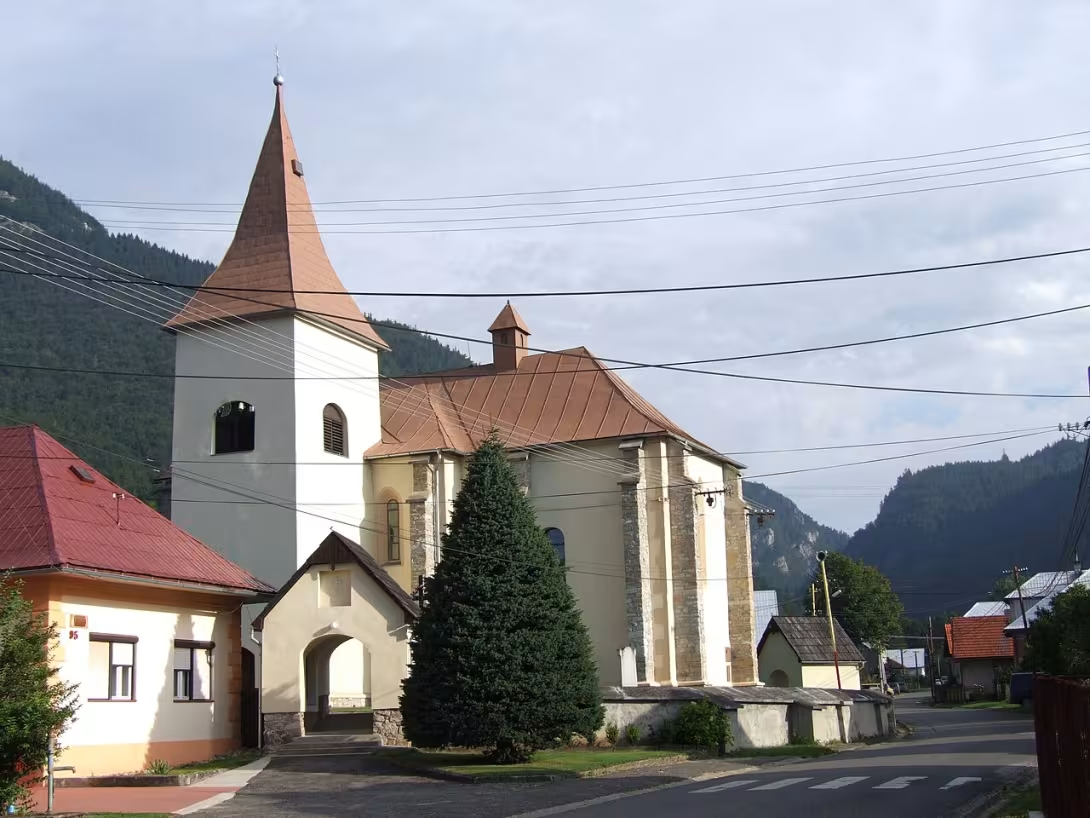

The historical view on the left is a visualisation generated by artificial intelligence and serves as inspiration.
Historical Milestones
- 1319-1326: construction of the church by Heinczmann from Sásová
- 1531: In the documents mentioned priest Peter of Kvačian
- 1716: baroque interior design with windows and wall painting
- 1796: construction of a baroque-classicist church (according to one of the versions)
- 1937: renovation
- 1951: general repair and discovery of gothic wall paintings
Restoration history
| Years | Type | Extent | Condition after restoration |
|---|---|---|---|
| 2009 |
Reštaurovanie
kostol sv.Kataríny |
Komplexná | dobrý |
| 2008 |
Obnova a reštaurovanie
kostol sv.Kataríny |
Komplexná | dobrý |
Source: Monuments Board of the Slovak Republic — open data, licence CC BY 4.0
Interesting facts
- It is a Gothic fortified church from the first half of the 14th century, which he built comes Heinczmann from Sásová. - The building rests the Renaissance fortress wall with goal. - In the interior there are rustic gothic wall paintings from the middle of the 15th century made by fresco secco technique. - The main altar of St. Catherine Alexandria with Baroque architecture comes from around 1716. - The liturgical amenities include a stone baptistery from 1697 and a baroque chalice from the 18th century.
Guide
The guide was voiced by a synthetic voice created by artificial intelligence.
Show guide text
The text was prepared by artificial intelligence and has not been editorially reviewed. It may contain inaccuracies.
You guys are in Quacs. You are standing in a place where time has stopped and every stone wall whispers stories of ancient centuries. In front of you is the church of St. Catherine, monumental and untanned symbol of this locality. The first impression this object gives is the feeling of extraordinary strength and security. It is not just a simple sacral structure that you could imagine in an open country; it is a fortified church that acts as the keeper of the place. Look at his silhouette and perceive the special atmosphere that creates the connection of a spiritual place with a functional gate to protection. It is an architecture that you will not only say about prayer but also about survival in uncertain times.
To understand why this church looks just like this, we must return to the first half of the 14th century. At this time, when the European world was still shaped in Gothic style, security was a priority. This fortified church was built not only for divine service but also as a refuge for the local inhabitants. According to historical records, this important object was made by Heinczmann from Sásová. Although the exact details of his personality or the motivations of the building are not in our hands, his message remains carved into stone. Heinczmann, as a prominent figure in the society of that time, left a permanent mark in this place that lasted centuries. This is evidence of religious devotion in the medieval world with the necessary need for physical protection.
Now that you have a closer look at the building, he pays attention to its architectural layers. The dominant element, which eyes perceive immediately upon arrival, is the Gothic character of the building. Gothic is manifested in its overall form and in the way the building operates - it is ascending but also very strong. However, if you look below and around the church, you will see another fascinating layer. The building enriches the Renaissance fortress wall with a goal. This element tells us that the church was not a static object, but constantly changed and adapted to the needs of time. The Renaissance element surrounding the Gothic core creates a fascinating contrast between two large eras in the history of architecture. Notice how this wall creates a clear border between the outside world and the sacred space inside. This goal, which many have probably crossed over the last centuries, is the entry into another world, a world where time is perceived differently.
Let us now take our thoughts to what awaits you in the interior if you choose to enter this holiness. When you cross the threshold, the atmosphere changes immediately. Inside you are not only quiet but also a visual treasure hidden from the eyes of random visitors. In the interior there are rustic gothic wall paintings, which come from the middle of the 15th century. These paintings were made by fresco secco technique, which means they were applied to dry stucco. This technique is very specific and requires enormous precision, because artists did not expect an endless time to correct errors that would become easier with wet technology. These paintings, even though they are rustic, carry the depth of a century of tradition and are directly connected with the people who walked here half a millennium ago. Watch their softness and try to capture the spirit of the time when art became the main tool of expression of faith.
Let us not forget the main altar, which represents the spiritual center of the entire church. Although we may not know every detail about him, his presence in space defines the direction of all views and prayers. In combination with wall paintings, the altar and its surroundings form a harmonious whole, which is intended to lead the visitor to peace and reflection.
Although the names of the particular architects who designed this church are not mentioned in our records, their genius is evident in how they managed to combine the fortification function with the aesthetic value of the sacral space. It is one of the great issues of history - who were these people who, in the time of unknown technology, were able to create such a resilient and beautiful building? How did they manage to coordinate the work so that the church survived centuries and remained so authentic? This unknownness gives the place a sense of mystery. Every stone you see now was laid by the hand of someone who may not know his name, but his work is here for us today.
The interesting thing I want you to think about is the duality of this place. St. Catherine's church is not just a building; it is a hybrid between a home for the soul and a fortress for the body. At the time it was formed, the world was filled with uncertainty, conflict, and danger. This building was the answer to these times. It is a monument that reminds us that people have always looked for a way to protect the most precious - their faith and their community. This link between safety and spiritual life is something we may perceive less today, but it is felt in Quacans at every step.
Now that you have come to know the basic faces of this historic place, I invite you to another personal discovery. Let yourself be carried away by the atmosphere, perceive the texture of the walls, perceive the coolness of stone and the warmth of history that works here. You can slowly pass the walls, observe the goal and try to imagine how it would be a part of this community a few centuries ago. Every detail, from the Renaissance wall to Gothic paintings, is part of a great puzzle that creates the identity of this region.
Thank you for spending time with us and paying attention to this unique place. We believe that this short trip in time has brought you a new perspective on the wealth of our history. You can join here freely and enjoy the rest of your day in the beautiful village Kvačany. Goodbye.
Tips for visitors
Visit the church in spring or summer, when the surroundings in the flower and the fortification architecture stand out in natural light. We recommend arriving early in the morning or shortly before the eclipse, when the shadows at the walls are most noticeable.
Since it is a sacral structure, dress appropriately and choose quiet shoes for the interior.
For photography are suitable places around the fortifications and views of the facade. Watch the effect of sunlight on the stone details.
Families with children can explore the exterior of the church and the fortification function that in the past protected the inhabitants from attacks.
Frequently asked questions
Can the monument be visited?
Religious buildings are usually open mainly during services; at other times a visit is normally arranged with the parish or the operator. We have not verified specific times.
Where is the monument?
Location: č. 94, Kvačany, Žilinský kraj. The map on this page shows the exact spot.
Why is the monument protected?
It is listed in the Central List of the Monuments Fund of the Slovak Republic as a national cultural monument (ÚZPF no. 315-315).
For children
Pull tighter shoelaces and prepare to travel in time! Imagine being transported exactly 707 years back. The year is 1319. There are no cars, asphalt roads or mobile phones around you. There are only dense forests, vibrant streams of atmosphere of mystery. It was this time that the church of St. Catherine was established in Kvačany. But beware, it wasn't just an ordinary house for prayers. It was a real medieval bunker!
Nearby
🏰 Historic sites (175)
- Kúria 0.1 km
- Keltská osada Púchovskej kultúry 0.8 km
- Evka 1978-2004 1.9 km
- Nehoda 1.6.2017 2.0 km
- 1817 2.0 km
- sv. Ján Nepomucký 2.0 km
- Pod Mníškom 3.2 km
- Bitka o Trnovecký háj 1945 3.4 km
- Spomíname 1964-2014 3.4 km
- sv. Svorad 3.6 km
- nad Konislavou 3.6 km
- Hrádok nad Vlčím 3.9 km
- Marcelovsky kaštieľ 3.9 km
- Hradisko na Opálenici 4.1 km
- Radko Švancar,nehoda-22r. 4.2 km
- SNP 1945 4.3 km
- Banské hunte 4.3 km
- Hrádok 4.4 km
- kamenný pranier 5.3 km
- Johanna Miloslava Lehotska 5.3 km
🍽️ Restaurants and dining (173)
- Pivovar Kvačany 0.2 km +421 904 392 750 web
- Bufet pod Kvačianskou dolinou 0.9 km
- Gazdovská krčma 1.9 km
- Bufet Goral 3.2 km
- Hostinec Borovec 3.4 km
- Koliba Gréta 4.3 km
- Penzion Restaurant Villa Betula 4.3 km web
- Bufet Zátoka 5.0 km Pod hájom 1
- Vanilka 5.5 km
- Koliba Holica 5.6 km web
- Pizza 6.4 km
- Liptovianka 6.4 km
- Roháčan 6.7 km Huty
- Reštaurácia u Námornika 6.7 km
- Salaš Bobrovník 7.1 km
- Marina 7.3 km
- u Capa 7.3 km
- V Rozlete 7.5 km +421 915 659 371 web
- Reštaurácia Manderlak 7.5 km web
- Kelt Bar Bobrovec 7.7 km
🏨 Accommodation (233)
- Boodka 1.1 km +421 948 642 353 web
- Villa s.Gallen 2.0 km web
- Podmeštrová 2.5 km web
- Resort Villa Flora *** 3.3 km web
- Penzión Borovec 3.4 km web
- Teepeecko 4.0 km +421911382923 web
- Chata Prosiek 4.0 km web
- Chata Katka 4.1 km +421 904 244 394 web
- Koliba Gréta 4.3 km web
- Villa Betula 4.3 km
- Chalupa u stratenej ovce 4.5 km +421 907 602 715 web
- Penzión pri Veži 4.7 km web
- Apartmány Čereňovka 4.8 km web
- Chata Zdenka 4.9 km web
- Chata Severanka 5.0 km web
- Aquatherm Cottages 5.4 km
- Koliba Holica 5.6 km
- Koliba Holica 5.6 km
- Chata Jasmína 5.7 km web
- RENDEZ-VOUS 6.4 km +421 44 55 988 00 web
🚲 Rentals and sport (62)
- Yacht club Ružomberok 4.8 km
- Yacht club Ružomberok 4.9 km
- PeZa Šport 5.0 km
- MaraFUN - požičovňa a škola vodných športov 6.8 km +421 905 828 444 web
- Plavecký bazén 7.2 km
- Marina 7.2 km
- Amazonia 7.3 km
- 21 atrakcií 7.3 km
- Dopadový bazén - Banana Fun + Black Magic 7.3 km
- Dopadový bazén - Raft Ramp 7.3 km
- Dopadový bazén - Trio 7.3 km
- Niagara 7.3 km
- Dopadový bazén - Delphin + 4Family 7.3 km
- Športový bazén 7.3 km
- Dopadový bazén 7.4 km
- Relaxačný bazén 7.4 km
- Raftaria 7.4 km
- Liptov Aréna 7.6 km +421915297271 web
- Mólo Maladinovo 7.7 km +421902631522
- Lozilla Climbing Gym 9.7 km Štefánikova web
🥾 Hiking and nature (649)
- Krasová vyvieračka 0.6 km
- Na Dráhach 0.7 km
- Nad Vodojemom 0.8 km
- Kvačany 1 1.1 km
- Hrádková 1.2 km
- Hoľa 1.2 km
- v Hrádkovej 1.2 km
- Hradková 1.2 km
- Kvačiansky previs 1.3 km
- Kvačianska 2 1.4 km
- Hrádková 1.5 km
- Srnčia jaskyňa v Prosečnom 1.7 km
- Janošíkova hlava 1.7 km
- v suchom vodopáde 1.9 km
- STUDNIČKA 1.9 km
- Kobyliská 1.9 km
- Roh 2.0 km
- Prosečné 2.2 km
- Ostrý vrch 2.2 km
- Čierna hora 2.2 km
Thematic route
1. Church of St. Catherine (Church with fortification) - sacral monument, which in the past served as a service and a fortified sanctuary. 2. Fortification walls and courtyards - defence area with remnants of protective elements. 3. Church tower - raised point overlooking the surroundings and strategic location of the building.
Seasonal recommendations
In spring, the surroundings of the church of St. Catherine in Kvačany will wake up to life and nature around the fortified building of greenery. The sun during this period provides a fine light suitable for observing the details of exterior and architecture. We recommend shoes to wet terrain and a visit in the morning.
Summer months bring about the flowering of vegetation and intense lighting, which highlights the contrast between the stone wall and the blue sky. Given the large influx of visitors, it is advisable to set off early in the morning or later in the afternoon to avoid the glow. Easy clothing and sun protection are essential.
Autumn in Žilina region is characterized by a color change of leaves around the historical building. In the period of Saint Catherine's day, the place is illuminated by special light. For colder mornings and evenings, layered clothing is recommended.
Winter in Kvačany brings snow, which will cover the surrounding landscapes and highlight the fortified church. The atmosphere is quiet especially in advent time. When visiting it is necessary to wear warm, waterproof clothing and footwear with anti-slip soles for safe movement around the monument.
Visualisations and artistic views


The visualisations are generated by artificial intelligence and serve as inspiration.
Photographs from the area
Real photos taken near the monument


Source and licence are given for each image.
Visitor Tips
No tips yet. Be the first!
Log in and add your tip.
Location on Map
More monuments – Kvačany
Show all in the town



Visitor photos
No photos yet. Be the first to add a photo from your visit!
Log in and add your photo or leave a rating.
You get more points for a visit verified in the app — we can tell from the GPS that you are there.
Reviews and comments